

The letter K rarely opens a scientific term, and when it does, that term usually carries real weight. Kelvin defines how physicists measure temperature from absolute zero. Kinetic energy explains why a thrown ball hurts more than a dropped one. Karyotype tells geneticists whether a chromosome count looks normal. Across every branch of science, K appears less often than almost any other letter, yet the words it produces tend to sit at the center of their fields rather than at the edges.
This guide collects real, verifiable science words that start with K, organized by branch: biology, chemistry, physics, astronomy, and earth science, with a plain definition and an example sentence for each. Whether you are studying for a biology exam, building a vocabulary list for students, or hunting for an unusual word for a crossword or Wordle guess, you will find everything grouped by subject instead of dumped into one long, undifferentiated list. We will also look at why K is so uncommon in scientific language, since almost nobody actually explains that part. It is very similar to other science words that usually starts with L and M.
Why Does K Appear So Rarely in Science?
Here is something most vocabulary lists skip entirely: the scarcity of science words that start with K is not random. Most English scientific terminology descends from Greek and Latin roots, and in those source languages, the hard “k” sound was frequently transliterated into English using C instead. Think “cardio,” “cranium,” or “cell “; each traces back to a Greek or Latin root that could just as easily have produced a K spelling, but did not. Latin itself rarely used K at all, favoring C or Qu in nearly every case.
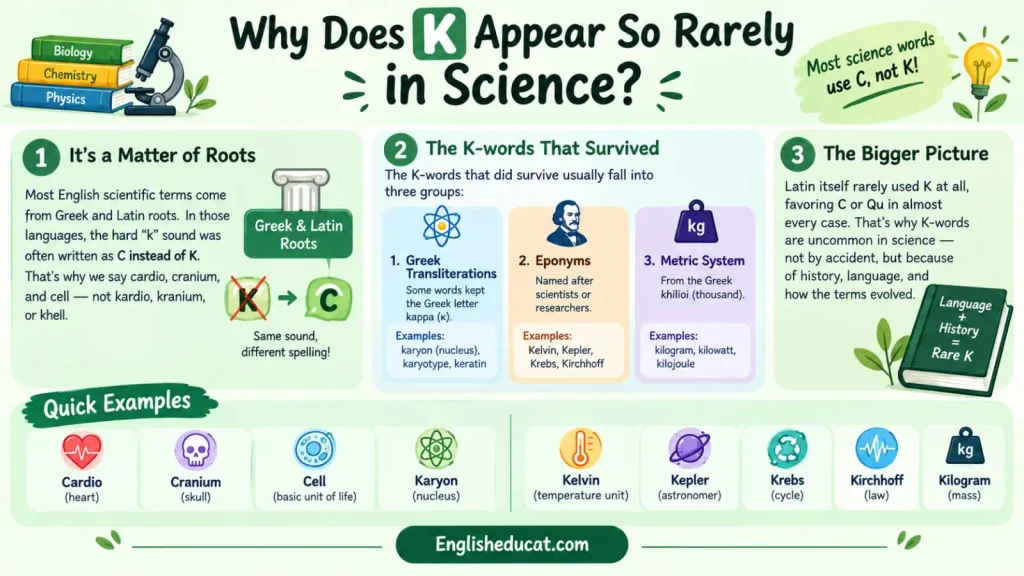
The K-words that did survive tend to fall into three groups. Some are direct transliterations from Greek, where the letter kappa was preserved rather than converted; this is why so many nucleus-related biology terms cluster together, since karyon is the Greek word for nucleus. Others are eponyms: Kelvin, Kepler, Krebs, and Kirchhoff each lent a name to a unit, law, or cycle still used daily. A third group comes from the metric system, where “kilo-” (from the Greek khilioi, meaning thousand) produces an entire family of measurement terms, from kilogram to kilowatt to kilojoule.
Biology Words That Start With K
Biology supplies one of the richest sets of science words that start with K, largely because of that shared root, karyon. Genetics, cell biology, and ecology each contribute their own cluster of terms.
| Term | Definition | Example |
| Karyotype | A profile showing an organism’s complete set of chromosomes. | Doctors ordered a karyotype after noticing signs of a chromosomal disorder. |
| Karyokinesis | Division of a cell’s nucleus during mitosis or meiosis. | The nucleus splits during karyokinesis, well before the rest of the cell follows suit. |
| Karyoplasm | The fluid material filling the interior of a cell’s nucleus. | Enzymes responsible for copying DNA drift freely through the karyoplasm. |
| Kinetochore | A protein structure on a chromosome where spindle fibers attach. | Chromosomes can’t separate properly if the kinetochore fails to form correctly. |
| Keratin | A tough, fibrous protein found in hair, nails, feathers, and skin. | Fingernails owe their rigidity almost entirely to keratin. |
| Keratinocyte | A skin cell that produces and stores keratin. | New keratinocytes form in the lower skin layers and gradually migrate upward as they mature. |
| Kinase | An enzyme that attaches a phosphate group to another molecule, often activating it. | A single kinase can switch an entire signaling pathway on by adding one phosphate group. |
| Kinesin | A motor protein that transports cargo along microtubules inside cells. | Vesicles get hauled toward the cell’s outer edge by kinesin, powered by chemical energy. |
| Kinesis | Movement triggered by a stimulus but not aimed toward or away from it. | A woodlouse speeds up in dry air — that’s kinesis, not navigation. |
| Kingdom | A major taxonomic rank grouping broadly related organisms. | Fungi and animals sit in entirely separate biological kingdoms, despite superficial similarities. |
| Keystone species | A species whose ecological influence far outweighs its numbers. | Remove the keystone species, and an entire ecosystem can unravel — sea otters and kelp forests are a textbook case. |
| Kelp | Large brown seaweed that forms dense underwater forests in cold coastal waters. | Countless fish and invertebrates shelter within a single kelp forest. |
| Krill | Tiny marine crustaceans forming a foundational link in ocean food webs. | Tons of krill disappear into a blue whale’s mouth in a single feeding session. |
| Kin selection | Evolutionary favoring of traits that benefit an individual’s close relatives. | Worker bees sacrifice themselves for the hive largely because of kin selection. |
| K-selection | A reproductive strategy favoring fewer offspring with heavier parental investment. | Elephants follow K-selection, raising very few young but investing heavily in each one. |
| Klinefelter syndrome | A genetic condition in males caused by an extra X chromosome. | A karyotype test typically confirms Klinefelter syndrome. |
| Krebs cycle | A central metabolic pathway that extracts usable energy from nutrients. | Cellular respiration hinges on the Krebs cycle, which unfolds inside the mitochondria. |
| Kleptoparasitism | Stealing already-captured food from another animal. | Gulls are notorious for kleptoparasitism, snatching fish directly from other birds’ beaks. |
Chemistry Words That Start With K
From everyday units to obscure named reactions, science words that start with K in chemistry span an unusually wide range of difficulty.
| Term | Definition | Example |
| Kelvin | The SI base unit of temperature, with zero set at absolute zero. | Nothing on the Kelvin scale ever dips below zero, by definition. |
| Ketone | An organic compound built around a carbonyl group bonded to two carbon atoms. | Acetone, familiar from nail polish remover, is the simplest ketone. |
| Ketal | A compound formed when a ketone reacts with two alcohol molecules. | Chemists sometimes form a ketal purely to shield a reactive ketone during a later step. |
| Ketene | A reactive compound containing a carbon-carbon-oxygen double-bond system. | Industrial production of acetic anhydride relies on ketene as a key intermediate. |
| Krypton | A colorless, chemically inert noble gas used in specialty lighting. | Certain high-intensity flash bulbs are filled with krypton rather than ordinary air. |
| Kaolinite | A soft clay mineral made of hydrated aluminum silicate. | Glossy magazine paper gets its smooth finish from a kaolinite coating. |
| Kerosene | A flammable hydrocarbon liquid distilled from crude petroleum. | Refined kerosene doubles as both a heating fuel and a jet engine fuel. |
| Kalium | The Latin-derived name for potassium, explaining its symbol, K. | Kalium hydroxide is simply an older name for potassium hydroxide. |
| Ksp | The equilibrium constant describing how readily a compound dissolves in water. | A vanishingly small Ksp value tells a chemist a salt barely dissolves at all. |
| K-shell | The innermost electron shell surrounding an atom’s nucleus. | Characteristic X-rays appear the moment an electron fills a K-shell vacancy. |
| Kinetics | The branch of chemistry concerned with how fast reactions proceed. | Undergraduate kinetics labs almost always show reaction rates dropping sharply as temperature falls. |
| Kinetic theory | A model explaining gas behavior through the constant, random motion of particles. | Gas particles are assumed, under kinetic theory, to collide with perfectly elastic impacts. |
| Kilojoule | A unit of energy equal to one thousand joules. | Many countries list a food’s energy content in kilojoules rather than calories. |
| Kilopascal | A unit of pressure equal to one thousand pascals. | Some tire gauges display readings directly in kilopascals instead of PSI. |
| Kjeldahl method | A lab technique for measuring a sample’s nitrogen content. | Food scientists still rely on the Kjeldahl method to test protein levels. |
| Kaon | A subatomic particle made of a quark paired with an antiquark. | Kaon decay first revealed an unexpected violation of a fundamental physical symmetry. |
Physics Words That Start With K
Several of the science words that start with K in physics are units you have likely used without ever noticing their letter of origin.
| Term | Definition | Example |
| Kinetic energy | Energy an object possesses purely because it’s moving. | A bowling ball rolling down the lane carries far more kinetic energy than the same ball sitting still. |
| Kinematics | The study of motion itself, without regard to what causes it. | Calculating a falling object’s speed at any instant is a classic kinematics problem. |
| Kinetic friction | The resistive force between two surfaces already sliding against each other. | A hockey puck gradually loses speed to kinetic friction as it glides across the ice. |
| Kilogram | The SI base unit of mass. | Roughly one kilogram is what a liter of water weighs under standard conditions. |
| Kilowatt | A unit of power equal to one thousand watts. | Most household space heaters draw somewhere around one to two kilowatts. |
| Kilovolt | A unit of electric potential equal to one thousand volts. | Medical X-ray equipment commonly runs at close to one hundred kilovolts. |
| Kirchhoff’s current law | A rule stating that current entering a junction must equal current leaving it. | Solving for an unknown branch current almost always starts with Kirchhoff’s current law. |
| Kirchhoff’s voltage law | A rule stating that voltage around any closed circuit loop sums to zero. | Introductory circuits courses lean heavily on Kirchhoff’s voltage law for solving loop equations. |
| Klystron | A specialized vacuum tube used to amplify microwave signals. | Early radar technology depended almost entirely on the klystron for signal amplification. |
| Knot | A unit of speed equal to one nautical mile per hour. | The cargo ship held a steady cruising speed near fifteen knots. |
| Kinematic viscosity | A fluid’s resistance to flow relative to its density. | Warming an engine noticeably lowers the motor oil’s kinematic viscosity. |
| Kármán vortex street | A repeating pattern of swirling vortices shed behind an object moving through fluid. | A flag fluttering rhythmically in steady wind is a visible example of a Kármán vortex street. |
| Kelvin-Helmholtz instability | Instability forming where two fluids moving at different speeds meet. | Wave-like cloud formations sometimes trace directly back to Kelvin-Helmholtz instability. |
| Klein-Gordon equation | A relativistic wave equation describing particles with zero intrinsic spin. | Quantum field theory still nods to the Klein-Gordon equation as an early foundational model. |
Astronomy and Space Science Words That Start With K
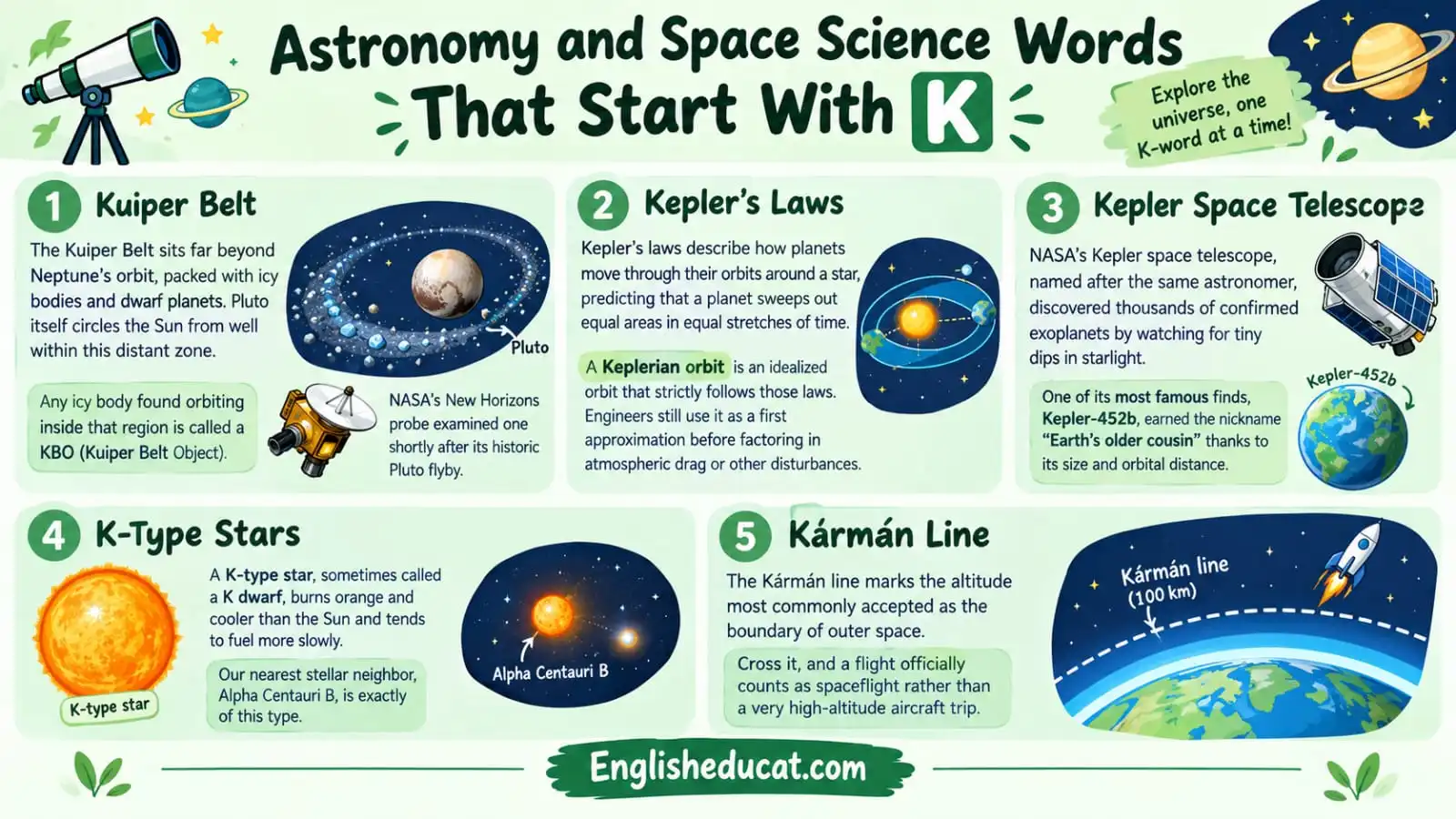
Space science hands us some genuinely memorable K-words, and several honor the astronomers who first described the phenomena they name. The Kuiper Belt sits far beyond Neptune’s orbit, packed with icy bodies and dwarf planets; Pluto itself circles the Sun from well within this distant zone. Any icy body found orbiting inside that region is called a KBO, or Kuiper Belt Object; NASA’s New Horizons probe examined one shortly after its historic Pluto flyby.
Kepler’s laws describe, with remarkable precision, how planets move through their orbits around a star, predicting that a planet sweeps out equal areas of its path in equal stretches of time. An idealized orbit that strictly follows those laws is known as a Keplerian orbit, and engineers still use it as a first approximation before factoring in atmospheric drag or other real-world disturbances. Fittingly, NASA’s Kepler space telescope, named after the same astronomer, discovered thousands of confirmed exoplanets by watching for tiny dips in starlight. One of its most famous finds, Kepler-452b, earned the informal nickname “Earth’s older cousin” thanks to its size and orbital distance.
Not every star resembles our Sun. A K-type star, sometimes called a K dwarf, burns orange and cooler than the Sun and tends to fuel more slowly; our nearest stellar neighbor, Alpha Centauri B, is exactly of this type. Meanwhile, the Kármán line marks the altitude most commonly accepted as the boundary of outer space; cross it, and a flight officially counts as spaceflight rather than a very high-altitude aircraft trip.
Some of the most dramatic K-terms describe violent cosmic events. A kilonova is an intensely bright explosion triggered when two neutron stars collide, and the 2017 detection of one gave direct, long-awaited confirmation of gravitational wave predictions. Closer to home, Kirkwood gaps are empty zones within the asteroid belt, carved out by gravitational resonance with Jupiter, wherever an asteroid’s orbital period would otherwise sync destructively with the giant orbit of planet of its own. And inside gas giants like Jupiter, the Kelvin-Helmholtz mechanism, slow gravitational contraction that releases heat, kept the interior warm of planet for billions of years, long before anyone considered nuclear fusion as an explanation.
Earth and Environmental Science Words That Start With K
Geology and environmental science round out our set of K-words, and many of them describe landforms carved by ice, water, or volcanic fire. Karst terrain forms wherever soluble rock, limestone especially, slowly dissolves, leaving behind dramatic sinkholes, caves, and hidden underground rivers. Glaciers leave their own distinctive fingerprints on the landscape: a kame is a mound of sand and gravel dropped by meltwater against a retreating ice sheet, while a kettle lake fills a depression left behind once a buried chunk of glacial ice finally melts away. When that same kind of depression forms but never fills with water, geologists call it a kettle hole instead.
Pressure and heat deep underground produce their own set of terms. Kyanite, a striking blue aluminum silicate mineral, only forms under intense pressure within metamorphic rock. Kimberlite, an igneous rock type, matters enormously to the diamond industry, since it is the primary natural source diamonds are mined from, typically appearing from deep volcanic pipes reaching far below the surface.
Wind, water, and volcanic activity fill out the rest of the list. A katabatic wind is cold, dense air flowing downhill purely under the pull of gravity, often rushing down a mountainside with surprising force once the sun sets. The Kuroshio Current, meanwhile, carries warm tropical water northward along the Pacific coast of Japan. And two of the most famous volcanoes on Earth both start with K: Krakatoa, the Indonesian island whose 1883 eruption sent tsunamis across the entire Indian Ocean, and Kilauea, the Hawaiian shield volcano that has erupted almost continuously for decades, constantly reshaping the land around it.
Advanced K-Words (Bonus Section)
These next few science words that start with K go beyond everyday vocabulary lists. Each is genuine and verifiable, used in real specialized research, but rare enough that even thorough guides tend to skip them.
In biology, koinophilia describes a preference for mates with common, average physical traits, one proposed explanation for why unusual features often get selected against across generations. Physics contributes several deep cuts: the Kondo effect, an unexpected rise in electrical resistance of metal at low temperatures caused by magnetic impurities, puzzled physicists for decades before a satisfying explanation finally arrived in the 1960s. Kaluza-Klein theory attempts to unify gravity and electromagnetism by proposing an extra spatial dimension, and it is often cited as a conceptual ancestor of modern string theory. The Kutta-Joukowski theorem, meanwhile, links the lift force on an airfoil to the circulation of air around it, and remains a cornerstone of classical aerodynamic theory in engineering programs.
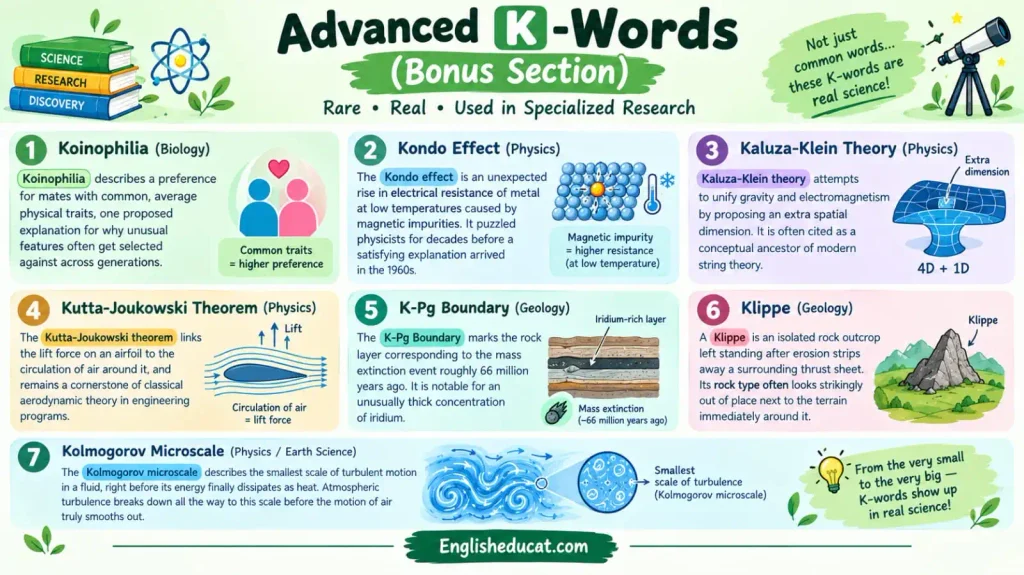
Geology offers two more. The K-Pg boundary marks the rock layer corresponding to the mass extinction event roughly 66 million years ago, and it is notable for an unusually thick concentration of iridium. A klippe, meanwhile, is an isolated rock outcrop left standing after erosion strips away a surrounding thrust sheet; its rock type often looks strikingly out of place next to the terrain immediately around it. Finally, straddling physics and earth science, the Kolmogorov microscale describes the smallest scale of turbulent motion in a fluid, right before its energy finally dissipates as heat; atmospheric turbulence breaks down all the way to this scale before the motion of air truly smooths out.
Why Learn Science Words That Start With K?
Learning science words that start with K is not just trivia for its own sake. Once you understand the etymology behind them Greek roots that held onto their hard K sound, names of scientists turned into units and laws, and the metric system’s entire “kilo-” family these words stop feeling like arbitrary strings of letters and start feeling like small fragments of scientific history you can recall on demand.
Different readers get different value from a list like this. Students preparing for a biology or chemistry exam benefit from seeing karyotype, kinetics, and Kelvin grouped by subject rather than scattered alphabetically next to unrelated terms. Teachers building a vocabulary worksheet can pull straight from a branch-organized set instead of assembling one from scratch. And anyone hunting for an unusual five- or six-letter word for a word game krill, karst, kaons gets a genuine edge that a generic dictionary search would not easily provide.
There is also a broader payoff. Once you notice how consistently K’s rarity traces back to Greek versus Latin spelling choices, other rare letters in scientific vocabulary start making a lot more sense too.
Frequently Asked Questions
What are some science words that start with K?
Common examples include Kelvin, kinetic energy, karyotype, krypton, and kilogram. These particular science words span physics, biology, and chemistry, and most relate to measurement, motion, or genetics, the areas where K-words cluster most heavily.
Why are there so few science words that start with K?
Most scientific vocabulary traces back to Greek and Latin roots, and the hard K sound in those roots was usually rendered with C or Qu instead of K. The words that survived are mostly direct Greek transliterations, metric prefixes, or names honoring scientists like Kelvin and Kepler.
What is the most important science word that starts with K?
Kelvin is a strong candidate, since it is the SI base unit of temperature used across physics, chemistry, and astronomy. Unlike Celsius or Fahrenheit, the Kelvin scale begins at absolute zero, which makes it essential for many scientific calculations.
Are there any short science words that start with K, good for word games?
Yes, examples include “krill” (biology), “karst” (earth science), and “kaons” (physics). These shorter entries are especially handy for games like Wordle or Scrabble.
What biology words start with K?
Key terms include karyotype, keratin, kinase, kingdom, and keystone species. Most relate to cell structure, genetics, or an organism’s ecological role within its environment.
What K-words are used in astronomy?
Astronomy includes the Kuiper Belt, Kepler’s laws, and the Kármán line, which marks the recognized edge of space. Several of these terms are named directly after the astronomers who first described them, including Johannes Kepler.
Conclusion
K may be the quiet letter of the scientific alphabet, but quiet does not mean small. One unit, Kelvin, underpins temperature measurement across every branch of physical science. One root, karyon, gave biology an entire vocabulary of nucleus-related terms. One mission, Kepler, reshaped how we search for planets beyond our solar system. That is the real story behind science words that start with K: not scarcity for its own sake, but a small, tightly-earned set of words that each pull far more scientific weight than their letter count would suggest.
Whether you came here to study, to teach, to win a word game, or simply because a stray thought about the alphabet sent you down a rabbit hole, you now have a genuinely complete, branch-by-branch map of science words that start with K plus the etymology explaining why this particular letter behaves the way it does. Bookmark it, borrow from it, or build your next vocabulary lesson around it. Either way, K has earned a much closer look than it usually gets.

Senior English Content Editor
Sarah has over 10 years of experience teaching English as a Second Language in Chicago public schools. She specializes in vocabulary building and simplifying complex word meanings for everyday learners. Sarah holds a Master’s degree in English Education from the University of Illinois.