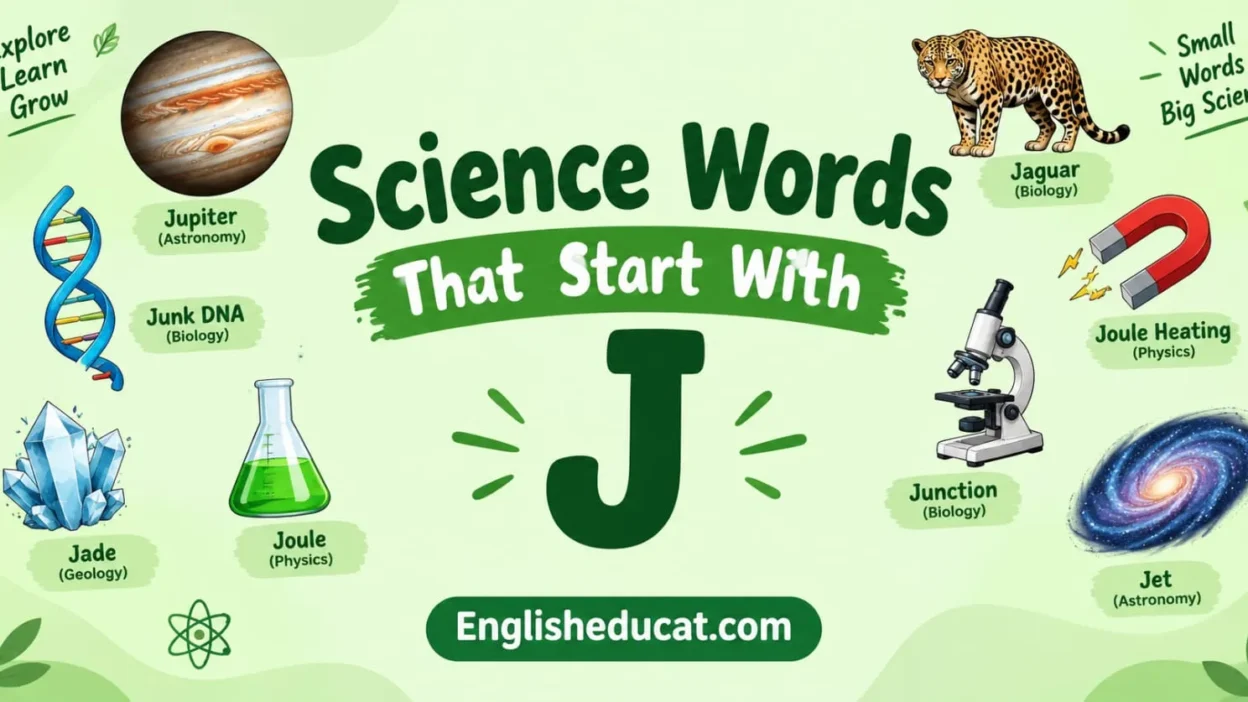
A single letter connects the unit that measures energy in a physics lab, the largest planet in the solar system, and a section of the small intestine most people last thought about during a biology exam, and that letter is J. This guide gathers 126 real and verifiable science words that start with J, sorted into biology, chemistry, physics, astronomy, and earth science, each with a plain-language definition and an example of how it is actually used.
Nothing here is padded with invented terms; you can confirm every entry in a textbook or peer-reviewed glossary. Whether you are studying for class, building a word list for students, hunting for a strong Scrabble play, or curious why so many J-words carry the name of a scientist, this collection is meant to be read once and trusted afterward.
Why J Is Science’s Most “Named After a Scientist” Letter
Before the branch-by-branch lists, it is worth flagging what sets this letter apart: an unusually large share of its vocabulary consists of eponyms, terms named after their discoverers. Karl Jansky, an engineer at Bell Labs, has a radio-astronomy unit named after him for detecting the first radio waves from the Milky Way.
There are many words that start with J just like other science words that start with K and L. Brian Josephson predicted a quantum tunneling effect as a graduate student and later won a Nobel Prize for it; both the effect and the junction that exploits it carry his name. Roughly one in six or seven J-words traces back to a person this way; few other letters carry that much biography folded in.
| Term | Named after | Field |
| Joule | James Prescott Joule | Physics |
| Josephson effect / junction | Brian Josephson | Physics |
| Jahn-Teller effect | Hermann Jahn & Edward Teller | Chemistry/Physics |
| Jansky (unit) | Karl Jansky | Astronomy |
| Jacobsen catalyst | Eric Jacobsen | Chemistry |
| Jarzynski equality | Christopher Jarzynski | Physics |
| Jaynes-Cummings model | Edwin Jaynes & Fred Cummings | Physics |
Biology Words That Start With J
Biology contains the largest number of J-words here, spanning human anatomy, animal names, and plant chemistry, several of which turn up early in physiology coursework.
Anatomy contributes many related structures. Food finishes most of its nutrient absorption in the jejunum, the middle stretch of small intestine between the duodenum and ileum. Bones meet and pivot at a joint, such as the hinge-style knee, and a fibrous sleeve called the joint capsule wraps around that connection, tightening and limiting movement when inflamed.
Blood drains from the head toward the heart through the jugular vein, while a nearby skull opening, the jugular foramen, gives passage to major veins and cranial nerves enough that a tumor pressing on it can knock out several nerve functions at once. Inside the kidney, the juxtaglomerular apparatus keeps blood pressure in check by releasing renin, and a juxtamedullary nephron sends its loop deep into the medulla, which lets the body concentrate urine efficiently.
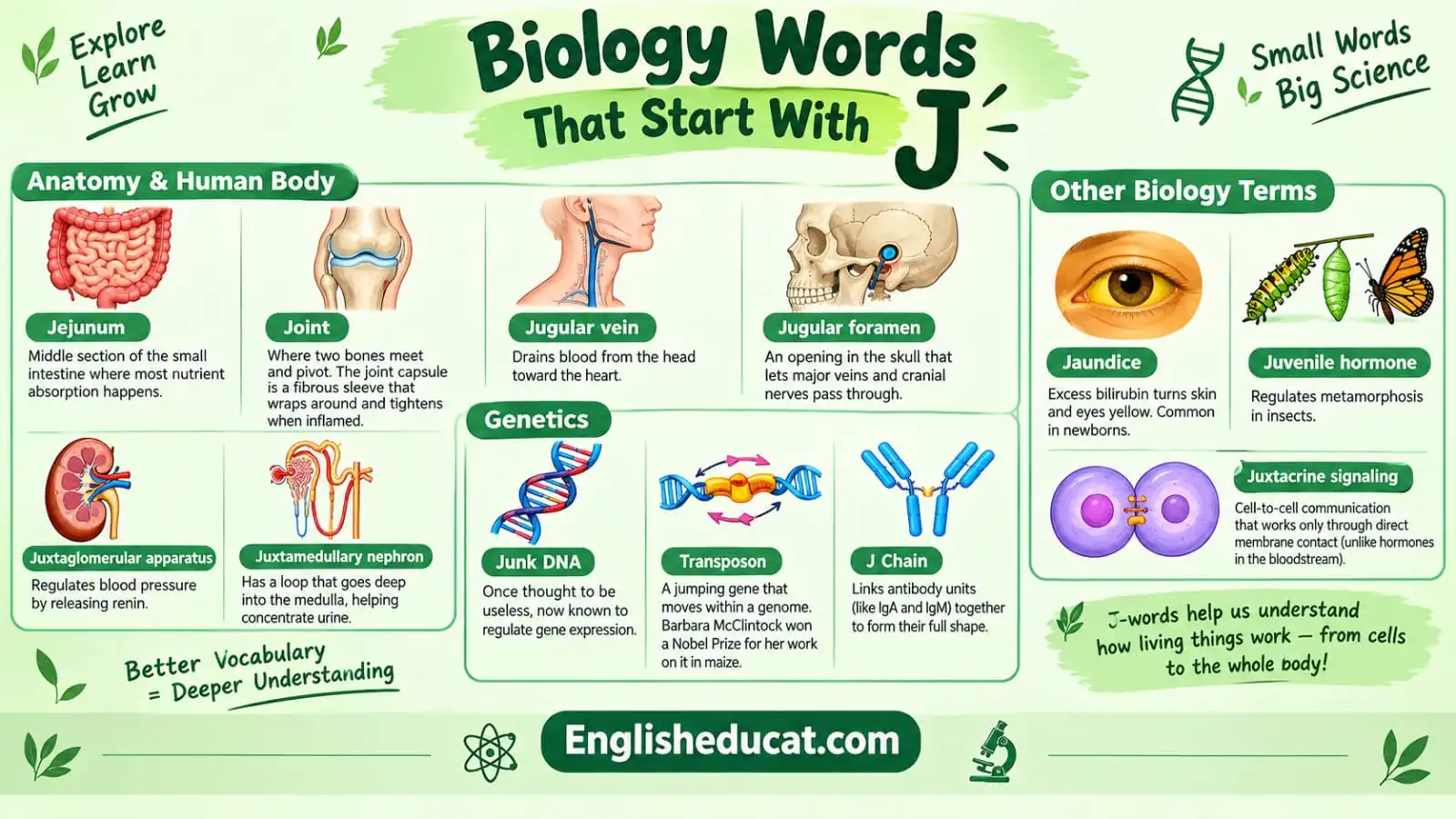
Genetics contributes some conceptually rich terms. Scientists once dismissed junk DNA as noncoding filler; it is now understood that much of it actually regulates gene expression. A jumping gene, or transposon, relocates within a genome, a discovery that earned geneticist Barbara McClintock a Nobel Prize for her work in maize. Antibody units like IgA and IgM owe their assembled shape to the J chain, a small protein linking the individual pieces together.
A few clinical terms round things out. Excess bilirubin turns skin and eyes yellow in jaundice, common enough in newborns that most parents recognize the word on sight. Insects rely on juvenile hormone to regulate metamorphosis, and juxtacrine signaling covers cell-to-cell communication that only works through direct membrane contact, unlike a hormone traveling through the bloodstream.
Zoology adds a colorful batch of entries, several of which are easier to picture as a group.
| Animal | What sets it apart |
| Jaguar | Largest cat native to the Americas |
| Jackal | Adaptable scavenger across Africa, Asia, and southeastern Europe |
| Jackrabbit | A long-eared hare built for sudden bursts of speed |
| Jerboa | Desert rodent that hops on elongated hind legs and gets most of its water from seeds |
| Jacana | Wading bird that walks across floating lily pads on remarkably long toes |
| Junco | Familiar winter backyard sparrow |
| Jay | Mimics hawk calls to scare off rivals |
| Jackdaw | Can recognize individual human faces |
| Jacamar | Brightly colored insect-eater from Central and South America |
| Joey | A baby kangaroo or other young marsupial |
Plants and toxicology close out the section. Gin gets its signature flavor from juniper berries, while jasmine is full of perfumery and the jacaranda tree is grown for its vivid purple flower clusters. Jack-in-the-pulpit takes its name from a hood-shaped bloom, and the Judas tree flowers directly on bare bark before its leaves appear.
On the dangerous side, jimsonweed contains alkaloids capable of causing hallucinations and a racing heart, and unripe ackee fruit brings on Jamaican vomiting sickness, in which a natural toxin triggers sudden, severe hypoglycemia. The jird is a burrowing desert rodent, and jungle fowl is the wild ancestor of every domestic chicken alive today.
Chemistry Words That Start With J
Chemistry moves heavily on named reactions, minerals, and plant-derived compounds for its J-vocabulary, several of which appear in undergraduate organic and analytical courses.
Chromic acid does the heavy lifting in Jones oxidation, converting alcohols into ketones or carboxylic acids; the chromium trioxide solution behind it is the Jones reagent, still a staple in sophomore organic labs. A chiral manganese or cobalt complex called the Jacobsen catalyst enables asymmetric epoxidation, producing a single enantiomer instead of a mixed batch a technique with real weight in pharmaceutical synthesis.
In clinical chemistry, picric acid drives the Jaffe reaction, turning creatinine into an orange-red compound as a standard way of estimating kidney function from blood or urine. Jack bean urease holds a special place in biochemistry: it was the first enzyme ever crystallized, and James Sumner’s 1926 isolation of it helped prove enzymes are proteins, work that later won him a Nobel Prize.
Plant chemistry offers juglone, a compound walnut tree roots release to suppress nearby plant growth (which is exactly why gardeners keep tomatoes away from walnut trees), alongside jasmonic acid and the broader hormone class jasmonate, which govern how plants respond to physical damage and insect attack.
Three minerals round out the list: jamesonite, a gray sulfosalt of lead, iron, and antimony that forms needle-like crystals; johannite, a green uranium-bearing sulfate; and jarosite, a yellow-brown iron sulfate whose detection on Mars pointed to a past of acidic surface water.
More theoretical chemistry closes the branch. Metals become easier to model once electron behavior is simplified into a uniform charged fluid, the basis of the jellium model. Dye molecules arranged in an ordered pattern form a J-aggregate, producing the narrow, shifted absorption bands used in photographic film. NMR spectra owe their fine splitting patterns to J-coupling, while a small voltage called junction potential, forming between two electrolyte solutions, has to be accounted for when calibrating a pH electrode.
A Janus particle carries two chemically distinct faces, letting it self-assemble in unusual ways, and the Joback method estimates physical properties of a compound directly from its molecular structure. Judd-Ofelt theory predicts how rare-earth ions absorb and emit light, guiding laser design, and the Jarzynski equality, a 1997 result, connects nonequilibrium work to equilibrium free energy, letting researchers pull thermodynamic data from single-molecule experiments.
Physics Words That Start With J
Physics may be the branch where J-words cluster most tightly around named phenomena.
Energy, work, and heat are all measured in joules, the SI unit; lifting an apple off a table takes roughly one. Joule’s law ties the heat generated by an electric current to the square of that current and the resistance it meets, which is why an element of a toaster warms up. Let a gas expand without exchanging heat, and you get the Joule-Thomson effect, a temperature shift exploited to liquefy gases like nitrogen.
Related terms fill out the family: Joule heating is the resistive heat any conductor produces, Joule expansion describes a gas expanding freely into a vacuum with no change in temperature, and the Joule cycle is an older name for the Brayton cycle used in turbines.
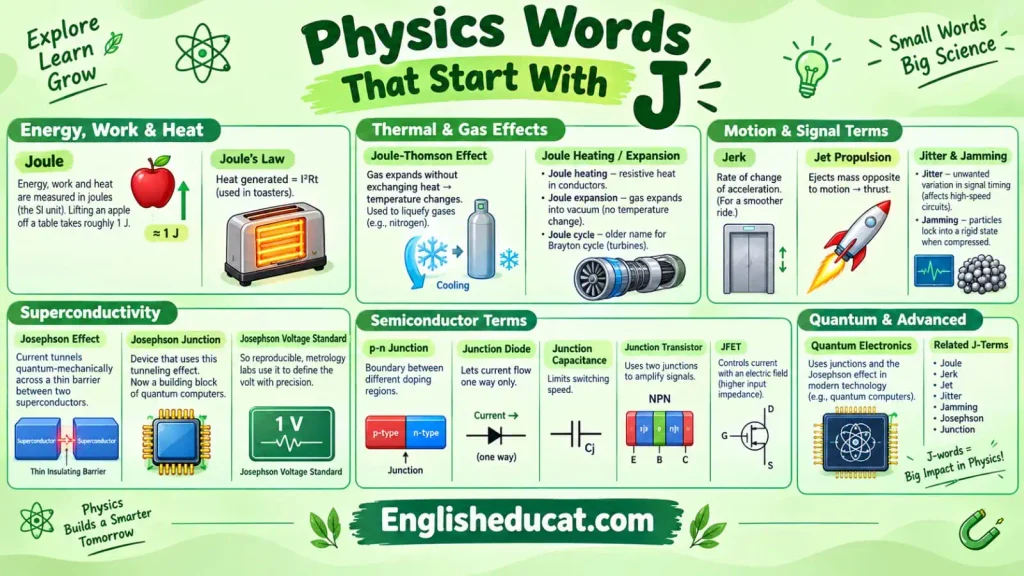
Elevator designers try to minimize jerk, the rate of change of acceleration, for a smoother ride. Jet propulsion generates thrust by ejecting mass opposite the direction of travel, which is how rockets keep accelerating in the vacuum of space. Unwanted variation in signal timing, called jitter, can degrade high-speed circuits, and jamming describes disordered particles and grains, for instance, locking into a rigid state once compressed past a critical density.
Superconductivity contributes the Josephson effect, in which current tunnels quantum-mechanically across a thin insulating barrier between two superconductors, and the Josephson junction, the device engineered to put that tunneling to use now a building block of quantum computers. Because the effect is so reproducible, metrology labs lean on the Josephson voltage standard to define the volt with precision.
Semiconductor terms follow a similar chain. A junction (specifically a p-n junction) is the boundary between differently doped regions, and building a device around that boundary gives you the junction diode, which only lets current flow one way. Every junction carries some junction capacitance, a limit on switching speed, while the junction transistor replaced vacuum tubes using two such junctions to amplify signals; a related junction field-effect transistor (JFET) controls current with an electric field instead, for higher input impedance. In quantum electronics, junction resonance describes tunneling boosted by constructive interference.
A handful of advanced terms deserve a mention too. Certain molecules distort their own geometry to shed unstable electronic symmetry, a phenomenon called the Jahn-Teller effect. The Jaynes-Cummings model describes a two-level atom interacting with a single mode of light, foundational to quantum optics, while engineers lean on the J-integral to describe stress intensity near a crack tip in fracture mechanics. Two teams independently discovered the J/psi meson, a bound state of a charm quark and its antiquark, in 1974, remembered as the “November Revolution” in particle physics. And calculus students meet the jump discontinuity, a point where the left and right limits of a function are finite but unequal, before the idea resurfaces throughout physics.
Astronomy & Space Words That Start With J
No planet dominates a letter quite like Jupiter dominates J. As the largest planet and fifth from the Sun, it anchors much of this terminology of the branch. Any gas giant resembling it, including Saturn, Uranus, and Neptune, counts as a Jovian planet, and own satellites of Jupiter Europa among them, a leading candidate in the search for life beyond Earth thanks to a suspected subsurface ocean, are its Jovian moons.
Voyager probes captured the first clear images of the faint of planet Jovian ring; its Jovian magnetosphere is the largest of any planet and traps intense radiation belts, and its Jovian aurora puts on displays far more powerful than Earth’s. Two different objects share a name here: NASA’s Juno spacecraft has orbited Jupiter since 2016, studying its deep atmosphere, while the asteroid Juno was the third asteroid ever discovered, back in 1804. Asteroids sharing orbit of Jupiter near stable gravitational points are the Jupiter Trojans, and the Great Red Spot on the planet is a storm larger than Earth that has been slowly shrinking for a century.
Saturn contributes Janus, a moon that periodically swaps orbits with its neighbor Epimetheus in what astronomers call the Janus-Epimetheus co-orbital resonance.
Astronomers also rely on a set of J-named measurement systems for everyday timekeeping and observation:
| Term | What it measures or defines |
| Jansky | Unit of radio wave flux density |
| Julian date | Continuous day count used for precise timekeeping |
| Julian calendar | Historical calendar system, distinct from the Julian date |
| Julian year | Fixed length of 365.25 days, used to standardize long time spans |
| Julian epoch | Reference point (commonly J2000.0) that star catalogs use for coordinates |
Deeper astrophysics rounds out the branch. Black holes and young stars can eject a narrow, high-energy stream of matter known as an astrophysical jet. Gravity only triggers the collapse of a gas cloud once it clears a threshold called the Jeans mass, and Jeans instability is the broader criterion explaining why some clouds fragment into multiple stars. A carbon star with unusually strong carbon-13 lines is classed as a J-type star, and the J-band, an infrared wavelength range, aids observation through dust. Mission planners sometimes jettison spacecraft components mid-flight to shed mass for the rest of a journey.
Earth & Environmental Science Words That Start With J
Geology and environmental science supply a wide-ranging final set of J-words, from dinosaur-era rock layers to modern emissions research.
Remarkable dinosaur diversity left its mark during the Jurassic period, part of the Mesozoic Era spanning roughly 201 to 145 million years ago. Rock formations fracture without shifting apart in a process called jointing; the hexagonal columns at Ireland’s Giant’s Causeway are a textbook example, and a joint set is a group of parallel fractures whose orientation reveals ancient tectonic stress.
Two minerals prized for their appearance are jasper, an opaque, colorful chalcedony variety, and jade, a term that actually covers two distinct minerals, one of which is jadeite, the harder and rarer form long valued by carvers.
Water hazards add some drama. A glacier’s sudden and catastrophic outburst flood is called a jökulhlaup, while juvenile water refers to water entering the hydrologic cycle of Earth for the first time, typically from volcanic activity. Coastal engineers build a jetty into the water to redirect currents or shelter a harbor, and marine researchers studying ocean pollution draw a line between jetsam debris deliberately thrown overboard and cargo lost unintentionally.
Landscape and forestry terms follow. Glacial deposition can leave behind randomly oriented ridges known as jackstraw topography, and juvenescence describes landscape rejuvenation, when renewed erosion after tectonic uplift carves fresh waterfalls and channels. The jack pine produces cones that only release seeds after fire, letting forests regenerate post-wildfire, and jarrah, a termite-resistant eucalyptus timber from Western Australia, gets rated on the Janka hardness scale, a standard wood-durability test. Jute rounds out the group as a biodegradable fiber grown as an alternative to synthetic textiles.
Ecology and monitoring supply the rest. Unchecked exponential population growth, often seen in invasive species without natural predators, traces a J-shaped curve. Emissions researchers study the jackrabbit start rapid acceleration from a stop for its effect on fuel consumption, and atmospheric chemists calculate a J-value, a photolysis rate coefficient describing how fast sunlight breaks down a molecule, when modeling processes like ozone depletion. Some of the earliest Homo erectus remains ever found came from the fossil site Java Man, and the Java Trench, a deep Indian Ocean trench, marks where one tectonic plate slides beneath another.
Advanced J-Words: A Bonus Section for the Curious
A handful of terms already covered above reward a second look, since each carries extra weight in its field. Graduate inorganic chemistry leans on the Jahn-Teller effect to explain distorted metal-complex geometries, and the Jarzynski equality connects nonequilibrium work to equilibrium thermodynamics. Quantum optics still treats the Jaynes-Cummings model as foundational, and Judd-Ofelt theory guides real laser engineering decisions.
Glaciologists actively monitor the jökulhlaup as a genuinely dangerous hazard, while the juxtaglomerular apparatus counts as advanced renal physiology, taught only after basic kidney anatomy. The J/psi meson redirected particle physics overnight in 1974, and Jeans instability remains a graduate-level concept explaining why gas clouds collapse into stars.
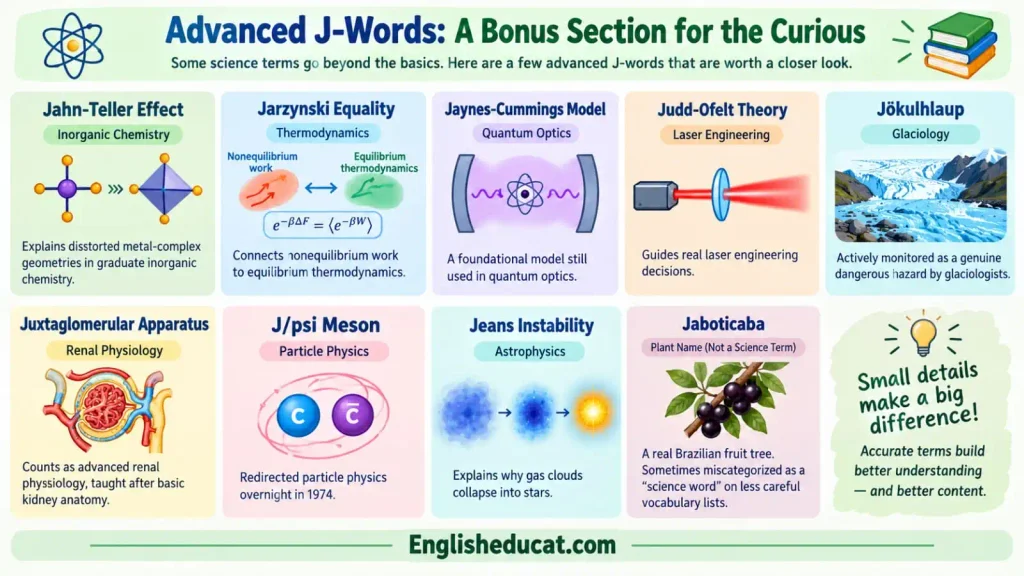
Worth a quick aside: jaboticaba, a real Brazilian fruit tree, sometimes gets miscategorized as a “science word” on less careful vocabulary lists. It is a genuine plant name, just not a technical term a small, telling example of how easily accuracy slips in this corner of content writing.
Why Learn J Science Words?
Learning this vocabulary does more than round out an alphabet list. It touches five very different fields at once, making it a good case study for building scientific literacy rather than memorizing trivia. A single letter connects human anatomy through the jejunum, plant chemistry through jasmonic acid, particle physics through the J/psi meson, planetary science through Jovian, and geology through the Jurassic period.
Students meet this vocabulary across biology, chemistry, and earth science curricula from elementary school through graduate coursework; jejunum or Jurassic is not obscure trivia so much as material that resurfaces sooner or later.
Word-game players will find J is a high-value eight-point Scrabble tile with more legitimate short words available than most people realize. And for writers and science communicators, understanding a term like the Josephson effect before using it prevents the kind of buzzword-heavy writing that erodes reader trust. Whatever brought you here, the goal has stayed the same: definitions you can verify, not just repeat.
Frequently Asked Questions
What is a science word that starts with J?
Any scientific term whose subject happens to begin with that letter joule (a unit of energy), Jupiter (the largest planet), or jejunum (part of the small intestine) is an obvious example, spanning every branch of science from biology to astrophysics.
What is the most important science word that starts with J?
Most people would point to the joule, the SI unit used to measure energy, work, and heat across physics, chemistry, and engineering. It also anchors related terms like Joule’s law and the Joule-Thomson effect.
What are some biology terms that start with J?
Jejunum (part of the small intestine), joint (a connection between bones), juvenile hormone (an insect development regulator), and juxtaglomerular apparatus (a kidney structure regulating blood pressure) are common entry points, alongside animal names like jaguar, jerboa, and jackal.
Are there science words that start with J related to space?
Plenty: Jupiter, Jovian planet, Jansky, Juno, and Julian date all qualify, and Jupiter alone anchors related terms like Jovian moons, the Jovian magnetosphere, and the Jupiter Trojans.
Why are so many science words that start with J named after people?
This letter carries an unusually high concentration of eponyms named after their discoverers, including the joule (James Prescott Joule), the Josephson effect (Brian Josephson), and the Jahn-Teller effect (Hermann Jahn and Edward Teller).
How many science words start with the letter J?
Well over 100 once every branch of science is counted together. This guide documents 126, though the exact number shifts depending on how strictly “science word” is defined.
Conclusion
Twenty-six letters carve up the alphabet, but few do as much quiet work across science as J. Across this guide, that single letter has carried us from the middle of the human small intestine to the storm-streaked clouds of Jupiter, from a walnut chemical of trees’ warfare against its neighbors to a subatomic particle that rewrote part of physics history overnight.
That is not alphabetical coincidence; it is a reminder that scientific vocabulary, dry as it looks on a flashcard, is really a record of people noticing something true about the world and naming it precisely enough to survive a hundred years of textbooks. So the next time jejunum surfaces on a quiz, the Great Red Spot of Jupiter appears in conversation, or a crossword asks for a rare J-word, there is more than a guess to work with: there is context, a real definition, and maybe even the scientist behind it. Building a vocabulary this way is not about memorizing a list; it is about owning it.

ESL Content Writer
Emily is a TESOL-certified writer who has taught English to international students for over 8 years. She loves breaking down idioms and everyday expressions into simple, relatable explanations that make sense to learners at any level.