

From hydrogen in chemistry to habitat in biology, science words that start with H appear in nearly every branch of study. Part of the reason is structural: a small cluster of Greek and Latin roots “hydro-” (water), “homo-/hetero-” (same/different), and “hyper-/hypo-” (over/under) quietly generates a large number of technical vocabulary across disciplines.
This guide pulls together more than 100 real science words that start with H, sorted by field biology, chemistry, physics, astronomy, and earth science each paired with a plain-language definition and an example sentence. A short bonus list of rarer and advanced terms sits at the end for students, teachers, and anyone who enjoys precise vocabulary. There are many other science words that start with I and J.
Why the Letter H Dominates Scientific Vocabulary
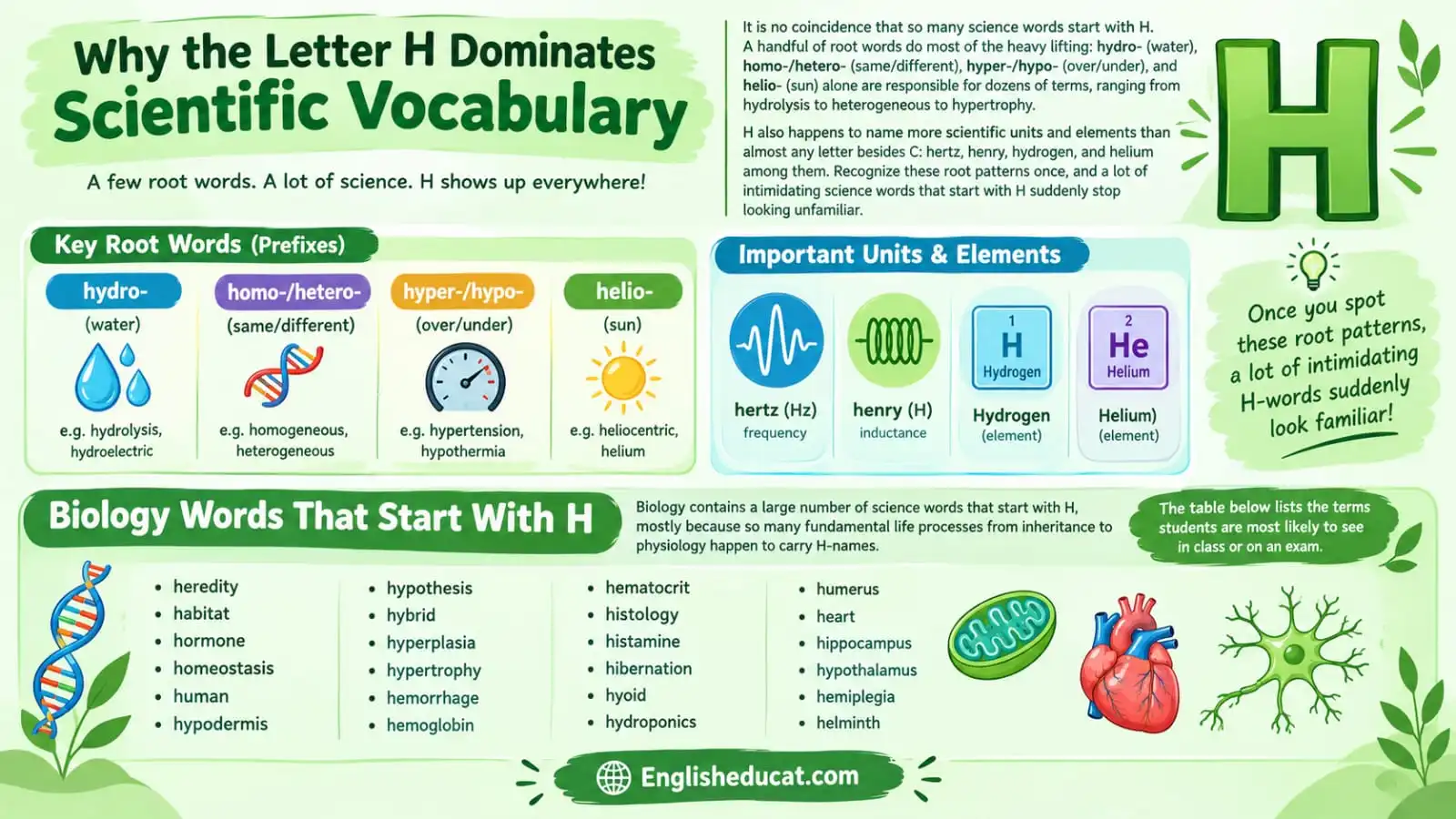
It is no coincidence that so many science words start with H. A handful of root words do most of the heavy lifting: hydro– (water), homo-/hetero- (same/different), hyper-/hypo- (over/under), and helio- (sun) alone are responsible for dozens of terms, ranging from hydrolysis to heterogeneous to hypertrophy. H also happens to name more scientific units and elements than almost any letter besides C: hertz, henry, hydrogen, and helium among them. Recognize these root patterns once, and a lot of intimidating science words that start with H suddenly stop looking unfamiliar.
Biology Words That Start With H
Biology contains a large number of science words that start with H, mostly because so many fundamental life processes from inheritance to physiology happen to carry H-names. The table below lists the terms students are most likely to see in class or on an exam.
| Term | Definition | Example Sentence |
| Habitat | The specific place and set of conditions where a species naturally survives and reproduces. | A coral reef supports the habitat of thousands of marine species. |
| Heredity | How biological traits move from one generation to the next through genes. | Eye color is shaped largely by heredity. |
| Hormone | A signaling chemical, released by a gland, that tells another part of the body what to do. | Insulin is a hormone that keeps blood sugar in check. |
| Homeostasis | A living system’s tendency to hold its internal conditions steady even as the outside world changes. | Sweating is one way the body keeps homeostasis during a heatwave. |
| Hemoglobin | An iron-based molecule inside red blood cells responsible for ferrying oxygen around the body. | Low hemoglobin often shows up as fatigue and pale skin. |
| Herbivore | An animal whose diet consists mainly or entirely of plant matter. | Deer spend most of the day grazing as herbivores. |
| Hybrid | The offspring resulting from crossing two distinct species or breeds. | A mule comes from crossing a horse with a donkey a classic hybrid. |
| Hypothalamus | A pea-sized brain region that keeps hunger, temperature, and hormone release in balance. | The hypothalamus triggers thirst once the body starts losing water. |
| Histology | The branch of biology focused on tissue structure under a microscope. | The histology report flagged unusual cell growth in the biopsy. |
| Hyphae | Thin, branching filaments that together make up a fungus’s body. | Fungal hyphae push through soil in search of nutrients. |
| Homologous chromosomes | Two matching chromosomes one from each parent carrying corresponding genes. | Homologous chromosomes line up during meiosis just before cells divide. |
| Heterozygous | Carrying two different versions of the same gene. | A heterozygous plant can display a blend of dominant and recessive traits. |
| Homozygous | Carrying two identical versions of the same gene. | A homozygous parent always passes the same allele to its offspring. |
| Hibernation | A deep, energy-saving dormant state some animals use to survive winter scarcity. | Bears slip into hibernation once food becomes hard to find. |
| Hippocampus | A curved brain structure central to forming new memories. | Injury to the hippocampus can make it hard to form new memories. |
Genetics, anatomy, and ecology all lean heavily share of biology on science words that start with H, and this table only scratches the surface.
Chemistry Words That Start With H
Chemistry supplies some of the most instantly recognizable science words that start with H, mostly due to hydrogen sitting at position one on the periodic table. Because so many of these terms pack a lot of meaning into a short definition, a table format works especially well here.
| Term | Definition | Example Sentence |
| Hydrogen | The simplest and most abundant element in the universe, symbol H. | Hydrogen bonds with oxygen to produce water. |
| Hydrolysis | A reaction in which water splits a larger compound into smaller pieces. | Hydrolysis breaks starch down into simple sugars. |
| Hydrocarbon | Any organic compound built only from carbon and hydrogen atoms. | Methane, a basic hydrocarbon, is the main component of natural gas. |
| Hydroxide | An ion made of oxygen and hydrogen (OH⁻) common to most bases. | Sodium hydroxide gives soap its strong, alkaline properties. |
| Halide | A compound formed when a halogen bonds with another element. | Silver halide reacts to light, which is why it’s used in photographic film. |
| Hygroscopic | Prone to pulling moisture straight out of the surrounding air. | Table salt clumps in humid weather because it’s mildly hygroscopic. |
| Homogeneous mixture | A blend where every part shares the exact same composition. | Saltwater counts as a homogeneous mixture once the salt fully dissolves. |
| Heterogeneous mixture | A blend where the individual components stay visibly distinct. | A tossed salad is a heterogeneous mixture of separate ingredients. |
| Hydration | The bonding of water molecules onto another substance. | Hydration turns white copper sulfate powder a vivid blue. |
| Hydrophobic | Resistant to mixing with or dissolving in water. | Oil sits on top of water because it’s hydrophobic. |
| Hydrophilic | Naturally drawn to water and quick to dissolve in it. | Sugar is hydrophilic, which is why it vanishes so easily in tea. |
| Helium | An extremely light, chemically inert gas found just after hydrogen on the periodic table. | Party balloons float because helium is lighter than air. |
| Hafnium | A dense, corrosion-resistant transition metal used in nuclear control rods. | Hafnium’s durability makes it a favorite in aerospace components. |
| Hess’s Law | A rule stating that a reaction’s total energy change stays the same no matter which path it takes. | Chemists rely on Hess’s Law to work out reaction energies indirectly. |
| Half-life | The time it takes for exactly half of a radioactive sample to decay. | Carbon-14’s half-life lets scientists date organic remains thousands of years old. |
Between elements, reactions, and named laws, science words that start with H in chemistry appear constantly on exams and in lab reports alike.
Physics Words That Start With H
Physics breaks the pattern a little; many of its science words that start with H name units, forces, or specific principles rather than materials. A definition-list format suits this section better, both for readability and for variety on the page.
- Heat: Thermal energy on the move between objects of different temperatures. Heat always drifts from the warmer object toward the cooler one.
- Hertz: The standard unit for frequency, marking one cycle per second. A tuning fork vibrating at 440 hertz produces the note A.
- Harmonic motion: A repeating back-and-forth swing around a resting point, like a pendulum. A weight bouncing on a spring is a textbook case of simple harmonic motion.
- Hooke’s Law: The rule linking how far a spring stretches to how much force is applied to it. Hooke’s Law is what makes a basic spring scale reliable within its limits.
- Horsepower: An older unit for measuring how much power an engine delivers. This engine is rated at roughly 300 horsepower.
- Heisenberg Uncertainty Principle: A quantum-level rule stating a particle’s position and momentum can not both be pinned down with total precision at once. The Heisenberg Uncertainty Principle sets a hard ceiling on how precisely atomic particles can be measured.
- Holography: A method for capturing and replaying three-dimensional images using interference patterns in light. Holography depends on laser light to record depth that a flat photograph simply can not.
- Hysteresis: A delay between a change in an input of a system and the moment its output actually reflects that change. Hysteresis inside a transformer core wastes a small amount of energy as heat.
- Huygens’ Principle: The idea that every point along a wavefront behaves like a fresh source of small secondary waves. Huygens’ Principle explains how light manages to bend slightly around obstacles.
- Hydrostatic pressure: The pressure a still fluid exerts purely because of gravity pulling on it. Hydrostatic pressure climbs noticeably the deeper a diver descends.
- Homopolar generator: An electrical generator design that produces direct current from a spinning magnetic disc. A homopolar generator was among the first machines to produce a steady electric current.
- Half-power point: The frequency at which output of a system falls to half its peak strength. Engineers use the half-power point to mark the edges of a filter’s bandwidth.
Physics is a good reminder that science words that start with H do not always name substances; plenty of them describe measurable behavior instead.
Astronomy & Space Words That Start With H
list of science words that start with H in astronomy is smaller but distinctive, describing everything from planetary motion to the fate of dying stars. Given how compact these definitions are, a table keeps things scannable.
| Term | Definition | Example Sentence |
| Heliocentric | Describing a solar-system model centered on the sun rather than Earth. | Copernicus’s heliocentric model eventually replaced the older Earth-centered view. |
| Hubble’s Law | The finding that distant galaxies recede faster the farther away they sit, pointing to an expanding universe. | Hubble’s Law gave early evidence that the universe has been expanding since the Big Bang. |
| Event horizon | The invisible line around a black hole past which nothing, not even light, can escape. | Anything that crosses the event horizon is gone for good. |
| Hypergiant | One of the most massive and luminous stars known, usually near the end of its life. | A single hypergiant can outshine the sun by millions of times. |
| Heliosphere | The enormous region of space dominated by charged particles streaming from the sun. | The heliosphere stretches well beyond the orbit of Pluto. |
| Heliopause | The far edge of the heliosphere, where solar wind gives way to interstellar space. | Voyager 1 crossed the heliopause back in 2012. |
| Galactic halo | A loosely spherical region surrounding a galaxy, holding older stars and much of its dark matter. | Astronomers study a galaxy’s halo to estimate how much dark matter it contains. |
| Herbig–Haro object | A glowing patch of gas created when jets from a newborn star slam into nearby material. | The Hubble Space Telescope has photographed several striking Herbig–Haro objects. |
| Hyperbolic orbit | An open path an object follows when it’s moving too fast to ever be pulled back by gravity. | A comet on a hyperbolic orbit swings past the sun once and never returns. |
| Helium flash | A short, intense burst of helium fusion inside an aging star’s core. | A helium flash marks a turning point late in the life of a sun-like star. |
Even at galactic scale, science words that start with H keep appearing, proof of just how far this single letter’s reach extends.
Earth & Environmental Science Words That Start With H
Weather, soil, and natural cycles round out the list of science words that start with H with terms that shape daily life more than most people realize. This section shifts back to a bulleted format for visual balance.
- Humidity: The quantity of water vapor floating in the surrounding air. High humidity makes a hot day feel even more oppressive.
- Hydrosphere: All the water on Earth, combined oceans, ice, groundwater, and vapor alike. The hydrosphere covers roughly seventy percent of the surface of the planet.
- Hurricane: A powerful, rotating tropical storm with winds of at least 74 mph. The hurricane dumped heavy rain along the coastline before weakening inland.
- Hydrologic cycle: The nonstop loop of water moving between the sky, the land, and the oceans. Evaporation and rainfall are two of the key stages in the hydrologic cycle.
- Hadley cell: A wide loop of circulating air that carries warm equatorial air toward the poles. The Hadley cell has a major influence on rainfall across the tropics.
- Soil horizon: One distinct, horizontal layer within soil, each with its own texture and makeup. Geologists study each soil horizon to piece together the history of a region.
- Humus: The rich, dark organic material left behind as plants and animals decompose. Humus keeps soil fertile by holding onto moisture and nutrients.
- Water hardness: A measure of how much dissolved calcium and magnesium a water supply contains. High water hardness leaves chalky mineral buildup inside pipes over time.
- Heat island: A city or urban zone that runs noticeably hotter than the countryside around it. Concrete and asphalt turn cities into heat islands during summer months.
- Hail: Chunks of ice that form and fall from strong thunderstorms. Large hail can dent cars and shred crops in just a few minutes.
- Hygrometer: A device built to measure how much moisture is in the air. A hygrometer in the greenhouse keeps humidity at the right level for seedlings.
- Holocene: The current geological epoch, which began about 11,700 years ago as the last ice age ended. Nearly all of recorded human history falls within the Holocene epoch.
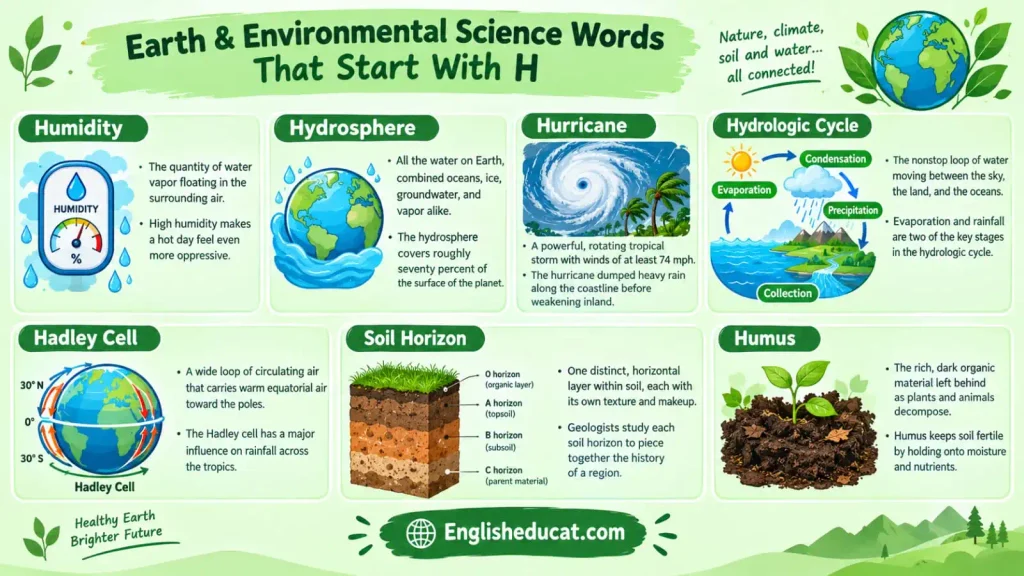
Weather patterns and soil composition alike depend on this cluster of earth science words that start with H.
Advanced & Rare Science Words That Start With H
For advanced students, competitive exam-takers, or anyone simply curious, here are eight less common science words that start with H worth adding to the list. These rarely surface in introductory coursework but appear often once study moves into specialized territory.
| Term | Field | Definition |
| Hapticity | Chemistry | A count of how many atoms in a ligand bond directly to the metal center of a complex. |
| Hyperfine structure | Physics | Tiny splits in atomic energy levels caused by interaction between electron spin and nuclear spin. |
| Hückel’s Rule | Chemistry | A shortcut for predicting whether a ring-shaped molecule qualifies as aromatic, based on its π-electron count. |
| Heterochromatin | Biology | Densely coiled DNA inside a cell’s nucleus that generally stays switched off, transcription-wise. |
| Holobiont | Biology/Ecology | A host organism treated as one ecological unit together with its entire community of microbes. |
| Hemidesmosome | Cell Biology | A junction structure that anchors a cell firmly to the tissue layer beneath it. |
| Hyperbaric | Medicine/Physics | Involving pressure well above normal atmospheric levels, as in hyperbaric oxygen chambers. |
| Homeostenosis | Physiology | The slow shrinking of an aging body’s reserve capacity to keep itself in balance. |
Terms like these show how far science words that start with H extend once a learner moves past the basics.
Why Learn H Science Words?
Building a working vocabulary of science words that start with H pays off well beyond a single quiz. These terms surface constantly across biology, chemistry, and physics exams, and they are a fixture of standardized testing and general scientific literacy checks throughout school. What matters even more, though, is the pattern-spotting skill this builds over time: once someone knows that “hydro-” means water points, or that “hyper-” and “hypo-” flag excess versus deficiency, a whole set of once-intimidating terms hyperthyroidism, hypoglycemia, and dozens more start making sense on first read.
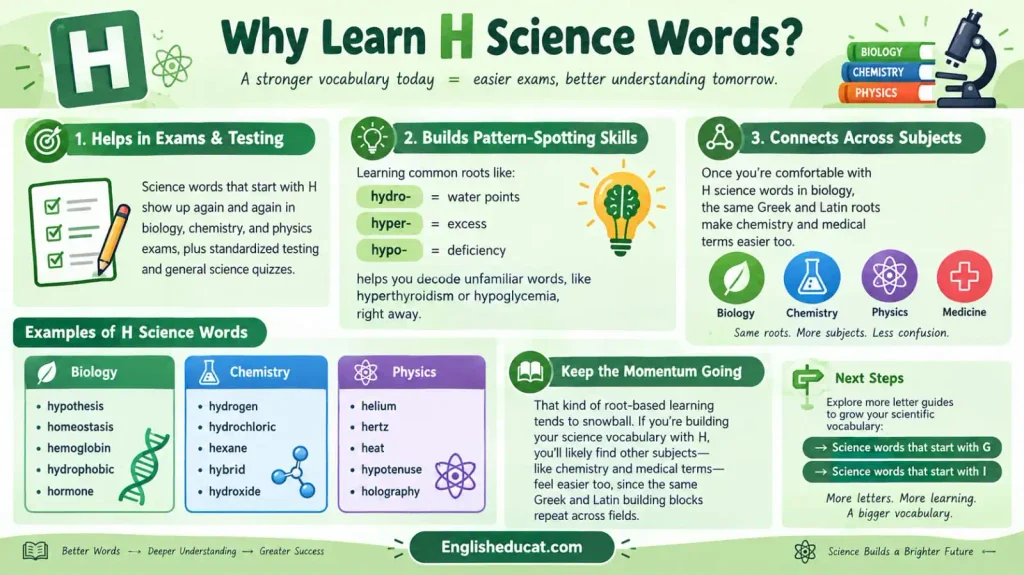
That kind of root-based learning tends to snowball. Someone comfortable with science words that start with H in biology usually finds chemistry and medical terminology easier too, since so many of the same Greek and Latin building blocks repeat across fields. Anyone looking to keep this momentum going might want to check out neighboring letter guides: science words that start with G, or with I as a natural next step toward a fuller scientific vocabulary.
Frequently Asked Questions
What are some common science words that start with H?
Hydrogen, habitat, hypothesis, heat, and homeostasis rank among the most familiar science words starting with H. They span chemistry, biology, and physics, and each one describes a foundational concept rather than something narrow or highly specialized.
What is a science word starting with H used in biology?
Habitat, heredity, and hormone are three H-words that come up constantly in biology. Habitat covers where an organism lives, heredity explains how traits pass down through generations, and hormones regulate processes ranging from growth to metabolism.
What is a 5-letter science word that starts with H?
Heart, hertz, and hydra all fit the bill as 5-letter science words beginning with H. Hertz measures wave frequency in physics, while hydra refers to both a small freshwater animal in biology and a constellation in astronomy.
Why do so many science words start with the letter H?
A cluster of productive Greek and Latin roots is the main reason: hydro- (water), homo-/hetero- (same/different), and hyper-/hypo- (over/under) among them. These roots generate entire families of related terms across chemistry, biology, and physics.
What is an advanced or rare science word that starts with H?
Hapticity, hyperfine structure, and Hückel’s Rule are solid examples of advanced H-terms. They tend to show up in university-level coursework or specialized research rather than in an introductory science class.
What science words starting with H are useful for exams or vocabulary tests?
Hypothesis, half-life, homogeneous, and heterogeneous are among the most exam-relevant H-terms out there. Since they describe core scientific ideas rather than obscure details, they keep reappearing across grade levels and test formats.
Conclusion
Few single letters open up as much of the scientific world as H does. From the hydrogen atom that makes up most of the visible universe to the hippocampus quietly filing away every memory a person forms, science words that start with H reach into biology, chemistry, physics, astronomy, and earth science all at once. What makes this list worth keeping is not just the number of entries; it is the hidden logic underneath them. Once the roots click, an intimidating wall of vocabulary turns into something closer to a cipher, and unfamiliar science words that start with H start reading less like obstacles and more like clues waiting to be solved.
Whether the goal is acing a biology test, sharpening everyday scientific literacy, or just enjoying the small satisfaction of knowing exactly what hygroscopic or heliopause means, this collection of science words that start with H is a solid place to start. Save it, come back to it, and let curiosity carry the rest because in science, H has never been just another letter. It is a doorway into nearly every field of discovery there is.

Senior English Content Editor
Sarah has over 10 years of experience teaching English as a Second Language in Chicago public schools. She specializes in vocabulary building and simplifying complex word meanings for everyday learners. Sarah holds a Master’s degree in English Education from the University of Illinois.