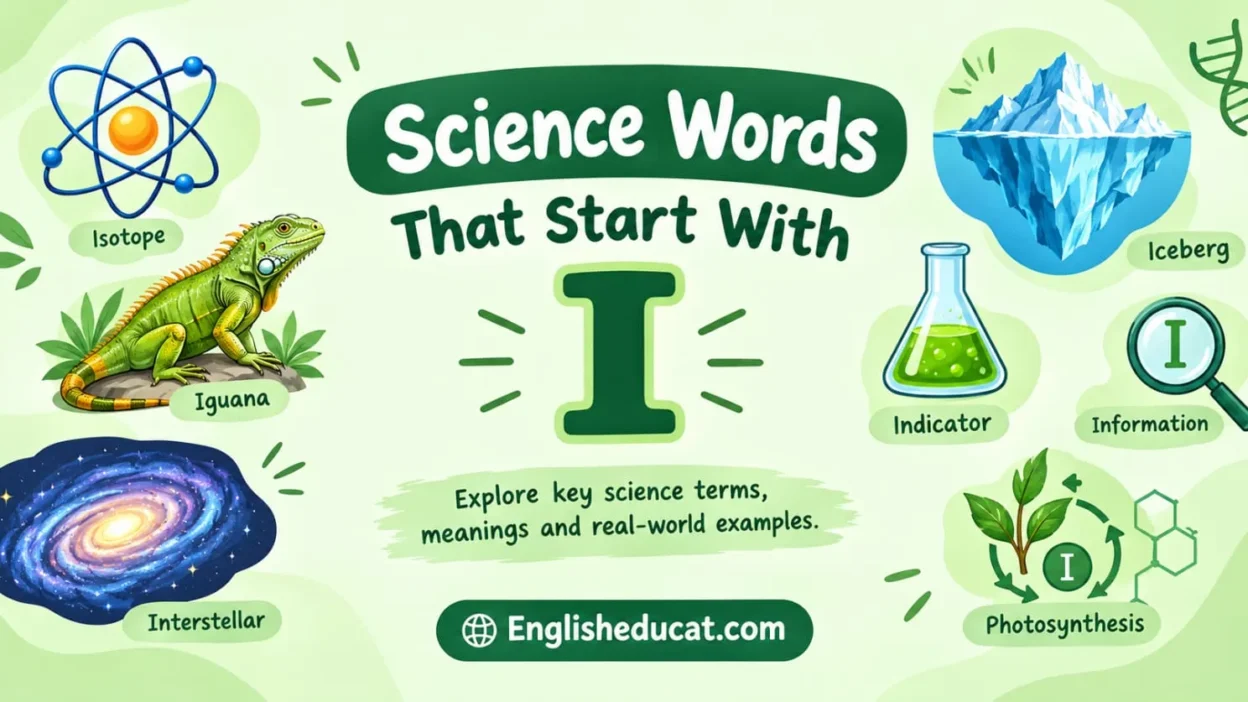
If you have ever paused mid-sentence trying to recall the word for a charged atom, or wondered why ice floats, then you have bumped into the letter I. Few letters carry this much scientific weight. Biology, chemistry, physics, astronomy, and earth science all lean on it heavily: think ion, inertia, immunity, and isotope because so many core scientific ideas involve something happening inside one thing, between two things, or in equal measure across a system.
This guide organizes more than 70 essential science words that start with I by branch and pairing each one with a plain-language definition and a real example sentence just like other science words that start with J and K. A separate section further down covers eight rarer, advanced terms for anyone chasing something beyond the basics: students prepping for an exam, teachers building a word wall, word-game players hunting for a valid I-word. However you found your way here, this list of science words that start with I is meant to be genuinely useful, not just a name-dropping exercise.
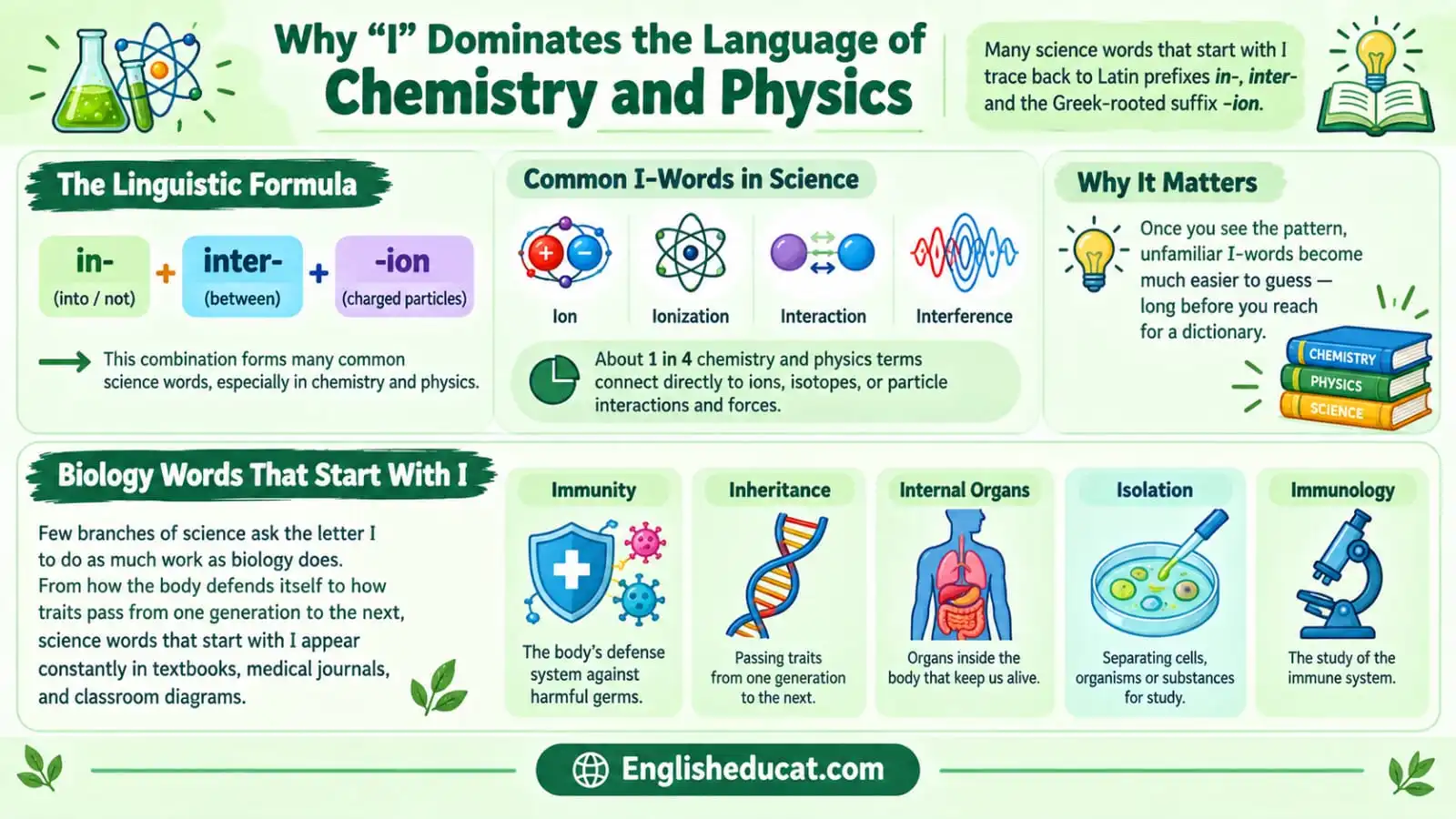
Why “I” Dominates the Language of Chemistry and Physics
Many science words that start with I trace back to two Latin prefixes: in- (meaning “into” or “not”) and inter- (meaning “between”). Layer in the Greek-rooted suffix -ion, used for charged particles, and a clear pattern emerges. Terms like ion, ionization, interaction, and interference are not random word choices; they are built from the same linguistic scaffolding scientists have leaned on for centuries. Roughly one in four chemistry and physics terms in this list connects directly to ions, isotopes, or the interaction between particles and forces. Once that pattern clicks, unfamiliar I-words become far easier to guess before you even reach for a dictionary.
Biology Words That Start With I
Few branches of science ask the letter I to do as much work as biology does. From how the body defends itself to how traits pass from one generation to the next, science words that start with I appear constantly in textbooks, medical journals, and classroom diagrams of the human body.
| Term | Definition | Example Sentence |
| Immunity | Protection the body builds against a specific disease or pathogen. | A round of chickenpox in childhood often leaves lasting immunity into adulthood. |
| Immunology | The scientific field examining how the immune system recognizes and fights invaders. | Immunology research accelerated dramatically once mRNA vaccine technology matured. |
| Inheritance | How particular traits get passed down from parents to offspring through genes. | Mendel’s pea plants first revealed the predictable patterns behind genetic inheritance. |
| Incubation | The stretch of time before eggs hatch, or before an infection’s symptoms surface. | A cold’s incubation period can leave you contagious before you ever feel sick. |
| Insulin | A pancreas-made hormone that keeps blood sugar within a safe range. | Without enough insulin, glucose builds up dangerously in the bloodstream. |
| Invertebrate | Any animal that manages without a spinal column. | Octopuses are remarkably intelligent invertebrates despite lacking a backbone. |
| Interphase | The growth-and-preparation stage a cell goes through before it divides. | Most of a cell’s life is actually spent in interphase, not in active division. |
| Instinct | Behavior an animal performs automatically, without ever being taught. | A newborn sea turtle crawls toward the ocean guided purely by instinct. |
| Iris | The ring of colored muscle that adjusts how much light enters the eye. | The iris contracts sharply the moment it’s exposed to bright light. |
| Ileum | The final stretch of the small intestine, where the last nutrients get absorbed. | Crohn’s disease frequently targets the ileum, causing chronic inflammation there. |
| Imprinting | A fast, early-life learning process that shapes lasting recognition or attachment. | Ducklings imprint by following the first moving object they encounter after hatching. |
| Invasive species | A transplanted organism that outcompetes and damages a native ecosystem. | Burmese pythons have devastated native wildlife populations across the Florida Everglades. |
| Interneuron | A relay neuron linking incoming sensory signals to outgoing motor commands. | Interneurons let a reflex fire in the spinal cord before the brain even registers pain. |
| Inflammation | The body’s built-in alarm response to injury, irritation, or infection. | Chronic inflammation is now linked to a wide range of long-term health conditions. |
Chemistry Words That Start With I
Open almost any chemistry textbook, and you will run into charged particles, mixtures that refuse to blend, and reactions that hinge on a single missing electron, and a striking number of the terms involved start with I. These science words that start with I appear just as often in a high school lab as in published research materials.
| Term | Definition | Example Sentence |
| Ion | An atom or molecule left electrically charged after gaining or losing electrons. | Table salt dissolves in water because it splits apart into sodium and chloride ions. |
| Isotope | One of several versions of an element that differ only in neutron count. | Doctors use radioactive isotopes like iodine-131 to treat certain thyroid conditions. |
| Ionic bond | The bond that forms when one atom essentially transfers an electron to another. | The strong ionic bond in salt crystals explains table salt’s unusually high melting point. |
| Ionization | The moment an atom or molecule picks up or sheds an electron and becomes charged. | Lightning briefly ionizes the surrounding air, which is part of what makes it glow. |
| Indicator | A chemical that visibly changes color to flag a shift in acidity or reaction state. | Red cabbage juice works as a surprisingly effective homemade pH indicator. |
| Isomer | One of two or more molecules sharing an identical formula but a different atomic layout. | The body processes glucose and its isomer fructose through completely different metabolic pathways. |
| Inert gas | An element so chemically unreactive that it rarely bonds with anything else. | Neon signs glow because an electric current excites the inert gas sealed inside the tube. |
| Inorganic | Describing matter that isn’t built primarily around carbon-hydrogen chemistry. | Most rocks and minerals fall squarely into the inorganic category. |
| Immiscible | Two liquids that refuse to blend into a single, uniform mixture. | Vinaigrette dressing separates because oil and vinegar are naturally immiscible. |
| Insoluble | A substance that simply won’t dissolve, no matter how long you stir it. | Chalk is famously insoluble, which is part of why it survives underwater for so long. |
| Iodine | A halogen element vital to thyroid function and widely used as a surface disinfectant. | A diluted iodine solution remains a go-to antiseptic in many first-aid kits. |
| Intermolecular force | The pull that neighboring molecules exert on one another. | Weak intermolecular forces are the reason gases like helium stay gaseous at room temperature. |
| Ionic compound | A compound held together by electrical attraction between positive and negative ions. | Magnesium oxide is an ionic compound used in everything from antacids to fireproof material. |
| Ignition | The threshold temperature or spark at which combustion actually begins. | Diesel engines skip spark plugs entirely because diesel fuel ignites under high compression alone. |
Physics Words That Start With I
Motion, energy, and the push-and-pull between waves: physics keeps circling back to the same handful of core ideas, and an unusually large share of the vocabulary describing them starts with I. You will find these science words in everything from an introductory mechanics unit to a peer-reviewed engineering paper.
| Term | Definition | Example Sentence |
| Inertia | An object’s built-in resistance to changing its current state of motion. | Seatbelts exist specifically to counteract the inertia that keeps your body moving forward in a crash. |
| Impulse | The push a force delivers to an object over a stretch of time. | Following through on a golf swing increases the impulse transferred to the ball. |
| Induction | Producing an electric current by moving a conductor through a magnetic field. | Induction cooktops heat pots directly using this same electromagnetic principle. |
| Interference | What happens when two waves cross paths and combine into a new pattern. | Oil slicks on wet pavement shimmer with color thanks to light interference. |
| Infrared | Radiation just beyond red on the spectrum, felt more often as heat than seen as light. | Night-vision goggles convert infrared heat signatures into a visible image. |
| Insulator | A material that stubbornly blocks the movement of heat or electric charge. | Wool sweaters work as insulators by trapping warm air close to the skin. |
| Intensity | How much energy a wave packs into a given area. | Standing too close to a speaker exposes your ears to dangerously high sound intensity. |
| Inclination | The angle at which one plane or line tilts away from another. | A satellite’s orbital inclination determines which parts of Earth it passes over. |
| Isotropy | Behaving exactly the same no matter which direction you measure from. | Deep space shows near-perfect isotropy once large-scale structure gets averaged out. |
| Inelastic collision | A crash where some kinetic energy gets lost, usually as heat or sound. | Two lumps of clay smacking together and sticking is a textbook inelastic collision. |
| Imaginary number | A number defined using the square root of a negative value. | Electrical engineers rely on imaginary numbers to model current that shifts out of phase. |
| Impedance | A circuit’s total resistance to alternating current, combining resistance and reactance. | Mismatched impedance between an amplifier and speaker can noticeably distort the sound. |
| Ionizing radiation | Radiation carrying enough energy to strip electrons clean off atoms. | Radiation workers wear badges that track their cumulative exposure to ionizing radiation. |
| Internal energy | The combined kinetic and potential energy locked inside a system’s particles. | Compressing a gas raises its internal energy even before any heat gets added. |
Astronomy & Space Words That Start With I
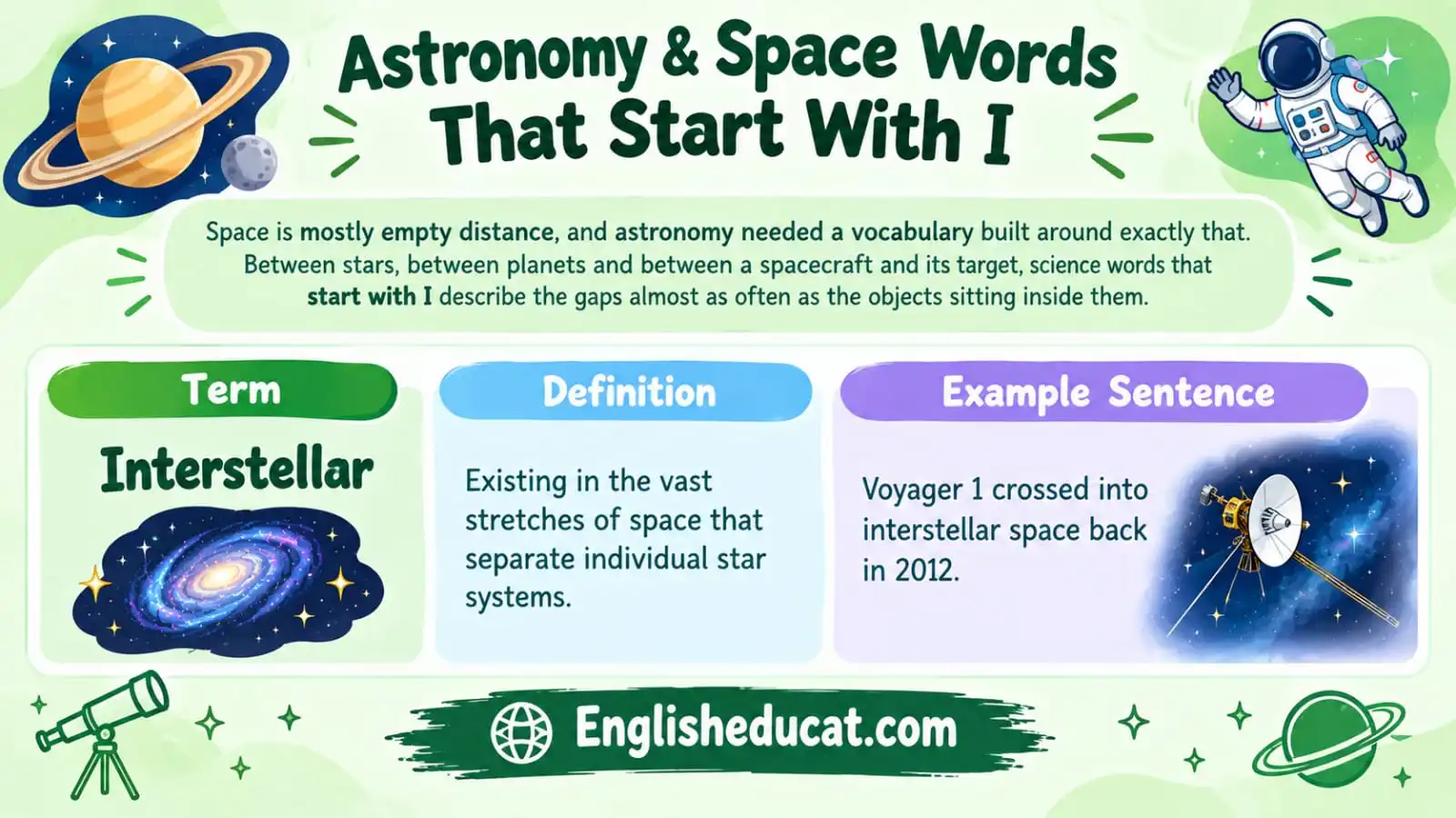
Space is mostly empty distance, and astronomy needed a vocabulary built around exactly that. Between stars, between planets and between a spacecraft and its target, science words that start with I describe the gaps almost as often as the objects sitting inside them.
| Term | Definition | Example Sentence |
| Interstellar | Existing in the vast stretches of space that separate individual star systems. | Voyager 1 crossed into interstellar space back in 2012. |
| Interplanetary | Occurring in the region of space that lies between planets. | Solar wind fills interplanetary space with a constant stream of charged particles. |
| Ionosphere | The electrically charged band high in Earth’s atmosphere, shaped by solar radiation. | Shortwave radio operators depend on the ionosphere to bounce signals around the globe. |
| Impact crater | A bowl-shaped scar left behind when a space object slams into a surface. | Meteor Crater in Arizona remains one of the best-preserved impact craters on Earth. |
| Io | Jupiter’s innermost major moon, notorious for near-constant volcanic eruptions. | Io’s surface gets resurfaced by lava faster than almost anywhere else in the solar system. |
| Irregular galaxy | A galaxy with no tidy spiral arms or elliptical outline to speak of. | Collisions between galaxies often leave behind a chaotic, irregular galaxy shape. |
| Ion thruster | A spacecraft engine that propels itself forward by firing out charged particles. | Though gentle, an ion thruster can run continuously for years without refueling. |
| Inclined orbit | A satellite path deliberately tilted away from the equator. | GPS satellites travel in an inclined orbit so their coverage sweeps across higher latitudes too. |
| Interferometry | Linking multiple telescopes so their combined signal sharpens the final image. | The Event Horizon Telescope used interferometry across continents to photograph a black hole. |
| Infrared astronomy | Observing the universe through heat radiation rather than visible light. | Infrared astronomy lets researchers peer through dust clouds that block ordinary starlight. |
| Interstellar medium | The thin scatter of gas and dust filling the space between star systems. | New stars are born when gravity slowly collapses pockets of the interstellar medium. |
| Inferior conjunction | The moment an inner planet lines up directly between Earth and the sun. | Transits of Venus across the sun can only happen near inferior conjunction. |
| Interplanetary magnetic field | The magnetic field the solar wind drags along with it through space. | Shifts in the interplanetary magnetic field can trigger unusually vivid auroras. |
| Ion tail | A comet’s straight, glowing tail, pushed directly away from the sun by solar wind. | Unlike a comet’s dust tail, its ion tail never curves along the orbital path. |
Earth & Environmental Science Words That Start With I
From ancient ice locked deep inside glaciers to the slow balancing act of the crust of the planet, earth science reaches for I-words constantly. Several of these terms carry extra weight right now, given how often ice, climate, and water systems dominate current environmental research.
| Term | Definition | Example Sentence |
| Igneous rock | Rock that formed as molten material cooled and hardened. | Obsidian is an igneous rock that cools so quickly it never forms visible crystals. |
| Iceberg | A chunk of freshwater ice that has calved off a glacier and drifted out to sea. | Roughly 90 percent of an iceberg’s mass stays hidden beneath the waterline. |
| Ice core | A long cylinder of ancient ice drilled out to study Earth’s past atmosphere. | Trapped air bubbles inside an ice core reveal exactly what past atmospheres contained. |
| Interglacial | A relatively mild stretch of time sandwiched between two ice ages. | Our current interglacial period has already lasted well over 10,000 years. |
| Insolation | The dose of solar energy that actually reaches a given patch of Earth’s surface. | Insolation near the equator stays far more consistent year-round than it does near the poles. |
| Irrigation | Deliberately channeling water onto farmland that wouldn’t get enough rainfall alone. | Ancient irrigation canals allowed civilizations to farm successfully in otherwise dry river valleys. |
| Isobar | A contour line on a weather map joining spots with matching air pressure. | Meteorologists watch for tightly packed isobars as an early sign of an approaching storm. |
| Isostasy | The slow equilibrium between Earth’s crust and the denser mantle it floats on. | Isostasy is part of why Scandinavia is still gradually rising after its last ice sheet melted. |
| Infiltration | Water’s gradual downward journey from the surface into the soil below. | Paved surfaces block infiltration, which is a major reason cities flood so easily. |
| Island arc | A curved string of volcanic islands formed above a subduction zone. | The Aleutian Islands form a classic island arc stretching off the coast of Alaska. |
| Ice sheet | An enormous, continuous slab of glacial ice blanketing a large landmass. | If the Greenland ice sheet fully melted, global sea levels would rise dramatically. |
| Intertidal zone | The strip of shoreline alternately drowned and exposed as the tide moves. | Tide pools scattered across the intertidal zone host a surprising density of marine life. |
| Ice age | A long stretch of Earth’s history marked by expanded polar ice and cooler global temperatures. | Saber-toothed cats and mammoths both roamed North America during the last ice age. |
| Isotherm | A line on a map connecting locations that share the same temperature. | Isotherms on a weather map curve noticeably around large bodies of water. |
Advanced & Rare Science Words Starting With I
Not every list of science words that start with I stops at the familiar ones. For advanced learners, researchers, crossword solvers, or anyone chasing a genuinely obscure term, here are eight rarer picks worth knowing.
| Term | Definition | Example Sentence |
| Iamatology | A little-used term for the formal study of medical remedies and cures. | Iamatology rarely appears outside historical medical texts, having largely been absorbed into pharmacology. |
| Iridology | A fringe practice claiming that patterns in the iris can diagnose health problems. | Mainstream medicine considers iridology a pseudoscience unsupported by clinical evidence. |
| Ichnology | The study of trace fossils, such as footprints, burrows, or tracks, rather than bones. | Ichnology let researchers estimate a dinosaur’s walking speed from nothing but a trail of footprints. |
| Idioplasm | An outdated 19th-century term for the material inside a cell believed to carry heredity. | Idioplasm theory was eventually replaced by a far more precise understanding of DNA. |
| Isopach | A map line connecting points where a rock layer has the same thickness. | Petroleum geologists rely on isopach maps to estimate how much oil a reservoir might hold. |
| Iatrogenic | Describing harm that results unintentionally from medical care itself. | Hospitals track iatrogenic infections closely as part of their patient-safety programs. |
| Interoceptor | A sensory nerve ending tuned to internal signals, like hunger or heartbeat. | Interoceptors are what let you notice a racing heart before you consciously register the anxiety behind it. |
| Isokinetic | Describing exercise performed at a fixed speed while resistance adjusts automatically. | Physical therapists often use isokinetic equipment to rebuild strength evenly after an injury. |
Why Learn Science Words That Start With I?
Memorizing a list of terms rarely feels meaningful on its own; the real value appears later, when one of these words saves you in an exam, a lab report, or a stubborn crossword clue. Students preparing for tests benefit from a compact, categorized reference instead of hunting through scattered textbook chapters. Teachers building vocabulary lessons or word walls get a ready-made list sorted by branch, which makes it simple to assign terms that match a specific unit, whether that is cell biology or plate tectonics. Word-game players working through Wordle, Scrabble, or a tricky crossword clue gain something just as practical: a real scientific term on hand instead of a shaky guess.
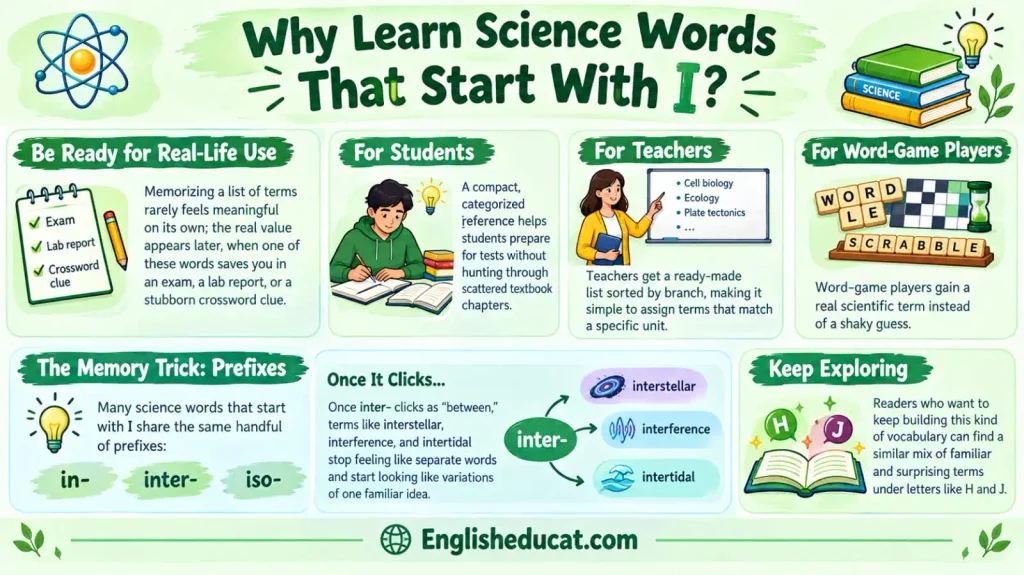
There is also a genuinely useful memory trick buried in this list. Because so many science words that start with I share the same handful of prefixes in-, inter-, iso- learning what the prefix means often unlocks several words at once. Once inter- clicks as “between,” terms like interstellar, interference, and intertidal stop feeling like separate vocabulary entries and start looking like variations on one familiar idea. Readers who want to keep building this kind of vocabulary can find a similar mix of familiar and surprising terms under letters like H and J.
Frequently Asked Questions
What are some science words that start with I?
Common examples include ion, inertia, isotope, immunity, infrared, and insulator. These science words that start with I appear across biology, chemistry, and physics, and most students encounter several of them before finishing high school.
What is a science word starting with I that means “resistance to motion”?
The correct term is inertia, a physics concept describing the tendency of an object to resist any change in its state of motion. It ranks among the most frequently cited science words that start with I in introductory physics courses.
Is “ion” considered a science word?
Yes. An ion is an atom or molecule carrying a net electric charge because it has gained or lost one or more electrons, making it a foundational term in both chemistry and biology.
What are advanced or rare science words starting with I?
Less common examples include iridology, ichnology, and isopach terms that rarely appear in everyday vocabulary lists but do surface in specialized scientific and academic writing.
How many science words start with the letter I?
This guide features more than 70 categorized science words that start with I, plus 8 advanced picks, though thousands of specialized terms across every scientific discipline begin with this letter.
Why do so many science words start with the prefix “in-” or “inter-”?
These prefixes come from Latin roots meaning “into, not” and “between.” Scientific vocabulary has leaned on Latin and Greek roots for centuries because they describe precise relationships between objects, forces, and processes.
Conclusion
A word list only earns its keep once it stops being a list and starts becoming muscle memory. That is the real payoff of working through one like this. Science words that start with I are not just entries to memorize; they are small keys that unlock bigger ideas, from the charge sitting on a single atom to the vast, quiet distance between two stars.
Push this list a little further than a single read-through. Pick five or six science words that start with I that felt genuinely new, use each one in a sentence of your own, and revisit them in a day or two; that short gap is where real retention actually happens. Whatever brought you here, you now have a solid, well-organized foundation of I-words spanning five branches of science. Keep working through the alphabet one letter at a time, and watch how quickly “just vocabulary” turns into real scientific fluency.

Linguistics Specialist
James is a linguist with a Ph.D. in Applied Linguistics from Boston University. His work focuses on word origins, synonyms, and how language evolves over time. He has contributed to several academic journals on English semantics.