
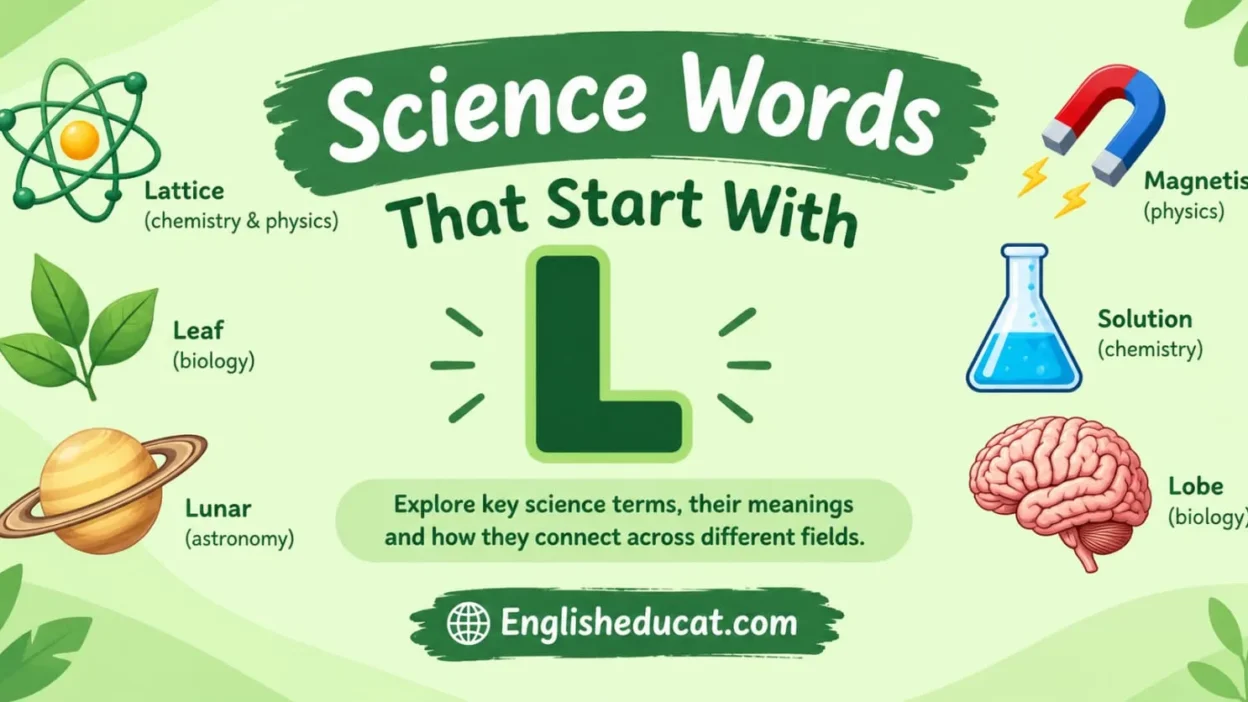
Open a biology textbook, a chemistry lab manual, or an astronomy article, and the letter L keeps appearing in the vocabulary: laser, lipid, lithosphere, luminosity, lever. Few letters carry this much scientific weight. Science words that start with L span nearly every branch of study, from the cells in your body to the far edge of the observable universe, and a good chunk of that vocabulary traces back to a single source: Latin. Early scientists wrote and named things in Latin, and Latin happens to be unusually generous with the letter L.
This guide organizes science words that start with L by subject biology, chemistry, physics, astronomy, and earth science so you can jump straight to what you need, whether that is exam prep, a crossword clue, or plain curiosity. Every entry includes a plain-language explanation and a real-world example showing how the term actually gets used. Also learn other science words that start with M and N.
Science words that start with L include laser, lipid, lithosphere, luminosity, larva, lever, latitude, and ligand, covering fields from physics to biology to earth science.
| Term | Quick Meaning |
| Laser | Focused beam of amplified light |
| Lipid | Fat or oil molecule used for energy storage |
| Lithosphere | Earth’s rigid outer rock layer |
| Luminosity | Total energy a star emits per second |
| Larva | Early, worm-like stage of an insect |
| Lever | Simple machine that amplifies force |
| Latitude | Angular distance north or south of the equator |
| Ligand | Molecule that binds to a metal atom |
| Lithification | Loose sediment hardening into solid rock |
| Lymphocyte | White blood cell central to immune response |
Why L Dominates Physics and Light-Related Science
Scan the physics section of any list of science words that start with L, and a pattern will emerge fast: an unusual number of them describe light or energy. That is not random. The Latin root lux (light) and its cousin lumen fed directly into modern physics vocabulary: laser, lens, luminosity, luminescence, light-year, lux, and even the discarded 19th-century idea of “luminiferous ether” all share that same linguistic ancestor. No other letter maps this tightly onto one physical phenomenon, which helps explain why L holds such a firm grip on science curricula from middle school through graduate research.
Biology Words That Start With L
Biology claims one of the largest slices of science words that start with L, largely because so much anatomical and cellular terminology was built from Latin and Greek roots.
Lipid. Cell membranes rely on lipids (fats and oil molecules for both structure and long-term energy storage. Picture the phospholipid bilayer, two stacked layers of lipid molecules, forming the flexible outer wall of every living cell.
Ligament. Joints stay put thanks to ligaments, tough bands of fibrous tissue linking one bone to the next. Sports medicine headlines mention torn ligaments constantly, especially the ACL in the knee, one of the most frequently injured structures in competitive athletes.
Larva. Before an insect reaches adulthood, it often passes through a larval stage, a worm-like form built for feeding rather than reproduction. Mosquito-control programs track larva counts in standing water, since that is the life stage where intervention actually works.
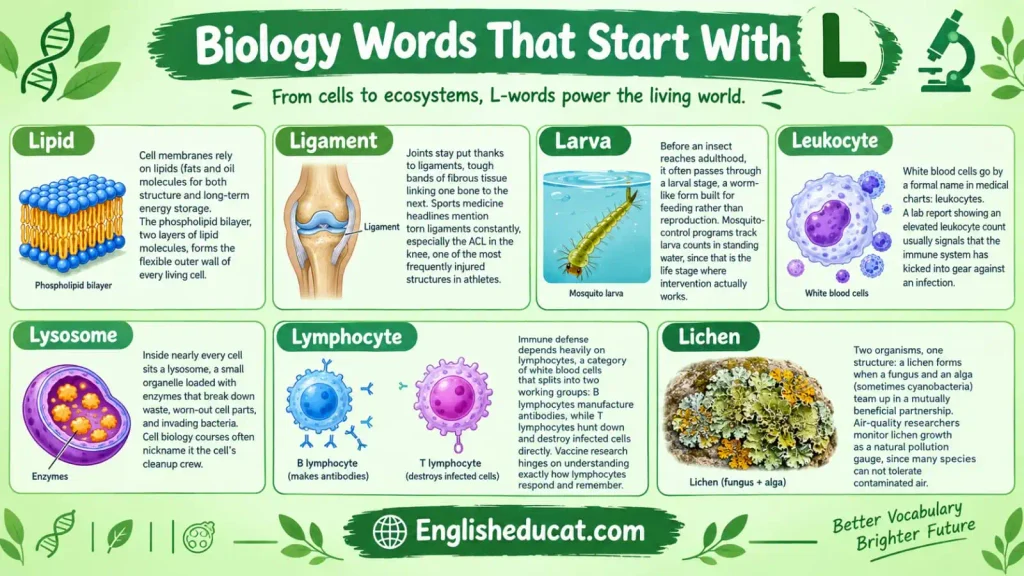
Leukocyte. White blood cells go by a formal name in medical charts: leukocytes. A lab report showing an elevated leukocyte count usually signals that the immune system has kicked into gear against an infection.
Lysosome. Inside nearly every cell sits a lysosome, a small organelle loaded with enzymes that break down waste, worn-out cell parts, and invading bacteria. Cell biology courses often nickname it the cell’s cleanup crew.
Lymphocyte. Immune defense depends heavily on lymphocytes, a category of white blood cells that splits into two working groups: B lymphocytes manufacture antibodies, while T lymphocytes hunt down and destroy infected cells directly. Vaccine research hinges on understanding exactly how lymphocytes respond and remember.
Lichen. Two organisms, one structure: a lichen forms when a fungus and an alga (sometimes cyanobacteria) team up in a mutually beneficial partnership. Air-quality researchers monitor lichen growth as a natural pollution gauge, since many species can not tolerate contaminated air.
Locus. Think of the locus of a gene as its street address on a chromosome: the exact physical spot where it sits. Geneticists tracking inherited conditions usually start by pinning down the locus responsible.
Lineage. Tracing a line of descent from a shared ancestor is what biologists mean by lineage. Studies of human migration lean on mitochondrial DNA lineage to reconstruct how populations spread across the globe over thousands of years.
Locomotion. Whatever method an organism uses to get from point A to point B swimming, walking, flying, slithering falls under locomotion. Comparative anatomy classes compare locomotion strategies across species to see how different body plans solve the same basic problem.
Lactose. Milk owes its sweetness to lactose, a sugar broken down in the body by the enzyme lactase. Not producing enough lactase leads to lactose intolerance, a condition affecting a large share of adults worldwide.
Lignin. Wood owes its rigidity to lignin, the compound that stiffens plant cell walls. Paper mills strip lignin out during processing; its absence is exactly why finished paper stays white instead of yellowing.
Loop of Henle. Tucked inside the kidney, the loop of Henle is a U-shaped tubule structure that concentrates urine by pulling water and salts back into the body. Nephrology courses describe it as the reason mammals can conserve water so much more efficiently than many other animals.
Lysis. When a cell’s outer membrane ruptures and the cell falls apart, that is lysis. Virologists see it happen directly whenever a virus finishes replicating inside a host cell and bursts free to infect its neighbors.
Lobe. Organs like the lungs, liver, and brain are all divided into rounded sections called lobes, each with its own specialized job. A radiologist reading a chest scan will often name the exact lobe where something unusual shows up.
Chemistry Words That Start With L
Fewer in number but no less technical, chemistry contributes a dense cluster of science words that start with L, many tied to molecular structure and how reactions behave.
Ligand. A ligand is any molecule or ion that attaches to a central metal atom, forming what chemists label a coordination complex. Plenty of metabolic enzymes depend on metal-ligand bonds to function, making ligands essential to how the body processes everything from oxygen to hormones.
Lattice. Crystals owe their properties to a lattice, the regular, repeating three-dimensional pattern in which their atoms or ions are arranged. Materials scientists engineer lattice structure on purpose when designing semiconductors, batteries, and even certain pharmaceuticals.
Litmus. Long before digital pH meters, chemists reached for litmus paper, a natural dye indicator that turns red in acidic solutions and blue in basic ones. Nearly every introductory chemistry student encounters litmus paper in their first acid-base lab.
Lye. Soap-making has relied on lye, a strong alkaline solution, typically sodium hydroxide, for centuries, and industry still uses it today. Because concentrated lye can cause severe chemical burns, safety data sheets classify it as corrosive.
Latent heat. Phase changes do not always come with a temperature change, and latent heat explains why: it is the energy absorbed or released when a substance shifts from solid to liquid or liquid to gas. Your refrigerator and air conditioner both run on this exact principle, cycling refrigerant through repeated phase changes to move heat out of a space.
Lewis acid and Lewis base describe a broader way of thinking about acid-base chemistry not by proton transfer, but by which molecule accepts or donates a pair of electrons. Organic chemistry students lean on Lewis theory constantly to explain reactions that the older Brønsted-Lowry model can not fully account for.
Lanthanides. Fifteen rare-earth metals sit together on the periodic table under the name lanthanides, prized for unusual magnetic and optical behavior. Your smartphone speaker likely contains neodymium, a lanthanide element essential to the tiny magnets inside modern electronics.
Liquefaction. Cooling a gas below its boiling point, or squeezing it under enough pressure, triggers liquefaction, the shift from gas to liquid. Natural gas suppliers depend on liquefaction to ship fuel efficiently, since liquefied natural gas takes up a fraction of the space its gaseous form would.
Lyophilization. Better known outside the lab as freeze-drying, lyophilization removes water from a frozen substance by dropping the surrounding pressure until ice converts straight into vapor, skipping the liquid stage entirely. Pharmaceutical manufacturers lean on this process to keep vaccines and medications stable that would otherwise break down quickly in liquid form.
London dispersion forces. Even molecules with no permanent charge attract each other briefly, thanks to London dispersion forces: momentary shifts in electron distribution that create temporary pulls between molecules. These weak forces explain why nonpolar gases like nitrogen can still condense into a liquid under the right conditions.
Limiting reactant. In any chemical reaction, one ingredient runs out before the others; that is the limiting reactant, and it sets a hard ceiling on how much product can form. Stoichiometry problems built around finding the limiting reactant show up on nearly every high school and college chemistry exam.
Physics Words That Start With L
Physics is where science words that start with L cluster most heavily, as the earlier section on light and energy already hinted.
Laser. Technically an acronym (Light Amplification by Stimulated Emission of Radiation), a laser produces a tight, single-direction beam of light through stimulated emission. Surgeons rely on lasers for precise incisions, while engineers build them into everything from barcode scanners to fiber-optic internet cables.
Lens. Curved and typically transparent, a lens bends light as it passes through. Convex lenses pull light rays together to magnify what you are looking at, which is exactly why both magnifying glasses and reading glasses use that shape.
Lever. One of the oldest tools in mechanics, a lever is a rigid bar balanced on a fixed pivot, used to multiply applied force. Ancient Greek engineers understood lever principles well enough to move enormous stone blocks; the same math still governs how a crowbar or a seesaw works today.
Load. Structures do not fail randomly; they fail when the load, force, or weight they are asked to bear exceeds what they were built to handle. Before certifying a bridge safe for traffic, civil engineers run exhaustive calculations on exactly how much load it can carry.
Luminosity. A star’s true energy output, independent of how far away it sits from an observer, is its luminosity. Astronomers rely on luminosity rather than apparent brightness to classify stars, since a distant but genuinely luminous star can look dimmer than a closer, weaker one.
Luminescence. Not all light comes from heat. Luminescence is light produced without heat, and fireflies, certain deep-sea fish, and glow-in-the-dark materials all produce it through chemical reactions rather than combustion, a contrast to incandescence, which is light generated by heat.
Longitudinal wave. Sound travels as a longitudinal wave, meaning the particles it moves through oscillate parallel to the direction of waves, compressing and stretching as it passes. Physics classes typically demonstrate this using a stretched spring, where you can watch the compressions travel visibly down its length.
Linear momentum. Multiply the mass of an object by its velocity, and you get linear momentum, one of the cornerstone quantities in classical mechanics. Because total momentum in a closed system stays constant before and after a collision, physics students use conservation of linear momentum to solve everything from billiard-ball collisions to rocket propulsion problems.
Lux. Brightness and illuminance are not quite the same thing, and lux, the SI unit of illuminance, captures the difference: it measures how much light actually lands on a surface per square meter. Photographers and lighting designers work with lux constantly, since a total output of a bulb in lumens would not tell you how bright a specific desk actually feels.
Lorentz force. Charged particles moving through electric and magnetic fields experience the Lorentz force, a foundational concept for anything involving electromagnetism. Particle accelerators depend on precise control over the Lorentz force to steer beams of charged particles close to light speed.
Astronomy & Space Words That Start With L
Space science offers a smaller but memorable set of science words that start with L, several of which loop back to that same light-and-energy root discussed earlier.
Light-year. Despite the name, a light-year measures distance, not time specifically: how far light travels in a single year, roughly 9.46 trillion kilometers. Whenever news outlets report a newly discovered exoplanet, they almost always cite its distance in light-years, since the raw numbers involved are otherwise too enormous to grasp intuitively.
Lunar eclipse. Earth occasionally slides directly between the Sun and the Moon, casting its shadow across the lunar surface in what is called a lunar eclipse. Unlike a solar eclipse, visible only along a narrow path, a lunar eclipse can be watched from the entire night side of the planet at once.
Lagrange point. Gravity from two large bodies can cancel out at specific spots in space, known as Lagrange points, letting a smaller object hover there with minimal fuel. The James Webb Space Telescope sits at the second Lagrange point, roughly 1.5 million kilometers from Earth, precisely because that location offers a stable, energy-efficient vantage point for deep-space observation.
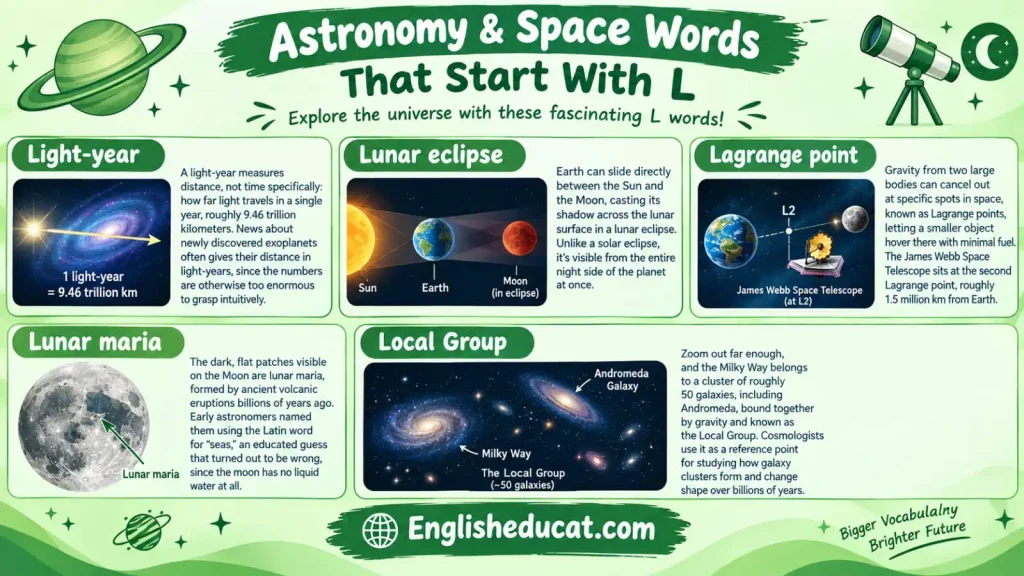
Lunar maria. Those dark, flat patches visible across the surface of the Moon are lunar maria, formed by ancient volcanic eruptions billions of years ago. Early astronomers named them using the Latin word for “seas,” an educated guess that turned out to be completely wrong, since the moon has no liquid water at all.
Local Group. Zoom out far enough, and the Milky Way belongs to a cluster of roughly 50 galaxies, including Andromeda, bound together by gravity and known as the Local Group. Cosmologists use it as a reference point for studying how galaxy clusters form and change shape over billions of years.
Libration. The moon appears to wobble slightly as seen from Earth, a phenomenon called libration, and it lets observers glimpse slightly more than half of the lunar surface over time rather than the fixed 50% you would expect. Amateur astronomers plan their best viewing nights around libration cycles, timing their telescopes for features that sit near the edge of the moon.
Earth Science Words That Start With L
Earth science rounds out the list with a practical, ground-level set of science words that start with L, most of them describing processes actively reshaping the planet.
Lava. Once molten rock breaks through the surface during a volcanic eruption, it is called lava, and it cools into igneous rock as it flows. Geologists draw the line between lava and magma based purely on location: identical material, different name, depending on whether it is still underground.
Lithosphere. The rigid outer shell of Earth, the crust plus the uppermost slice of mantle, makes up the lithosphere, broken into the tectonic plates responsible for continental drift. Seismologists watching for earthquake risk pay close attention to stress accumulating along the boundaries between these plates.
Latitude. Measured as angular distance north or south of the equator, latitude plays a major role in shaping a climate of region. Meteorologists cite latitude constantly to explain why two places at similar longitudes can experience wildly different weather.
Limestone. Built mainly from calcium carbonate, limestone is a sedimentary rock that often preserves visible fossils from the marine life that formed it millions of years ago. Construction crews use it heavily, both as raw building material and as a core ingredient in cement.
Landslide. Heavy rain, an earthquake, or even human excavation can trigger a landslide: a sudden, rapid movement of soil, rock, or debris down a slope. Disaster-preparedness agencies map landslide risk carefully across mountainous regions prone to sudden slope failure.
Leaching. Rainwater does not just soak into soil; it can carry dissolved nutrients downward with it, a process called leaching. Agricultural researchers track leaching closely, since heavy rainfall can strip valuable nutrients out of topsoil before crops get the chance to use them.
Littoral zone. Shallow water near a shoreline, where sunlight still reaches the bottom, is known as the littoral zone, and it supports some of the densest concentrations of aquatic life anywhere. Marine biologists rank it among the most ecologically productive habitats on Earth.
Loam. Farmers chase after loam for good reason; it is the ideal agricultural soil, a balanced mix of sand, silt, and clay that holds moisture while still draining properly. Gardeners actively amend poor soil to move it closer to a loam-like texture, since healthier root systems depend on it.
Advanced Science Words That Start With L
For readers ready to push past introductory vocabulary, this next set of science words that start with L leans into more specialized, discipline-specific territory.
Lepton. Electrons and neutrinos both belong to a category of fundamental particles called leptons, particles that, as far as physicists can tell, can not be broken down into anything smaller. Billions of leptons pass harmlessly through your body every second, and the Standard Model of particle physics treats them as one of the basic building blocks of matter, alongside quarks.
Logistic growth. Population growth rarely continues unchecked forever. Logistic growth describes the more realistic pattern: rapid expansion at first, followed by a slowdown as resources run short, producing a characteristic S-shaped curve. Wildlife ecologists build logistic growth models to estimate how many individuals a given habitat can actually support long-term.
Lentivirus. HIV belongs to a slow-acting family of retroviruses called lentiviruses, capable of lying dormant inside a host for years before triggering disease. Gene therapy researchers have also found a use for modified, non-pathogenic lentiviruses, repurposing them as delivery vehicles to insert therapeutic genes directly into patient cells.
Lyophilic and lyophobic. Whether a substance mixes easily with a surrounding liquid or resists it comes down to these two terms: lyophilic materials blend in readily, while lyophobic ones push back. Colloid chemistry depends on this distinction to explain why some suspensions stay stable indefinitely while others separate almost immediately.
Luminiferous. Mostly a historical footnote now, luminiferous means light-carrying, and it survives in scientific memory thanks to the discredited 19th-century idea of a “luminiferous ether,” a medium scientists once assumed light waves needed to travel through space. The famous Michelson-Morley experiment failed to detect any trace of it, a null result that helped clear the path toward Einstein’s theory of relativity.
Lamella. Thin, plate-like structures called lamellae (the plural form) change across wildly different fields, from the gill filaments of fish to the internal membranes stacked inside chloroplasts. Structural biologists studying bone tissue also use the term to describe the microscopic layered pattern that gives bone much of its strength.
Word-Game Reference: L Science Words by Letter Count
Solving a crossword or building a Wordle strategy around science vocabulary? This table sorts a handful of genuine science words that start with L by length.
| Letter Count | Examples |
| 4 letters | Lava, lens, load |
| 5 letters | Larva, laser, lever, lymph |
| 6 letters | Locus, litmus, ligand |
| 7 letters | Lobe(?), lichen, lysine, limnic |
| 8+ letters | Lipid bilayer, lithosphere, luminosity |
Confusable L-Words Worth Untangling
A handful of science words that start with L get mixed up constantly, usually because they sound alike or describe closely related ideas. This table clears up the most common mix-ups.
| Term Pair | The Difference |
| Lava vs. Magma | Same molten rock; magma underground, lava once it reaches the surface |
| Ligament vs. Tendon | Ligament connects bone to bone; tendon connects muscle to bone |
| Luminescence vs. Incandescence | Luminescence is light without heat; incandescence is light from heat |
| Latitude vs. Longitude | Latitude runs north-south from the equator; longitude runs east-west from the prime meridian |
| Lysosome vs. Ribosome | Lysosome breaks down cellular waste; ribosome builds proteins |
Why Learn Science Words That Start With L?
Building a working vocabulary of science words that start with L pays off in ways that go well beyond memorization drills. Textbooks and research articles rarely stop to define lipid, latitude, or luminosity; they assume you already know them, so a reader who is already comfortable with this vocabulary moves through dense material far more smoothly than someone stopping to look up every third word.
There is also a pattern worth noticing here. A handful of Latin and Greek roots unlock dozens of terms at once: learn that lyso- relates to breaking things down, leuko- means white, and litho- refers to stone, and suddenly lysosome, leukocyte, and lithosphere stop looking like disconnected vocabulary and start looking like pieces of the same puzzle. That kind of pattern recognition is what separates rote memorization from genuine scientific literacy.
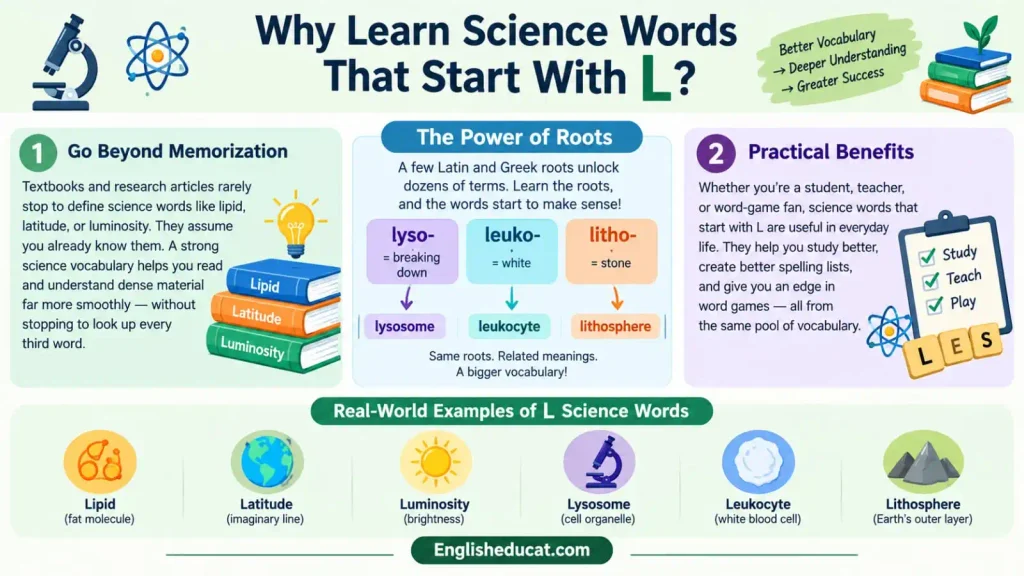
Practical motivations matter too. Students cramming for exams, teachers building spelling lists, and word-game players hunting for a five-letter science term are all drawing from the exact same pool of vocabulary, which is precisely why a single, well-organized reference on science words that start with L is worth bookmarking.
Frequently Asked Questions
What are some science words that start with L?
Common examples include laser, lipid, lithosphere, luminosity, larva, lever, and latitude terms spanning physics, biology, and earth science alike. The subject-by-subject breakdown above covers dozens more.
What is a 5-letter science word starting with L?
Larva, laser, and lever all fit the bill, along with lymph and lucid a useful shortlist for crossword and word-game solvers hunting specifically for science terms.
What is an easy science word that starts with L for kids?
Beginner-friendly options include leaf, lava, light, liquid, and lung concrete terms most students meet in elementary science before moving toward more technical vocabulary later on.
What does “lithosphere” mean in science?
The lithosphere is Earth’s rigid outer shell, combining the crust with the uppermost portion of the mantle. Broken into tectonic plates, its slow movement drives earthquakes, volcanic activity, and the gradual reshaping of continents across millions of years.
Why do so many science words start with L?
A large share of scientific vocabulary traces back to Latin, and Latin happens to be rich in L-words. Terms like lux (light), larva (mask or ghost), and locus (place) entered scientific use straight from Latin roots, which explains the letter’s outsized presence in specialized terminology today.
What is the difference between lava and magma?
They are the same molten rock material; only the location differs. It is magma while it is still underground, and it only becomes lava once it breaks through the surface during an eruption.
Conclusion
Few letters carry as much scientific weight as L. Lipid membranes hold your cells together; the lithosphere shifts quietly beneath your feet; a laser reshapes modern medicine one precise incision at a time; light-years separate us from galaxies we will never visit. Science words that start with L thread through nearly every branch of human knowledge, and that is no accident of the alphabet; it is a direct reflection of how deeply Latin’s vocabulary of light, place, and life shaped the way scientists still describe the world.
Whether a crossword clue brought you here, an upcoming biology exam did, or plain curiosity got the better of you, the terms in this guide were never meant to be memorized and forgotten. They are small keys, the kind that quietly unlock how scientists talk about lava flows, immune cells, distant starlight, and everything in between. Bookmark this page, revisit the confusable pairs whenever they trip you up, and the next time a science word starting with L crosses your path, you will already know exactly where it belongs.

Linguistics Specialist
James is a linguist with a Ph.D. in Applied Linguistics from Boston University. His work focuses on word origins, synonyms, and how language evolves over time. He has contributed to several academic journals on English semantics.