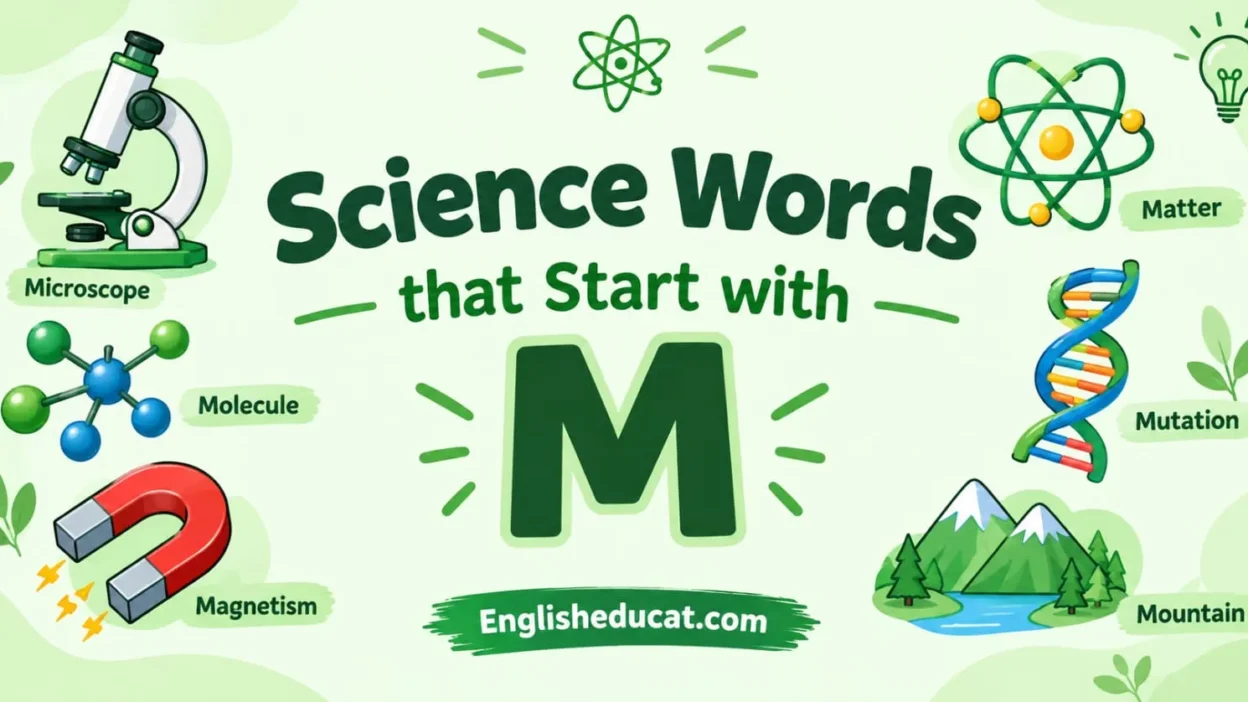
Few letters carry as much scientific weight as M. Mitochondria power every cell in your body, magnetism steers a compass needle, and the Milky Way stretches overhead on a clear night, all starting with the same letter. This collection of science words that start with M covers biology, chemistry, physics, astronomy, and earth science, pairing each term with a plain-language explanation and a real-world example sentence so the word sticks rather than just sitting on a page.
Whether you are cramming for an exam, filling out a vocabulary worksheet, or hunting for a good Scrabble play, this list of science words that start with M is organized so you can find exactly what you need, fast.
Why Does “M” Dominate Physics and Space Vocabulary?
Scan the list below, and a pattern jumps out: mass, momentum, motion, magnetism, and even the multiverse all begin with the letter M, and they all describe some form of movement or interaction. Space science follows the same thread: the moon, Mars, and the Milky Way share that initial too. This is not random.
Many of these science words that start with M trace back to Latin or Greek roots: momentum comes from the Latin word for “movement,” while magnet borrows from the Greek name for a stone found near the ancient city of Magnesia. That etymology helps explain why M sits at the center of so much force-and-motion vocabulary. It is very similar to other science words that start with N and O.
Biology Words That Start With M
Biology contributes a hefty share of science words that start with M, and several of these terms appear in nearly every introductory course.
Mitosis: the process by which one cell splits into two genetically matched copies. Your skin uses mitosis constantly, replacing damaged cells after even a minor scrape.
Meiosis: cell division that halves the chromosome count to build reproductive cells. Sperm and egg cells both trace their origin to meiosis.
Metabolism: the network of chemical reactions that keep a living thing running. Doctors sometimes point to a slower metabolism as one reason weight can creep up with age.
Mutation: an alteration in the genetic code of an organism. One lucky mutation was enough to make a bacterial strain resistant to a standard antibiotic.
Mammal: a warm-blooded vertebrate whose young feed on milk. Dolphins count as mammals despite spending their entire lives in the water.
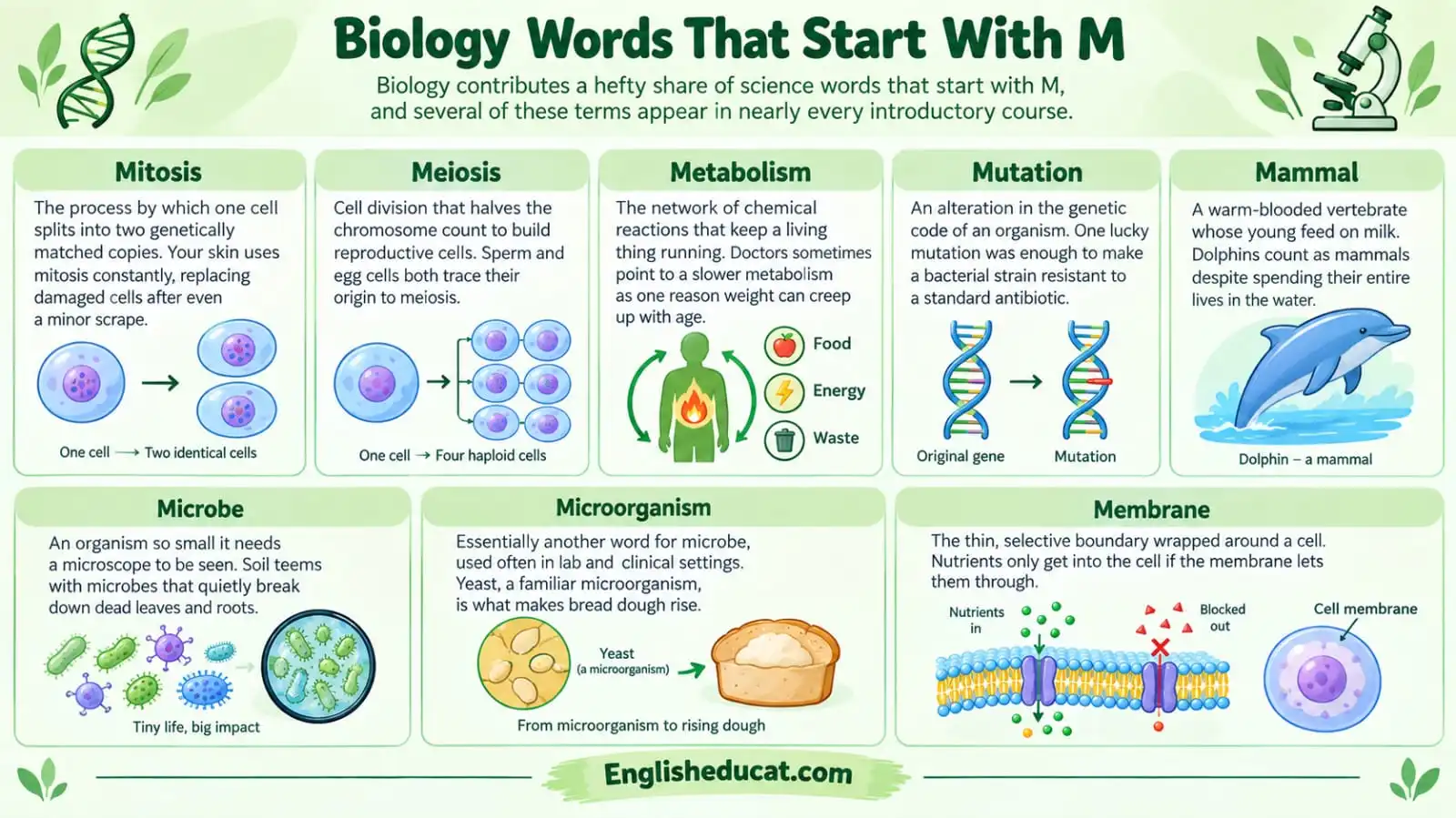
Microbe: an organism so small it needs a microscope to be seen. Soil teems with microbes that quietly break down dead leaves and roots.
Microorganism: essentially another word for microbe, used often in lab and clinical settings. Yeast, a familiar microorganism, is what makes bread dough rise.
Membrane: the thin, selective boundary wrapped around a cell. Nutrients only get into the cell if the membrane lets them through.
Mitochondria: the cell structures responsible for converting nutrients into usable energy. Muscle cells, which burn through energy quickly, tend to be packed with extra mitochondria.
Morphology: the branch of biology focused on the shape of an organism and physical layout. A close morphological comparison helped researchers sort the newly found beetle into the right family.
Mycelium: the underground web of threadlike fibers that forms a fungus’s main body. Long before any mushrooms poke through the soil, mycelium has already been spreading for weeks.
Myosin: a motor protein that muscle fibers rely on to contract. During a bicep curl, myosin filaments are busy sliding past strands of actin.
Mucus is a slick, protective fluid produced by certain body linings. Sneezing helps clear mucus that is trapping incoming dust and bacteria.
Multicellular: built from more than one cell working together. Trace a human body back far enough, and it is really trillions of cells cooperating a textbook case of multicellular life.
Microevolution: gradual genetic shifts that occur within a single species over generations. The changing wing color of peppered moths during industrial England is a classic microevolution case study.
Mutagen: any agent capable of raising the rate of genetic mutation. Skip the sunscreen long enough, and UV rays act as a mutagen on unprotected skin.
Mesoderm: the middle of the three layers found in an early-stage embryo. Bone and muscle both trace their developmental origin to the mesoderm.
Monocot: a flowering plant that sprouts with a single seed leaf. You can spot a monocot like corn by its narrow leaves and parallel veins.
Metastasis: the spread of cancerous cells from their original site to elsewhere in the body. Regular scans exist largely to catch metastasis before it advances too far.
Microbiology: the field of science devoted to studying microscopic organisms. It was microbiology research, in fact, that eventually led to the discovery of penicillin.
Metamorphosis: a striking physical transformation that occurs during the development of an organism. Few examples capture metamorphosis better than a caterpillar reemerging as a butterfly.
Microtubule: a slender protein filament that helps give a cell its structural shape. When a cell divides, microtubules are what physically pull the duplicated chromosomes apart.
Melanin is the pigment behind the color of skin, hair, and eyes. Spend an afternoon in the sun, and melanin production ramps up in response.
Muscle tissue built specifically to contract and generate movement. Unlike the muscles you can flex on command, cardiac muscle keeps contracting on its own, nonstop.
Mendelian: describing inheritance that follows the classic genetic ratios first identified by Gregor Mendel. Flower color in pea plants remains one of the cleanest examples of Mendelian inheritance taught in schools.
Microbiome: the collective community of microorganisms living in a particular environment, including inside the human body. Emerging research keeps tying the gut microbiome to things as varied as digestion and mood.
Macromolecule: an unusually large molecule, such as a protein or a full strand of DNA. DNA itself qualifies as a macromolecule, built from thousands of repeating nucleotide units strung together.
Mitosis vs. Meiosis, at a glance: Both processes split cells, but they exist for different reasons. Mitosis produces two identical copies for growth and repair, while meiosis cuts the chromosome number in half to create eggs or sperm. Under a microscope, the early steps look almost the same; the real difference only shows up in what each process is ultimately trying to accomplish.
Chemistry Words That Start With M
Chemistry hands over a heavy portion of science words that start with M, including several names you will recognize from the periodic table.
Molecule: two or more atoms held together by a chemical bond. Combine two hydrogen atoms with one oxygen atom, and you have built a water molecule.
Molarity: a way of expressing how concentrated a solution is, based on moles per liter. Lab protocols often call for a solution mixed to an exact molarity before an experiment can proceed.
Molality: solute concentration measured against the mass of the solvent rather than its volume. Because it is not affected by temperature swings, chemists reach for molality when precision really matters.
Mole: the standard unit chemists use to count out an amount of substance. One mole of carbon, oddly enough, contains 6.022 x 10²³ individual atoms.
Mixture: a physical blend of substances that have not undergone any chemical reaction. Stir sand into water, and you have got a mixture, not a new compound.
Metal: an element typically prized for conducting heat and electricity efficiently. Most household wiring relies on copper, a soft and highly conductive metal.
Metalloid: an element that straddles the line between metal and nonmetal behavior. Modern computing owes a lot to silicon, a metalloid at the heart of every processor chip.
Melting point: the exact temperature at which a solid transitions into liquid form. Ice reliably hits its melting point right at zero degrees Celsius.
Metallurgy: the applied science of extracting metals from ore and shaping them for use. Ancient metallurgy is arguably what allowed early societies to build both tools and weapons in the first place.
Monomer: a small, single molecule that links up repeatedly to form a longer polymer. Ethylene serves as the monomer behind ordinary polyethylene plastic.
Molecular bond: the attractive force keeping atoms locked together inside a molecule. When two atoms share a pair of electrons, that is a covalent molecular bond forming.
Miscible: a term for liquids that blend into one another with no separation. Pour rubbing alcohol into water, and the two are fully miscible, mixing at any ratio.
Molten: reduced to a liquid state through intense heat, usually said of rock or metal. Watching molten lava creep down a volcano’s slope is a slow but dramatic sight.
Mass spectrometry: a laboratory method used to identify substances based on the mass of their particles. Investigators used mass spectrometry to detect trace contaminants hiding in the water sample.
Molar mass: the total mass of one mole of a specific substance. Do the math, and you will find table salt has a molar mass close to 58.5 grams.
Methyl group: a small chemical unit consisting of one carbon atom bonded to three hydrogens. Attach a methyl group to the right spot on a molecule, and its behavior can shift dramatically.
Malleability: a metal’s capacity to be hammered or rolled into thin sheets without cracking. Jewelers favor gold precisely because its malleability allows for such fine, delicate detail.
Meniscus: the slightly curved surface a liquid forms when held in a narrow tube. Reading the meniscus at eye level is standard practice for an accurate volume measurement.
Molar volume: the amount of space occupied by exactly one mole of a substance. Under standard conditions, a gas typically settles into a molar volume of about 22.4 liters.
Several science words that start with M in chemistry are simply the names of elements worth knowing on sight if you are studying the periodic table:
| Element | Symbol | Quick Fact |
| Magnesium | Mg | Burns with an intensely bright white flame, often used in fireworks |
| Manganese | Mn | Added to steel to boost strength for construction and rail lines |
| Mercury | Hg | The only metal that remains liquid at room temperature |
| Molybdenum | Mo | Improves steel’s resistance to extreme heat |
Physics Words That Start With M
Physics may be where science words that start with M matter most, since mass, motion, and magnetism form the backbone of nearly everything in classical mechanics.
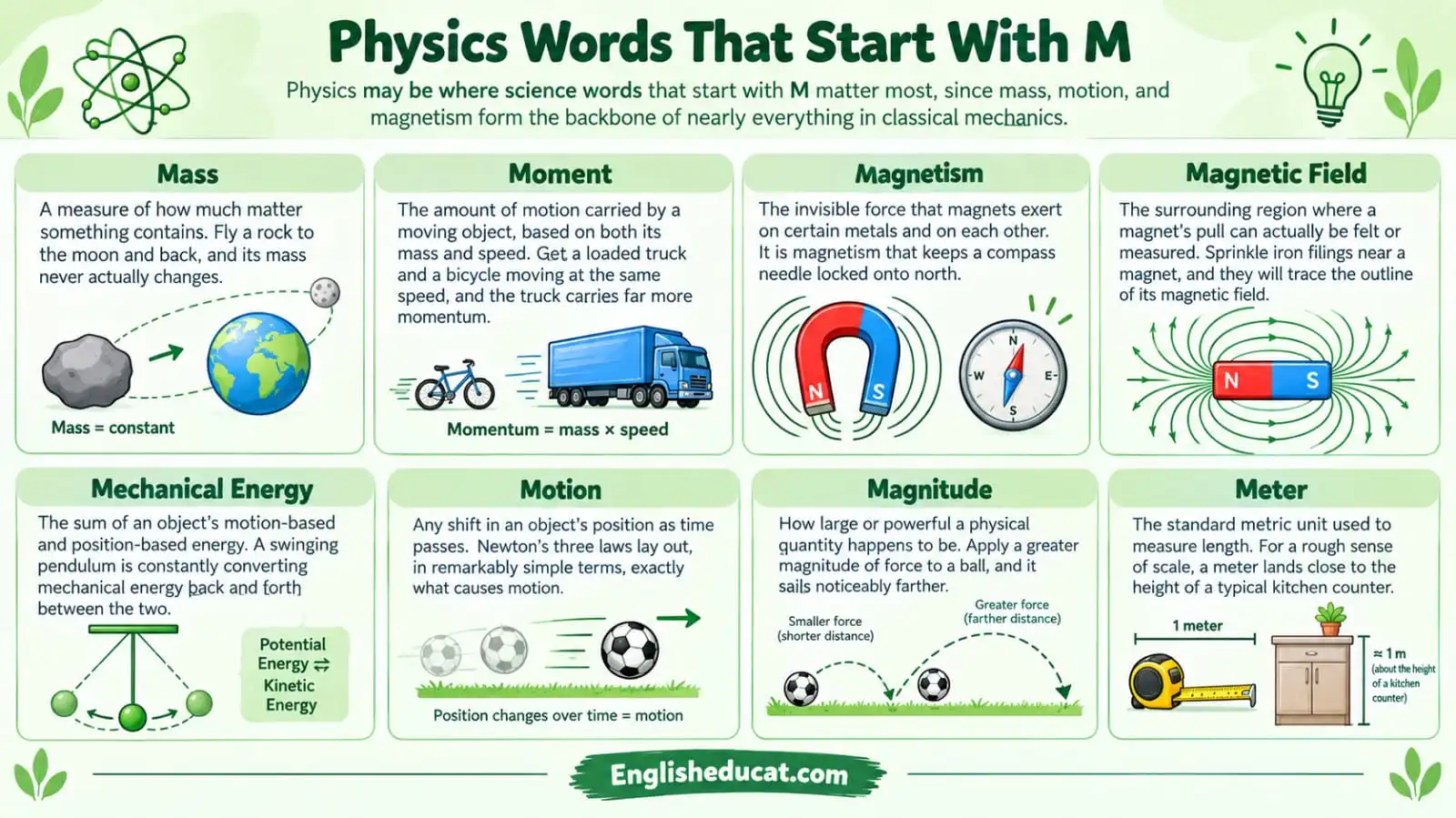
Mass: a measure of how much matter something contains. Fly a rock to the moon and back, and its mass never actually changes.
Moment the amount of motion carried by a moving object, based on both its mass and speed. Get a loaded truck and a bicycle moving at the same speed, and the truck carries far more momentum.
Magnetism: the invisible force that magnets exert on certain metals and on each other. It is magnetism that keeps a compass needle locked onto north.
Magnetic field: the surrounding region where a magnet’s pull can actually be felt or measured. Sprinkle iron filings near a magnet, and they will trace the outline of its magnetic field.
Mechanical energy: the sum of an object’s motion-based and position-based energy. A swinging pendulum is constantly converting mechanical energy back and forth between the two.
Motion: any shift in an object’s position as time passes. Newton’s three laws lay out, in remarkably simple terms, exactly what causes motion.
Magnitude: how large or powerful a physical quantity happens to be. Apply a greater magnitude of force to a ball, and it sails noticeably farther.
Meter: the standard metric unit used to measure length. For a rough sense of scale, a meter lands close to the height of a typical kitchen counter.
Microwave: a type of electromagnetic wave shorter than a radio wave but longer than infrared. Inside a microwave oven, these waves work by exciting the water molecules in food.
Magnetic flux: a measurement of how much magnetic field passes through a given surface. Changing the magnetic flux around a coil is precisely what induces an electric current in it.
Microgravity: an environment where the pull of gravity is barely noticeable. Astronauts drift freely through the space station thanks to microgravity.
Mass-energy equivalence: the principle that mass can be converted into energy, and vice versa. Einstein packaged mass-energy equivalence into one deceptively simple equation, E=mc².
Magnetic induction: the generation of a magnetic field as a byproduct of electric current. Every electric generator on the planet runs on this same principle of magnetic induction.
Mach number: a ratio comparing an object’s velocity to the speed of sound. Cruise at Mach 2, and a jet is moving twice as fast as sound travels.
Mass defect: a slight, measurable loss of mass converted directly into energy inside an atomic nucleus. Nuclear reactors extract usable power from exactly this kind of mass defect.
Moment of inertia: a measure of how strongly an object resists changes to its rotation. Pull the arms in tight, and a figure skater’s moment of inertia drops instantly, speeding up the spin.
Magnetic dipole: a pairing of two opposite magnetic poles acting as a single unit. An ordinary bar magnet is about as clean an example of a magnetic dipole as physics offers.
Medium: whatever physical material a wave passes through on its way somewhere. Because sound needs a medium to travel, it can not cross the vacuum of space at all.
Magnification: the extent to which an image is enlarged for closer viewing. Crank up the magnification on a microscope, and individual bacterial cells suddenly come into focus.
Monochromatic light is made of a single, pure wavelength rather than a mix. Unlike the scattered light from a bulb, laser beams are monochromatic by design.
Mass vs. Momentum: These two often get tangled together, but they are not the same thing. Mass is fixed; it’s simply how much matter an object contains, while momentum shifts constantly, since it depends on both mass and how fast something is moving.
Astronomy & Space Words That Start With M
Look up at night, and you will find some of the most recognizable science words that start with M, several of which are visible without any special equipment.
Milky Way: the galaxy that our entire solar system calls home. On a dark, rural night, the Milky Way appears as a faint band stretching clear across the sky.
Meteor: a chunk of space debris that burns up upon hitting Earth’s atmosphere. A meteor lit up the sky for barely a second just after sunset.
Meteorite: whatever’s left of a meteor once it actually reaches the ground. Scientists pored over the meteorite for clues about conditions in the early solar system.
Meteoroid: a small rocky fragment still drifting through space, not yet inside the atmosphere. The instant a meteoroid enters the atmosphere, it earns the new label “meteor.”
Moon: a natural body that orbits a planet. Earth’s own moon is largely responsible for the rhythm of ocean tides.
Mars: the fourth planet out from the Sun, often called the Red Planet. Rovers exploring Mars have spent years hunting for signs that water once flowed there.
Magnetosphere: the protective zone shaped by a planet’s magnetic field. Earth’s magnetosphere deflects the bulk of the charged particles streaming out from the Sun.
Main-sequence star: a star actively fusing hydrogen into helium at its core. Our own Sun qualifies as a main-sequence star, roughly halfway through its expected lifespan.
Meteor shower a burst of meteors that all appear to radiate from one point in the sky. Stargazers circle their calendars every August for the reliably strong Perseid meteor shower.
Mesosphere: the layer of atmosphere sitting just above the stratosphere. Nearly all incoming meteors burn up completely somewhere within the mesosphere.
Micrometeorite: a meteorite so small it is often nearly microscopic. Micrometeorites drift down onto Earth constantly, almost always without anyone noticing.
Molecular cloud: a dense pocket of interstellar gas dense enough to eventually birth new stars. Astronomers have caught young stars igniting inside collapsing molecular clouds.
Moonquake: a tremor detected beneath the lunar surface. Seismic instruments left behind by Apollo missions picked up several moonquakes over the years.
Meridian: an imaginary reference line used to pinpoint a celestial or geographic location. Observatory logs noted the precise moment the star crossed the meridian overhead.
Martian: relating specifically to the planet Mars. Dust storms on the Martian surface have been known to rage on for weeks at a stretch.
Multi-stage rocket: a rocket engineered to jettison spent sections mid-flight. Shedding empty fuel tanks along the way is exactly what makes a multi-stage rocket so much more efficient.
Meteor, Meteorite, or Meteoroid? The distinction comes down entirely to location and timing. A meteoroid is still out in space, a meteor is that same object streaking through the atmosphere, and a meteorite is whatever piece survives the trip down to solid ground.
Earth & Environmental Science Words That Start With M
This branch closes out the list of science words that start with M with terms that have roots in geology, weather patterns, and environmental science.
Magma: molten rock churning beneath Earth’s crust. Long before it ever erupts as lava, magma pushes its way upward through underground vents.
Mantle: the dense, thick layer of Earth sandwiched between the crust and the core. Slow-moving convection currents inside the mantle are what drag tectonic plates around the globe.
Mineral: a naturally formed, non-living solid with a fixed internal crystal structure. Granite owes much of its sparkle to quartz, one of the most common minerals around.
Monsoon: a seasonal shift in wind direction that reliably triggers heavy rain. India depends heavily on the monsoon for the majority of its yearly rainfall.
Microclimate: a localized climate that differs from the broader region surrounding it. A shaded courtyard, oddly enough, can develop its own noticeably cooler microclimate.
Metamorphic rock: rock reshaped by intense heat and pressure over long stretches of time. Marble begins its life as ordinary limestone before pressure turns it into metamorphic rock.
Mid-ocean ridge: an underwater mountain range formed where the seafloor is actively spreading apart. Fresh oceanic crust is born continuously along the mid-ocean ridge.
Mass extinction: a rapid, catastrophic decline in species across the planet. A colossal asteroid strike is the leading theory behind the mass extinction that wiped out the dinosaurs.
Mudflat: a stretch of muddy shoreline left exposed once the tide pulls back. Shorebirds pick through the exposed mudflat, hunting for buried invertebrates.
Marsh: a wetland thick with grasses and reeds rather than trees. A healthy marsh quietly filters out pollutants long before they ever reach open water.
Mulch: organic material spread across soil to keep moisture locked in. Gardeners layer on mulch to hold water in the ground and crowd out weeds.
Mitigation: deliberate steps taken to lessen the damage from a hazard or disaster. Restoring wetlands is one common mitigation strategy against seasonal flooding.
Migration: the seasonal back-and-forth movement of animals between habitats. Monarch butterflies pull off a migration so long it actually spans multiple generations.
Mangrove: a salt-tolerant tree species that roots itself along tropical coastlines. Tangled mangrove roots act as a natural buffer against storm surges.
Methane: a greenhouse gas released heavily by livestock and organic decay. Pound for pound, methane traps considerably more heat than carbon dioxide does.
Meteorology: the scientific discipline devoted to studying weather and the atmosphere. Modern meteorology leans heavily on satellite imagery to track storms before they hit.
Microplastic: a minuscule fragment of plastic that has broken down into the environment. Microplastic has now been detected in ocean samples pulled from nearly every depth.
Monoculture: an agricultural approach centered on growing just one crop across a wide area. A single pest outbreak can devastate an entire field under monoculture farming.
Mineralogy: the branch of science focused specifically on minerals and their properties. Mineralogy allowed geologists to trace a rock sample straight back to its volcanic source.
Moraine: a pile of rocky debris left behind as a glacier retreats. The moraine sitting in the valley marks exactly how far the glacier once extended.
Advanced M-Words: A Bonus for Serious Learners
These eight terms move past the introductory level and appear far more often in graduate coursework or specialized research than in a typical classroom.
Mesophile: an organism whose ideal environment sits at a moderate, not extreme, temperature range. Most bacteria capable of making humans sick happen to be mesophiles.
Magnetostriction: a shape change that certain materials undergo when exposed to a magnetic field. Engineers exploit magnetostriction to build specialized sonar components.
Metachromasia: a color shift some dyes display once they bind to particular tissue types. Metachromasia gave researchers a clear visual marker for spotting mast cell granules under a microscope.
Muon: a subatomic particle closely related to the electron, but with far greater mass. Cosmic rays constantly generate muons that rain down onto Earth’s surface.
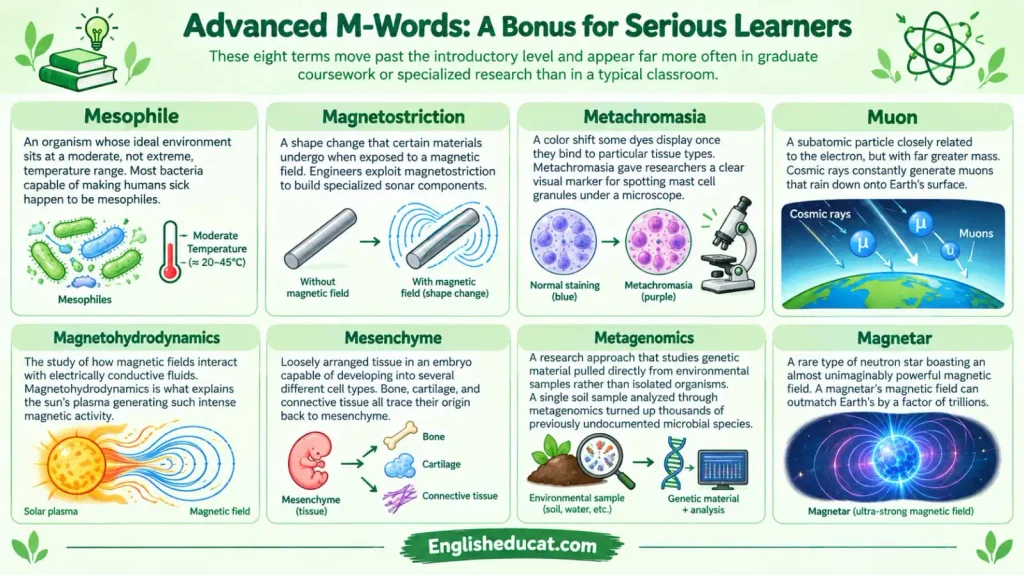
Magnetohydrodynamics: the study of how magnetic fields interact with electrically conductive fluids. Magnetohydrodynamics is what explains the sun’s plasma generating such intense magnetic activity.
Mesenchyme: loosely arranged tissue in an embryo capable of developing into several different cell types. Bone, cartilage, and connective tissue all trace their origin back to mesenchyme.
Metagenomics is a research approach that studies genetic material pulled directly from environmental samples rather than isolated organisms. A single soil sample analyzed through metagenomics turned up thousands of previously undocumented microbial species.
Magnetar a rare type of neutron star boasting an almost unimaginably powerful magnetic field. A magnetar’s magnetic field can outmatch Earth’s by a factor of trillions.
Why Learn Science Words That Start With M?
Building familiarity with science words that start with M pays off in ways that go beyond a vocabulary quiz. Once you recognize that momentum, magnetism, and metabolism are all, in their own way, describing force or change, dense textbook passages start feeling far less intimidating.
Teachers often lean on this particular letter because it is unusually rich in cross-subject terms; a student who can confidently explain mitosis, molecule, and magnetosphere has just touched biology, chemistry, and astronomy in the span of three words.
There is a practical payoff, too. Standardized tests draw disproportionately from exactly this kind of foundational vocabulary, and professionals who communicate science for a living journalists, museum educators, textbook authors depend on precise terms like mutation or magnitude to keep their explanations accurate instead of vague.
Spend real time with a full list of science words that start with M, and the goal shifts from rote memorization toward something more useful: picking up the working vocabulary that researchers, teachers, and science writers actually rely on every day.
Frequently Asked Questions
What is a science word that starts with M?
Molecule, mitosis, and magnetism are three widely used examples. Each one is a foundational concept introduced early in biology, chemistry, or physics courses.
What are 10 science words that start with M?
Ten common picks include matter, mass, molecule, mutation, mitosis, magnetism, metabolism, microbe, meteor, and mineral. Between them, they touch biology, chemistry, physics, and astronomy.
What is the most important M science word in physics?
Mass has a strong claim, since it underlies calculations involving momentum, force, and gravity alike. It measures how much matter an object holds, regardless of where that object happens to be.
What is the difference between a meteor, a meteorite, and a meteoroid?
The difference is purely about stage and location. A meteoroid is still traveling through space, a meteor is that same object burning up in the atmosphere, and a meteorite is whatever survives long enough to hit the ground.
What is a rare or advanced science word that starts with M?
Magnetohydrodynamics and metagenomics both fit the bill, since neither typically appears outside specialized research settings. One studies magnetic behavior in fluids like plasma; the other studies genetic material collected directly from the environment.
How many science words start with the letter M?
Hundreds of scientific terms begin with M once you count every discipline, though a practical study list usually settles somewhere between 100 and 150 commonly used terms. This guide organizes 125 of them by branch, plus 8 advanced picks for anyone ready to go further.
Conclusion
Somewhere between the mitochondria humming away in your own cells and a magnetar sitting thousands of light-years distant, the letter M has quietly worked its way into nearly every corner of science. That is really the payoff of working through a list like this one: science words that start with M stop feeling like flashcard fodder and start appearing everywhere you look, in a news story about methane emissions, in a doctor’s offhand comment about metabolism, in the next meteor shower lighting up the sky above your house.
Vocabulary like this was never meant to sit still on a page. Pick a handful of these terms, try using them out loud today, and watch how quickly this list stops feeling like a wall of words and starts feeling like a language you already know how to speak.

ESL Content Writer
Emily is a TESOL-certified writer who has taught English to international students for over 8 years. She loves breaking down idioms and everyday expressions into simple, relatable explanations that make sense to learners at any level.