

X is the letter that is least used to open an English word, but in science there are many science words that start with X. Almost every word that starts with X traces back to one of two Greek roots: xeno- (“foreign”) and xero- (“dry”). Learn those two building blocks, and unfamiliar terms start making sense at a glance: a desert plant, a compound with no business in the human body.
This guide contains 117 real science words that start with X, sorted into five branches: biology, chemistry, physics, astronomy, and earth science, and also a bonus section of eight advanced terms. Each entry gets a plain-language definition and an example sentence, organized by subject rather than buried in one long alphabetical dump.
Why X-Ray Words Dominate the Letter X in Science
Roughly one in five science words here is built on “X-ray,” and that is no accident. There are many words in X-ray science words that start with X. When Wilhelm Röntgen discovered this radiation in 1895, he had no idea what it was, so he labeled it “X” for unknown. The name stuck, and every field that later adopted X-ray technology medicine, astrophysics, materials science inherited that letter with it.
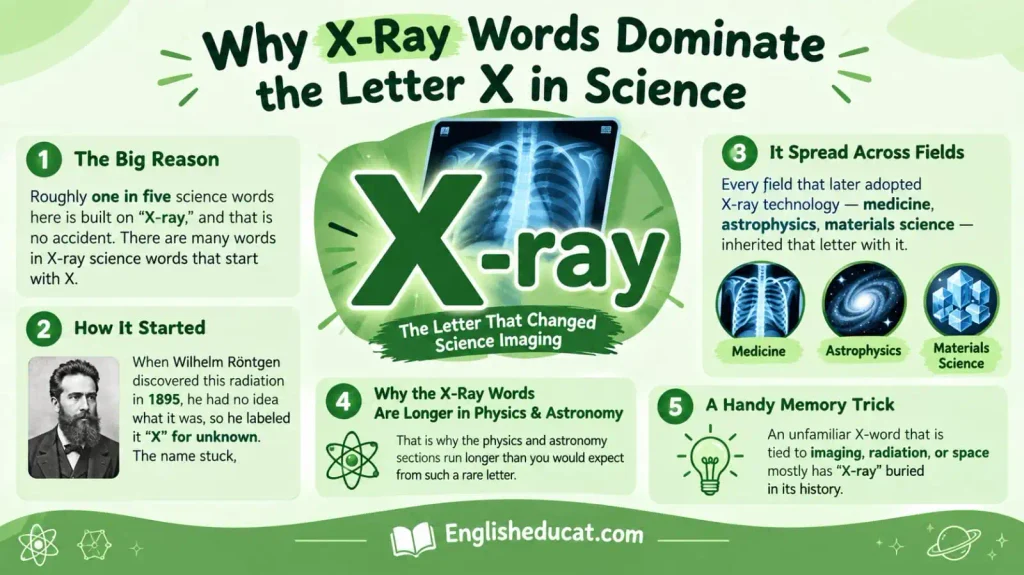
That is why the physics and astronomy sections run longer than you would expect from such a rare letter. It is also a handy memory trick: an unfamiliar X-word that is tied to imaging, radiation, or space mostly has “X-ray” buried in its history. You can also learn other science words like Y and Z.
Biology Words That Start With X
Biology contributes more X-words than any other branch, mostly built on the same two ideas: dryness (xero-) in desert-adapted plants, and foreignness (xeno-) in transplants, foreign chemicals, and genetics. Botany courses usually introduce xylem early, right alongside phloem, since the two tissues work as a pair to move water and nutrients through a plant. It is the term that contains most science words that start with X.
| Term | Definition | Example Sentence |
| Xylem | Plant tissue that pulls water and minerals up from the roots. | The xylem carried water from the roots to the leaves. |
| Xylem vessel | A hollow xylem cell that channels water upward. | Under the microscope, we traced a single xylem vessel. |
| Xylem parenchyma | Living cells within xylem tissue that store food reserves. | Xylem parenchyma cells store starch reserves in winter. |
| Xylem sap | The mineral-laden water moving upward through a plant’s xylem. | Xylem sap rises fastest on hot, dry afternoons. |
| Xerophyte | A plant built to get by on very little water. | Cacti are classic xerophytes found in desert biomes. |
| Xerophytic adaptation | A physical feature that helps a plant hold onto water in a dry climate. | Thick waxy cuticles are a common xerophytic adaptation. |
| Xerophile | An organism that does best in extremely dry conditions. | Certain fungi are xerophiles that grow on stored grain. |
| Xerophilic | Suited to, or thriving in, dry habitats. | Xerophilic bacteria can survive in salt flats. |
| Xanthophyll | A yellow pigment present in leaves and flowers, often masked by chlorophyll. | Xanthophyll becomes visible once chlorophyll breaks down in fall. |
| Xanthophyte | An alga belonging to the yellow-green algae group. | The biologist classified the sample as a xanthophyte species. |
| Xylan | A polysaccharide that makes up much of the hemicellulose in plant cell walls. | Xylan makes up a large part of straw’s fiber content. |
| Xyloglucan | A hemicellulose that helps bind cellulose fibers into a stable cell wall. | Xyloglucan helps bind cellulose fibers together in the wall. |
| Xylose | A simple sugar pulled from wood pulp and plant fiber. | Xylose is extracted from corn cobs for sweetener production. |
| Xylitol | A sugar alcohol used as a low-calorie sweetener. | Xylitol is common in sugar-free chewing gum. |
| Xenobiotic | Any chemical foreign to an organism’s normal biology. | The liver metabolizes xenobiotics like drugs and pesticides. |
| Xenobiology | The study of biological systems that don’t occur in nature as we know it. | Xenobiology explores life built from alternative genetic codes. |
| Xenograft | A tissue or organ transplant taken from a different species. | Doctors tested a pig heart xenograft in the patient. |
| Xenotransplantation | The practice of transplanting organs or tissue across species lines. | Xenotransplantation could help solve the organ donor shortage. |
| Xenogeneic | Cells or tissue coming from a different species. | The immune system quickly rejected the xenogeneic graft. |
| X chromosome | One of the two sex chromosomes carried by many species. | Females typically inherit one X chromosome from each parent. |
| X-linked inheritance | An inheritance pattern controlled by genes on the X chromosome. | Color blindness follows an X-linked inheritance pattern. |
| X-inactivation | The process that shuts down one X chromosome in each female cell. | X-inactivation ensures females don’t overexpress X-linked genes. |
| Xenopus | A genus of African clawed frog used in lab research. | Xenopus embryos are popular models in developmental biology. |
| Xerostomia | The clinical term for chronic dry mouth. | Certain medications can cause xerostomia as a side effect. |
| Xerophthalmia | An eye condition caused by a severe lack of vitamin A. | Untreated xerophthalmia can eventually lead to blindness. |
| Xiphoid process | The small piece of cartilage capping the bottom of the sternum. | The xiphoid process can be felt just below the ribs. |
| Xylophagous | Wood-eating typically describing insects like termites. | Termites are xylophagous insects that damage wooden structures. |
Two of these appears well outside the classroom. Xenotransplantation is an active research area; surgeons have already tested genetically modified pig organs in human patients as a possible fix for organ shortages. Xenobiotic metabolism is standard pharmacology vocabulary that describes how the liver handles everything from prescription drugs to pollutants.
Chemistry Words That Start With X
X words in chemistry usually split into two families: xenon-based compounds and xylene-based solvents. For many years, scientists assumed noble gases simply could not form chemical bonds until researchers synthesized the first xenon compound in 1962 and rewrote that assumption.
| Term | Definition | Example Sentence |
| Xenon | A colorless, odorless noble gas used in lighting and lasers. | Xenon fills the bulbs of high-intensity car headlights. |
| Xenon difluoride | A reactive xenon compound used as a fluorinating agent. | Xenon difluoride is used to etch silicon in manufacturing. |
| Xenon trioxide | An unstable, explosive oxide of xenon and oxygen. | Xenon trioxide must be handled with extreme caution in labs. |
| Xenon tetroxide | A yellow, unstable compound of xenon and oxygen. | Xenon tetroxide decomposes rapidly at room temperature. |
| Xenon hexafluoroplatinate | The first noble gas compound ever synthesized, in 1962. | Xenon hexafluoroplatinate proved that noble gases could react chemically. |
| Xylene | A flammable hydrocarbon used as an industrial solvent. | Xylene is commonly used to thin paints and varnishes. |
| Xylenol | A phenol compound used in making disinfectants. | Xylenol derivatives appear in several antiseptic formulas. |
| Xylenol orange | An indicator used to detect metal ions in titration. | Xylenol orange changes color when it binds to certain metals. |
| Xylidine | An organic compound used in dye manufacturing. | Xylidine is a precursor in several agricultural chemical processes. |
| Xanthate | A salt or ester used to separate metals from raw ore. | Xanthate reagents help float minerals away from waste rock. |
| Xanthene | An organic compound that serves as a base structure for dyes. | Xanthene derivatives are used to make fluorescent dyes. |
| Xanthone | Organic compounds found in some plant extracts. | Xanthone compounds are studied for their antioxidant properties. |
| Xanthoproteic reaction | A nitric-acid test that flags the presence of protein. | The xanthoproteic reaction turned the sample yellow, confirming protein. |
| Xanthine | A purine compound found naturally in tea, coffee, and the human body. | Xanthine is broken down into uric acid by the body. |
| Xanthine oxidase | The enzyme responsible for converting xanthine into uric acid. | Xanthine oxidase inhibitors are used to treat gout. |
| Xerogel | A dry, porous solid left behind once a gel’s liquid evaporates away. | The xerogel retained its shape after the solvent evaporated. |
| Xylose isomerase | An enzyme that converts glucose into fructose. | Xylose isomerase is key to producing high-fructose corn syrup. |
| Xylitol dehydrogenase | An enzyme converting xylitol into xylulose. | Xylitol dehydrogenase plays a role in microbial sugar metabolism. |
| Xylulose | A short-lived sugar intermediate in glucose metabolism pathways. | Xylulose appears briefly during the pentose phosphate pathway. |
| Xanthogenate | A salt used as a collector in mineral flotation processing. | Xanthogenate compounds help separate copper ore from waste material. |
| Xylene cyanol | A tracking dye used in gel electrophoresis. | Xylene cyanol helped researchers monitor the gel’s progress. |
| Xanthic | A yellowish tint in a chemical compound. | The xanthic tint suggested the presence of a specific pigment. |
| Xerographic toner | Fine powder used in dry, ink-free photocopying. | Xerographic toner fuses to paper using heat and pressure. |
Anyone who has had routine blood work has brushed up against xanthine oxidase; it is the enzyme that gout medications like allopurinol are built to block. Xylene cyanol, meanwhile, is a fixture in any lab running gel electrophoresis, tracking the progress of a sample through the gel.
Physics Words That Start With X
Physics holds the largest share of X-ray vocabulary here of science words that start with X, fitting since X-rays were discovered by a physicist experimenting with cathode ray tubes. These terms span hospital diagnostic equipment to the lasers driving cutting-edge materials research.
| Term | Definition | Example Sentence |
| X-ray | High-energy electromagnetic radiation that passes through solid matter. | Doctors used an X-ray to check for a broken bone. |
| X-ray diffraction | A technique for mapping crystal structure by scattering X-rays. | X-ray diffraction revealed the mineral’s atomic arrangement. |
| X-ray crystallography | A method for mapping the atomic layout inside a crystal. | X-ray crystallography helped scientists map the protein’s shape. |
| X-ray spectroscopy | A technique reading X-ray signatures to identify elements. | X-ray spectroscopy confirmed traces of iron in the sample. |
| X-ray photoelectron spectroscopy | A surface technique measuring emitted electron energy. | X-ray photoelectron spectroscopy revealed the surface’s chemical composition. |
| X-ray fluorescence | The X-rays a material re-emits after absorbing incoming radiation. | X-ray fluorescence identified the metal content of the artifact. |
| X-ray tube | A device that generates X-rays for imaging or research. | The X-ray tube produced a steady beam for the scan. |
| X-ray laser | A laser that fires coherent beams of X-ray radiation. | The X-ray laser captured images of ultrafast chemical reactions. |
| X-ray interferometry | A technique combining X-ray waves to measure tiny distances. | X-ray interferometry detected nanometer-scale shifts in the sample. |
| X-ray scattering | The way X-rays bend and deflect as they pass through atoms. | X-ray scattering patterns revealed the material’s internal structure. |
| X-ray absorption | How much X-ray energy a material soaks up as the beam passes through. | X-ray absorption levels helped identify the sample’s density. |
| X-ray emission | X-ray photons released by an atom after it’s been excited. | X-ray emission spectra can reveal an element’s identity. |
| X-band | A range of microwave frequencies commonly used in radar systems. | Weather radars often operate within the X-band frequency range. |
| X-ray optics | The branch of physics concerned with focusing and steering X-rays. | X-ray optics allow telescopes to sharpen faint cosmic signals. |
| X-ray reflectivity | A measurement of how a surface bounces back incoming X-rays. | X-ray reflectivity measured the thin film’s exact thickness. |
| X-ray microscope | An instrument using X-rays to image extremely fine structures. | The X-ray microscope revealed details invisible to optical lenses. |
| Xenon ion engine | A spacecraft thruster powered by charged xenon particles. | The xenon ion engine propelled the probe efficiently through space. |
| Xenon flash lamp | A light source that fires brief, brilliant pulses of light. | The xenon flash lamp captured the object mid-motion. |
| Xenon plasma | Xenon gas heated into a glowing, ionized state. | Xenon plasma glows brightly inside specialized lamp bulbs. |
| X-ray photon | A single particle carrying X-ray electromagnetic energy. | Each X-ray photon carries far more energy than visible light. |
| X-ray Compton scattering | A collision where an X-ray loses energy to an electron. | X-ray Compton scattering helped confirm the photon’s particle nature. |
| X-ray free electron laser | A machine producing extremely bright, ultra-short X-ray pulses. | The X-ray free electron laser filmed a chemical bond breaking. |
| Xerography | The dry copying process behind photocopiers. | Xerography made office photocopying fast and ink-free. |
X-ray crystallography is worth knowing; it is the technique behind the diffraction images, captured by Rosalind Franklin’s lab, that pointed Watson and Crick toward the double helix structure of DNA. It is still the go-to method for working out a new drug molecule’s shape today.
Astronomy and Space Science Words That Start With X
In astronomy, nearly every X-word points to something emitting X-rays, and X-rays only come from the most violent events of the universe: feeding black holes, fast-spinning neutron stars, colliding galaxies. Earth’s atmosphere blocks X-rays before they reach the ground, so this field runs entirely on space-based telescopes.

| Term | Definition | Example Sentence |
| X-ray astronomy | The study of celestial objects that give off high-energy X-rays. | X-ray astronomy revealed hidden black holes in nearby galaxies. |
| X-ray binary | A star system where one member emits X-rays. | In an X-ray binary, gas falls from one star to another. |
| X-ray burster | A neutron star that lets off sudden, intense bursts of X-rays. | The X-ray burster flared briefly before fading from view. |
| X-ray pulsar | A rotating neutron star sweeping out beams of X-ray radiation. | The X-ray pulsar spun rapidly, sweeping its beam past Earth. |
| X-ray telescope | A space-based instrument built to detect and focus incoming X-rays. | The orbiting X-ray telescope mapped hot gas in the cluster. |
| X-ray background | A faint, diffuse glow of X-rays detected across the entire sky. | Scientists studied the X-ray background for hints of distant quasars. |
| X-ray transient | A sudden, short burst of X-ray emission from space. | Astronomers rushed to observe the newly detected X-ray transient. |
| X-ray nova | A once-quiet star system that abruptly starts emitting X-rays. | The X-ray nova brightened dramatically within just a few days. |
| X-ray flare | A sudden eruption of X-rays from a star’s outer atmosphere. | The solar X-ray flare disrupted radio signals on Earth. |
| X-ray source | Any object in space flagged as an emitter of X-rays. | The satellite catalogued dozens of new X-ray sources. |
| X-ray quasar | A distant, highly active galaxy emitting strong X-rays. | The X-ray quasar’s brightness suggested a massive black hole. |
| X-ray cluster | A group of galaxies bound together by hot, X-ray-emitting gas. | The X-ray cluster revealed gas heated to millions of degrees. |
| X-ray jet | A narrow, high-energy beam of X-rays shot out by a black hole. | The X-ray jet stretched thousands of light-years into space. |
| X-ray timing | Tracking the precise pulse periods of a spinning neutron star. | X-ray timing confirmed the pulsar’s incredibly steady rotation rate. |
| X-ray observatory | A space facility dedicated to studying cosmic X-rays. | The orbiting X-ray observatory monitored several active galaxies. |
| X-ray corona | The hot, X-ray-glowing region that surrounds a black hole. | The X-ray corona flickered as material spiraled inward. |
| X-ray spectrometer | An onboard satellite instrument that measures X-ray wavelengths. | The probe’s X-ray spectrometer identified elements in the nebula. |
| X-ray reverberation | A time-delay pattern in X-ray light reflected off nearby gas. | X-ray reverberation mapping showed gas orbiting close to the black hole. |
NASA’s Chandra X-ray Observatory, running since 1999, is the real-world instrument behind most of these terms; its data lets astronomers pick out X-ray binaries and pulsars no ground-based telescope could ever catch.
Earth and Environmental Science Words That Start With X
Earth science words that start with X lean almost entirely on the xero- root: dry habitats, dry soils, and the occasional rare mineral. Most appear more in soil science and ecology coursework than in a general earth-science textbook.
| Term | Definition | Example Sentence |
| Xeric | Describes a habitat or climate that runs very dry. | Cacti thrive in xeric regions with minimal rainfall. |
| Xeriscape | A landscaping style built around minimizing water use. | The xeriscape garden used gravel and native drought-tolerant plants. |
| Xeriscaping | The practice of landscaping around drought-resistant plants and low-water design. | Xeriscaping helped the city cut outdoor water use significantly. |
| Xerification | A region’s gradual drift toward a drier climate. | Xerification threatens grasslands as rainfall patterns shift. |
| Xenolith | A rock fragment trapped inside a different host rock. | The xenolith offered clues about Earth’s deep mantle. |
| Xenocryst | A crystal in rock that didn’t form there originally. | Geologists identified a xenocryst embedded in the volcanic rock. |
| Xerothermic | Warm and dry at once — used to describe a climate or period. | The xerothermic period reshaped vegetation across the region. |
| Xerarch succession | Ecological succession that starts out on dry ground. | Xerarch succession starts on bare rock and progresses toward forest. |
| Xerosere | A sequence of plant communities developing in a dry environment. | The xerosere began with lichens colonizing bare stone. |
| Xylite | Fossilized wood partway through turning into mineral. | Xylite deposits revealed ancient forest remains in the coal seam. |
| Xenotime | A rare-earth phosphate mineral often used in radiometric dating. | Xenotime crystals helped researchers date the rock formation. |
| Xeralf | A soil type common in Mediterranean climates. | Xeralf soils support olive groves across the region. |
| Xeric shrubland | A habitat of low, drought-adapted bushes. | Xeric shrubland stretched across the arid hillside. |
| Xeric woodland | A sparse forest of drought-tolerant trees. | The xeric woodland supported pinyon pines and junipers. |
| Xeromorphic soil | Soil shaped by long-term dry-climate weathering. | Xeromorphic soil formed after centuries of low rainfall. |
| Xerocole | An organism whose entire life cycle plays out during the dry season. | The xerocole insect emerges only after seasonal rains end. |
| Xylotomy | Preparing wood sections for microscopic study. | Xylotomy techniques help identify ancient tree species from fossils. |
| Xeric adaptation | Any trait that helps an organism survive in a dry habitat. | Deep root systems are a common xeric adaptation. |
Xeriscaping has drifted past academic vocabulary; cities across the drought-prone American Southwest now offer cash rebates to homeowners who swap lawns for xeriscaped yards, making it one of the rare X-words with real money attached.
Advanced and Rare X-Words
These eight sit above intro level, worth knowing for advanced study, a spelling bee, or a genuine challenge.
| Term | Definition | Example Sentence |
| Xenomorphism | Mineral crystals that never developed their own defined faces. | Xenomorphism occurs when a mineral crystallizes without free growth space. |
| Xanthelasma | Yellowish, cholesterol-rich deposits that form on the eyelids. | The dermatologist identified xanthelasma linked to high cholesterol. |
| Xanthopsia | A visual disturbance that makes everything look tinted yellow. | Xanthopsia can be a side effect of certain medications. |
| Xerocline | A dry-facing slope receiving less moisture than its surroundings. | The south-facing xerocline supported only sparse, drought-hardy plants. |
| Xenotropic virus | A virus that can only infect cells of a different species than its original host. | The xenotropic virus could not replicate in its original host species. |
| Xiphisternum | An alternate name for the sternum’s lower cartilage tip. | The xiphisternum ossifies gradually as a person ages. |
| Xerophily | An organism’s ecological preference for extremely dry conditions. | Xerophily allows certain mosses to survive on bare desert rock. |
| Xenocatalysis | Catalysis driven by an externally introduced catalytic agent. | Xenocatalysis sped up the reaction without altering its products. |
Why Learn Science Words That Start With X?
X looks like the alphabet’s afterthought. But this list runs to 117 legitimate scientific terms, nearly all tracing back to just two roots: xeno- for “foreign,” xero- for “dry.” Once those prefixes are familiar, a word like xerophyte or xenograft stops being a wall and becomes something you can work out on sight.
That has practical payoff. Standardized tests occasionally lean on rare vocabulary, and X-words trip people up simply because they have not seen them before. Teachers building alphabet-based vocabulary units hit the opposite wall: X is sparse enough that a lesson is hard to fill without a list like this. For Scrabble or Wordle, xylose, xenon, and xeric are worth keeping in your back pocket.

If a “thin” letter like X hides this much, it is worth wondering what the other hard letters hide. Q and Z are next on our list.
Frequently Asked Questions
What are some science words that start with X?
Common examples include xenon, xylem, X-ray, xerophyte, xenobiotic, and xylose. Most trace back to xeno- (foreign) and xero- (dry), appearing across biology, chemistry, physics, astronomy, and earth science.
What is the most commonly used science word starting with X?
X-ray, by a wide margin. Discovered by Wilhelm Röntgen in 1895, it now anchors dozens of compound terms across medicine, physics, and astronomy.
Are there any chemistry terms that start with X?
Yes, xenon, xylene, xanthine, and xerogel are all well-established. Xenon is a noble gas used in lighting and lasers; xylene is an industrial solvent used to thin paints.
What biology words start with X?
Key terms include xylem, xerophyte, xenograft, and the X chromosome. Xylem moves water through a plant, xerophytes survive dry climates, and xenografts involve transplanting tissue between species.
Why are there so few science words that start with X?
X rarely opened native Greek or Latin terms, making it a rare starting letter in English generally. Most X-science words were built later using the xeno- and xero- prefixes.
What is a 4-letter science word that starts with X?
Xylo and xeno are common 4-letter roots. Xyst is a covered exercise area from historical anatomy texts, and xero- is among the shortest genuine X-science fragments.
Conclusion
X gets written off as empty until someone actually looks. Past the desert plants, the noble gas, and the sex chromosome sits black holes screaming X-rays across the galaxy, pig organs trialed as human transplants, and a photocopier running on the same physics that photographs a broken bone. That is not a thin letter.
Next time X appears on a spelling list or crossword clue, remember: two Greek roots, xeno- and xero-, and 117 once-unfamiliar words start explaining themselves once you know where to look for science words that start with X.

Linguistics Specialist
James is a linguist with a Ph.D. in Applied Linguistics from Boston University. His work focuses on word origins, synonyms, and how language evolves over time. He has contributed to several academic journals on English semantics.