
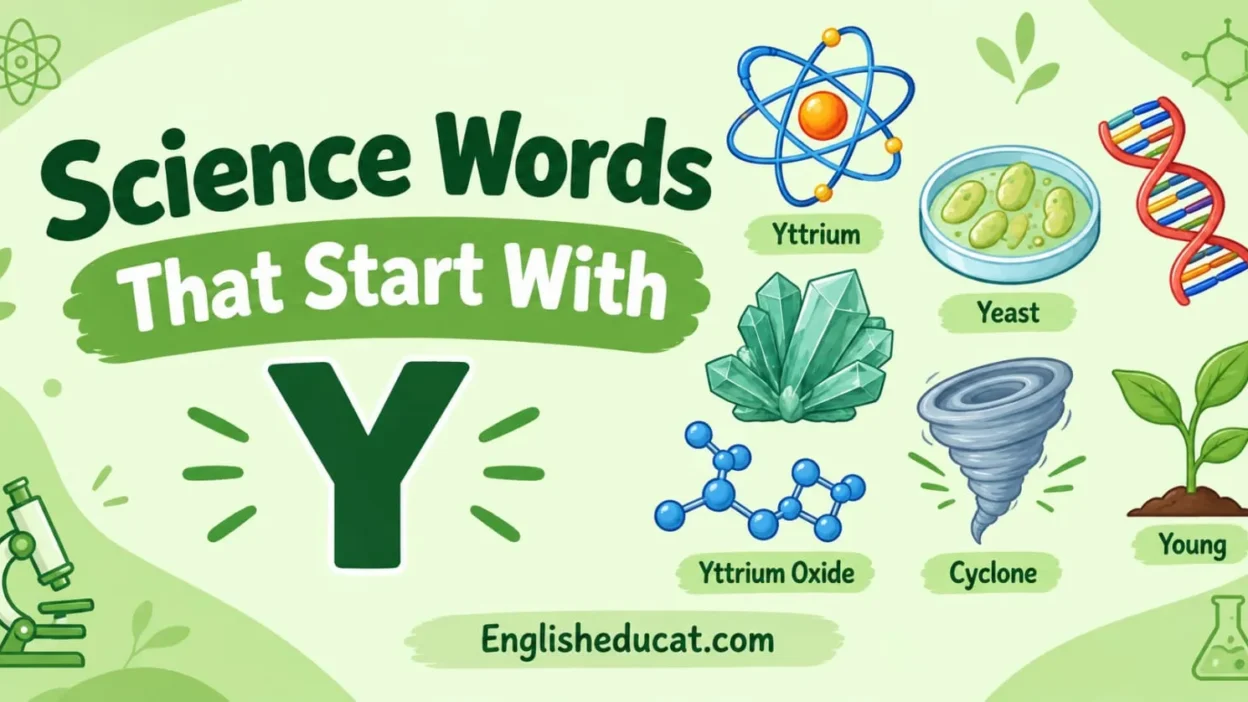
Y is one of the rarest starting letters for science words in scientific vocabulary, yet the words it produces carry a lot of weight or importance. The Y-chromosome carries the genetic trigger for male development in humans and most mammals. Yttrium and its rare-earth relatives power modern lasers and MRI scanners.
Young’s modulus underlies nearly every engineering calculation involving material stress. Even the humble yeast cell ranks among biology’s most heavily studied model organisms in genetics labs worldwide. Below you will find 130 real science words that start with Y, that are sorted by branch: Biology, Chemistry, Physics, Astronomy, and Earth Science. Each entry gets a plain-language definition and an example sentence showing how it is used in context.
Students can use it to review exam vocabulary, teachers can pull straight from it for word walls and spelling lists, and anyone who is simply curious why Y is so scarce in science textbooks will also find that answer. A bonus list of advanced and specialist-level Y-words will round things out at the end. You should also learn other science words like Z that is also so rare word.
Biology Words That Start With Y
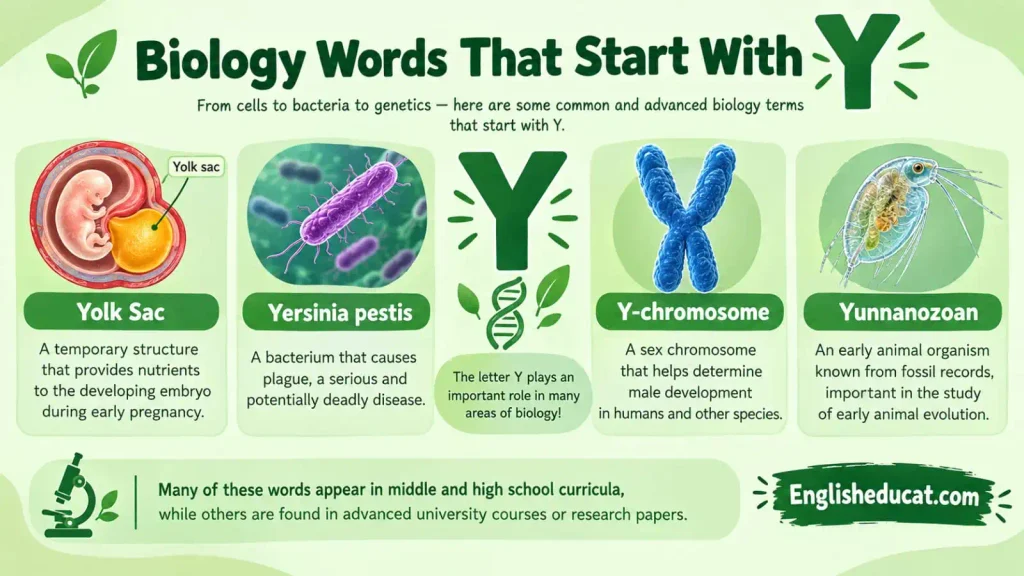
Biology contains a large number of science words that start with Y, and it is easy to see why once you start listing examples: a cellular structure like the yolk sac, a disease-causing bacterium like Yersinia pestis, and a foundational genetics term like the Y-chromosome all fall under this one branch. Many of these words appear in standard middle school and high school curricula, while others like Yunnanozoan appear only in specialized university coursework or research papers.
| Term | Definition | Example Sentence |
| Yeast | A microorganism that breaks down sugar, giving bread its rise and beer its fizz. | Bakers add yeast to dough so it rises before baking. |
| Y-chromosome | The chromosome carrying the genetic trigger for male development in most mammals. | The Y-chromosome is passed only from father to son. |
| Yolk | The energy-dense core of an egg that fuels a developing embryo before it hatches. | The yolk supplies fat and protein to the growing chick. |
| Yolk sac | An early support structure that nourishes an embryo before the placenta takes over. | An ultrasound at six weeks revealed a clear yolk sac. |
| Yolk stalk | The temporary channel keeping an embryo’s gut connected to its yolk sac. | The yolk stalk normally disappears by the seventh week of development. |
| Yolk plug | A seal of yolk-rich cells that closes off the blastopore during early development. | The yolk plug marks a key stage of amphibian gastrulation. |
| Yolk sac tumor | A rare, fast-growing tumor built from germ cells that mimics embryonic yolk sac tissue. | Doctors track a specific blood marker to monitor yolk sac tumor treatment. |
| Y-linked inheritance | Genetic trait passed exclusively from father to son. | Y-linked inheritance explains why the trait appears in every male generation. |
| Y-linked disease | Inherited disorder caused by a mutation on the Y chromosome. | A Y-linked disease can only be passed down through male offspring. |
| Yellow fever | A mosquito-borne viral illness that can turn the skin yellow as it damages the liver. | Travelers to parts of Africa are often required to get a yellow fever vaccine. |
| Yellow fever virus | The specific pathogen, a close relative of dengue and Zika, behind yellow fever infections. | Researchers sequence yellow fever virus strains to track how the pathogen evolves over time. |
| Yeast infection | An overgrowth of Candida fungus that throws off the body’s normal microbial balance. | The doctor prescribed an antifungal cream for the yeast infection. |
| Yersinia pestis | The bacterium behind the plague outbreaks that reshaped medieval Europe. | Yersinia pestis spread rapidly through flea-infested rat populations in medieval Europe. |
| Yersiniosis | Intestinal infection caused by certain Yersinia bacteria. | Contaminated pork was traced as the source of the yersiniosis outbreak. |
| Yaws | A disfiguring tropical skin disease caused by a close bacterial cousin of syphilis. | Mass treatment campaigns have sharply reduced yaws cases worldwide. |
| Yogurt | Milk thickened and given its tangy flavor through fermentation by live bacterial cultures. | Yogurt contains probiotics that support gut health. |
| Yarrow | Flowering plant studied for its anti-inflammatory compounds. | Traditional healers used yarrow to help wounds stop bleeding. |
| Yucca | A hardy desert plant genus with spiky, sword-shaped leaves and deep, drought-resistant roots. | Yucca plants rely on a single moth species for pollination. |
| Yellow jacket | Stinging wasp with bold black-and-yellow markings. | Yellow jackets become more aggressive in late summer as food grows scarce. |
| Yak | Large, shaggy-haired ox species adapted to high altitudes. | Yaks are commonly used as pack animals across the Himalayan plateau. |
| Yellow-eyed penguin | Rare penguin species native to New Zealand. | The yellow-eyed penguin has become a flagship species for local conservation. |
| Yellow ground squirrel | Burrowing rodent species found across parts of Central Asia. | The yellow ground squirrel spends much of the year in underground hibernation. |
| Yawn | Reflexive deep breath often linked to drowsiness or boredom. | Contagious yawning is observed in several social mammal species. |
| Yearling | An animal between roughly one and two years old. | Wildlife biologists tagged the yearling deer to track its movements. |
| Young organism | An individual in the earliest stage of biological development. | A young organism often has different nutritional needs than an adult of the same species. |
| Yellow spot | The macula, a retinal region responsible for sharp central vision. | Damage to the yellow spot can impair detailed central vision. |
| Yellow bone marrow | Fatty marrow tissue found inside adult long bones. | Yellow bone marrow can convert back into blood-forming marrow after severe blood loss. |
| Yellow nail syndrome | Rare condition causing thickened, yellow nails along with lymphedema. | The patient’s yellow nail syndrome was linked to chronic sinus problems. |
| Yohimbine | Alkaloid derived from tree bark, studied for physiological effects. | Researchers examined how yohimbine influences certain nervous system receptors. |
| Y-maze | Y-shaped apparatus used to test memory and decision-making in animals. | The mouse’s performance in the Y-maze suggested strong short-term memory. |
| Yeast two-hybrid | Laboratory technique used to detect interactions between two proteins. | Scientists used a yeast two-hybrid screen to find new binding partners for the protein. |
| Yeast artificial chromosome (YAC) | Engineered vector that carries large DNA fragments inside yeast cells. | A yeast artificial chromosome allowed researchers to clone an entire human gene region. |
| Yin-Yang hypothesis | Biological model describing balance between two opposing cellular signals. | The Yin-Yang hypothesis helps explain how cells regulate opposing growth signals. |
| Yeast two-hybrid vector | Genetic tool combining two proteins to test whether they physically interact. | The bait and prey proteins fused successfully in the yeast two-hybrid vector test. |
| Yolk granules | Small nutrient particles stored inside egg cells. | Yolk granules supply lipids and proteins to the developing embryo. |
| Yellowstone hotspot organisms | Term for the extremophile microbes thriving in Yellowstone’s thermal pools. | Yellowstone hotspot organisms have helped scientists understand life in extreme heat. |
| Yunnanozoan | Extinct early chordate fossil found in Cambrian rock layers in China. | Yunnanozoan fossils gave paleontologists new clues about early vertebrate ancestors. |
| Yakut garnet (biomineral studies) | A garnet variety sometimes referenced in biomineral and geochemical biology studies. | Researchers studied trace elements in Yakut garnet to understand its formation. |
Chemistry Words That Start With Y
As introduced above, much of the chemistry vocabulary of Y traces directly back to the yttrium family of elements that are first pulled from that Ytterby quarry. But chemistry Y words are not limited to element names; the branch also covers core lab concepts like reaction yield, materials terms like yield strength, and even a named organic chemistry reaction technique in the ylide.
| Term | Definition | Example Sentence |
| Yttrium | Silvery metallic element used in lasers, alloys, and electronics. | Yttrium is a key ingredient in certain high-performance laser crystals. |
| Ytterbium | Soft rare-earth element used in optical fibers and specialty alloys. | Ytterbium-doped fiber is used in some high-power industrial lasers. |
| Yttria | Yttrium oxide, a compound used in ceramics and coatings. | Engineers added yttria to the ceramic mix to boost its heat resistance. |
| Yttrium oxide | White crystalline compound used in ceramics and display phosphors. | Yttrium oxide helps stabilize the crystal structure of certain ceramics. |
| Yttrium aluminum garnet | Synthetic crystal commonly used as a laser medium. | Yttrium aluminum garnet crystals are central to many surgical laser systems. |
| Yttrium-90 | Radioactive isotope used in targeted cancer treatment. | Doctors used Yttrium-90 to deliver radiation directly to the tumor. |
| Yttrium nitrate | Soluble yttrium salt used in specialty materials production. | Yttrium nitrate solutions are used to synthesize fine ceramic powders. |
| Ytterbium chloride | Chemical compound formed from ytterbium and chlorine. | Ytterbium chloride serves as a starting material for producing pure ytterbium metal. |
| Ytterbium fluoride | Fluoride compound of ytterbium used in optical coatings. | Ytterbium fluoride is applied as a thin coating on certain camera lenses. |
| Yttric | Adjective describing minerals or compounds that contain yttrium. | Geologists identified several yttric minerals in the rare-earth deposit. |
| Yield | How much usable product a chemical reaction actually produces compared to what’s theoretically possible. | The reaction achieved a yield of over ninety percent under ideal conditions. |
| Yield percentage | The percentage score comparing a reaction’s actual output to its maximum possible output. | A low yield percentage prompted chemists to adjust the reaction temperature. |
| Yield reaction | Term describing how efficiently a chemical process converts inputs to products. | The team optimized the yield reaction by changing the catalyst used. |
| Ylide | Molecule containing a positively and negatively charged atom bonded together. | Chemists use a phosphorus ylide in the Wittig reaction to form new carbon bonds. |
| Yellow cake | Processed uranium concentrate powder used as an intermediate nuclear fuel product. | The facility converted raw uranium ore into yellow cake for further refining. |
| Yellow precipitate | Solid yellow substance that separates out of a solution during a reaction. | A yellow precipitate formed when potassium iodide was added to the lead solution. |
| Yellow phosphorus | Highly reactive form of phosphorus that must be stored underwater. | Yellow phosphorus ignites almost immediately when exposed to open air. |
| Yellow mercury oxide | Toxic yellow compound once used in antiseptic preparations. | Yellow mercury oxide is now handled only under strict safety controls. |
| Yocto- | Metric prefix representing a factor of ten to the negative twenty-four. | Forces at the yoctonewton scale are studied in particle physics experiments. |
| Yotta- | Metric prefix representing a factor of ten to the positive twenty-four. | Future global data storage could eventually be measured in yottabytes. |
| YAG laser | Solid-state laser that uses a yttrium aluminum garnet crystal. | Surgeons often use a YAG laser for precise eye procedures. |
| Yield strength | The load a material can absorb before it stops springing back and stays bent for good. | Engineers select steel based partly on its yield strength for load-bearing parts. |
| Yield point | The exact moment a material crosses over from flexing temporarily to deforming permanently. | Beyond the yield point, the metal no longer returns to its original shape. |
| Yield stress | The threshold stress that pushes a material past its ability to snap back into shape. | The alloy’s yield stress increased noticeably after heat treatment. |
| Yield ratio | Comparison between a material’s yield strength and its ultimate tensile strength. | A high yield ratio means the material shows little warning before failure. |
| Yeast fermentation | Chemical process converting sugars into alcohol and carbon dioxide. | Yeast fermentation is what causes bread dough to rise. |
| Yttrium alloy | Metal mixture that includes yttrium to improve its properties. | Adding a small amount of yttrium alloy improved the metal’s resistance to corrosion. |
Physics Words That Start With Y
It is the most important part of science words starting with Y. Two Y-words dominate in physics words more than any others: Young’s modulus, which measures how stiff a material is, and yaw, which describes rotation around a vertical axis and appears everywhere from aircraft design to car safety systems. Beyond those two words, Y vocabolary of physics spans everything from graph basics like the Y-axis to particle-scale units like the yoctonewton.
| Term | Definition | Example Sentence |
| Yaw | The side-to-side rotation of a vehicle or aircraft around an imaginary vertical line through its center. | Strong crosswinds caused the aircraft to experience unexpected yaw. |
| Yaw angle | Degree of rotational deviation from a reference direction. | Sensors continuously measure the drone’s yaw angle during flight. |
| Yaw rate | Speed at which an object rotates around its vertical axis. | The car’s stability system reacts instantly to changes in yaw rate. |
| Yaw moment | Rotational force acting around a vehicle’s vertical axis. | Wind tunnel tests measured the yaw moment created by the new spoiler design. |
| Yaw stability | A system’s ability to resist unwanted rotational motion. | Engineers redesigned the tail fin to improve the aircraft’s yaw stability. |
| Yaw thruster | Small device used to adjust a spacecraft’s rotational orientation. | The satellite fired its yaw thruster to correct its alignment. |
| Yaw maneuver | Controlled rotational adjustment used to reorient a vehicle or spacecraft. | Mission control commanded a yaw maneuver to point the antenna toward Earth. |
| Young’s modulus | Measurement of a material’s stiffness under mechanical stress. | Steel has a much higher Young’s modulus than rubber. |
| Young’s experiment | Classic demonstration proving that light behaves as a wave. | Young’s experiment showed clear interference patterns using two narrow slits. |
| Young’s interference | Pattern of bright and dark bands formed by overlapping light waves. | The physics class recreated Young’s interference using a laser and a double slit. |
| Young-Laplace equation | Formula describing the pressure difference across a curved fluid surface. | The Young-Laplace equation explains why smaller bubbles have higher internal pressure. |
| Y-axis | Vertical reference line used in graphing physical quantities. | The researcher plotted temperature on the Y-axis against time on the X-axis. |
| Y-intercept | Point where a graphed line crosses the vertical axis. | The Y-intercept of the equation showed the starting value before any change occurred. |
| Yukawa potential | Equation describing the short-range strong nuclear force between particles. | The Yukawa potential predicts how quickly the nuclear force weakens with distance. |
| Yoctonewton | Extremely small unit of force used in particle-scale measurements. | Sensitive lab equipment can now detect forces as small as a few yoctonewtons. |
| Yottawatt | Enormous unit of power equal to ten to the twenty-fourth watts. | Astrophysicists estimated the gamma-ray burst released energy at several yottawatts. |
| Y-junction | Three-way branching point used in optical, electronic, or fluid systems. | Light passing through the Y-junction split evenly into two output paths. |
| Y-factor method | Technique used to measure noise levels in radio receivers and amplifiers. | Engineers calibrated the antenna receiver using the Y-factor method. |
| Yield surface | Mathematical boundary defining the limits of elastic behavior in a material. | The simulation used a yield surface model to predict how the metal would deform. |
| Yielding mechanism | The specific way a material deforms once it passes its elastic limit. | Researchers studied the alloy’s yielding mechanism under repeated stress cycles. |
| Y-network | Three-terminal circuit configuration shaped like the letter Y. | Electrical engineers converted the circuit into an equivalent Y-network for easier analysis. |
| Y-delta starter | Motor-starting method that reduces the initial electrical surge on startup. | The factory installed Y-delta starters to protect its large industrial motors. |
| Yoke design | Mechanical configuration that transmits force or motion between components. | A revised yoke design reduced pilot fatigue on long flights. |
| Y-buffer | Computer graphics technique that stores height data for rendering surfaces. | The game engine used a Y-buffer to render layered terrain more efficiently. |
| Yaw dynamics | The study of rotational motion around a vehicle’s vertical axis. | Understanding yaw dynamics helps engineers design more stable race cars. |
Astronomy & Space Words That Start With Y
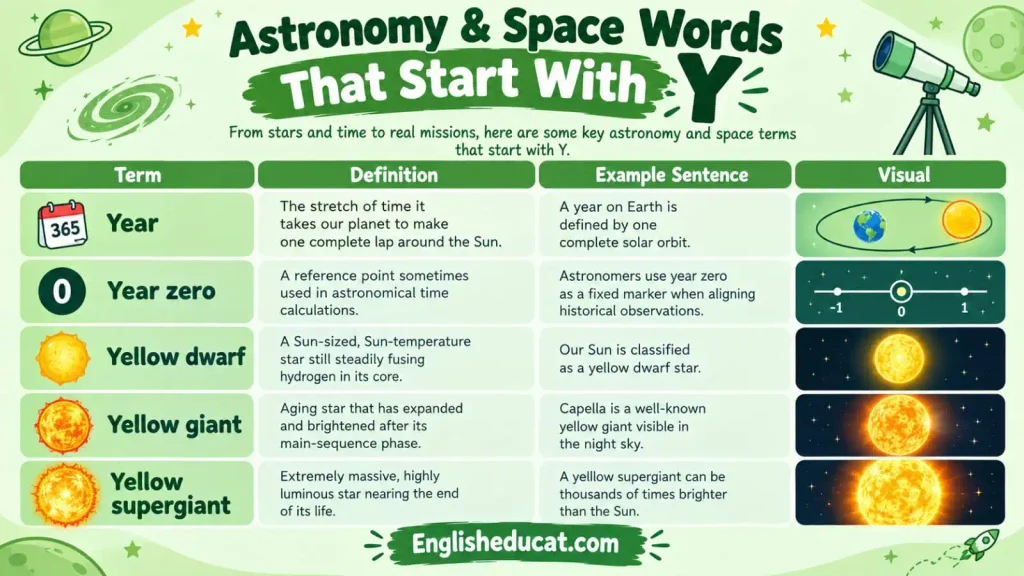
Y’s astronomy vocabulary really is the smallest of the five branches covered here for science words starting with Y, and rather than pad the list with borrowed or loosely related terms, this section stays honest about that. What Y does contribute to astronomy tends to be specific and interesting: a recently discovered class of star, a real Chinese lunar rover, and a thermal effect so subtle it took astronomers many years to confirm.
| Term | Definition | Example Sentence |
| Year | The stretch of time it takes our planet to make one complete lap around the Sun. | A year on Earth is defined by one complete solar orbit. |
| Year zero | A reference point sometimes used in astronomical time calculations. | Astronomers use year zero as a fixed marker when aligning historical observations. |
| Yellow dwarf | A Sun-sized, Sun-temperature star still steadily fusing hydrogen in its core. | Our Sun is classified as a yellow dwarf star. |
| Yellow giant | Aging star that has expanded and brightened after its main-sequence phase. | Capella is a well-known yellow giant visible in the night sky. |
| Yellow supergiant | Extremely massive, highly luminous star nearing the end of its life. | A yellow supergiant can be thousands of times brighter than the Sun. |
| Yellow star | General term for a G-type star similar to the Sun. | Astronomers classified the newly found star as a yellow star based on its temperature. |
| Young star | A recently formed star still in its early evolutionary stages. | The nebula contains dozens of young stars still shrouded in gas and dust. |
| Young stellar object | A star still forming and actively pulling in surrounding material. | Infrared telescopes are ideal for spotting a young stellar object hidden in dust clouds. |
| Young galaxy | A galaxy still in the earlier stages of its formation. | Deep space telescopes have captured images of remarkably young galaxies. |
| Y-dwarf | The coolest known class of brown dwarf star. | A Y-dwarf can have a surface temperature cooler than a typical oven. |
| Yarkovsky effect | Subtle thermal force that gradually shifts the orbits of small asteroids. | The Yarkovsky effect can slowly nudge an asteroid onto a new trajectory over centuries. |
| Yerkes Observatory | Historic research facility once home to the world’s largest refracting telescope. | Yerkes Observatory played a key role in the early development of stellar spectroscopy. |
| Yerkes classification | Stellar classification system based on a star’s luminosity. | The Yerkes classification adds a luminosity dimension to standard stellar spectral types. |
| Ylem | Early theoretical term for the dense, primordial matter of the early universe. | Physicists once used the term ylem to describe the hot matter just after the Big Bang. |
| Yutu | Chinese lunar rover that studied surface material on the Moon. | Yutu transmitted valuable data on lunar soil composition back to Earth. |
| Yutu regolith | Lunar soil and rock samples studied by China’s Yutu rover. | Analysis of Yutu regolith revealed unexpected mineral differences from earlier lunar samples. |
| Yaw axis (spacecraft) | The vertical axis a spacecraft rotates around during orientation adjustments. | Mission engineers adjusted the probe’s yaw axis to keep its antenna pointed at Earth. |
| Yerkes-Schmidt telescope design | Optical telescope design refined through research done at Yerkes Observatory. | The Yerkes-Schmidt telescope design improved wide-field astronomical imaging. |
Earth & Environmental Science Words That Start With Y
Where physics and astronomy lean abstract, the Y vocabulary of earth science stays grounded in things you can actually walk on, farm, or measure in a rain gauge. This branch covers landforms shaped by wind and water, soil and agriculture terms used by farmers and researchers alike, and a few words like yellowcake that sit at the intersection of geology and nuclear policy.
| Term | Definition | Example Sentence |
| Yardang | A streamlined ridge of rock sculpted over centuries by relentless desert wind. | Mars rovers have photographed yardangs shaped by ancient wind patterns. |
| Yardang field | A landscape densely covered with multiple wind-eroded rock ridges. | The desert’s yardang field stretches for several kilometers in the prevailing wind direction. |
| Yazoo stream | Tributary that flows parallel to a main river because natural levees block it from joining. | The Yazoo River is a classic example of a Yazoo stream running beside the Mississippi. |
| Yellowstone hotspot | Volcanic hotspot beneath the Yellowstone region that drives its geothermal activity. | Scientists monitor seismic activity above the Yellowstone hotspot to track magma movement. |
| Young valley | A V-shaped valley representing an early stage of river erosion. | The steep-sided young valley showed few signs of long-term erosion. |
| Youthful coast | A shoreline with cliffs and headlands indicating recent geological formation. | The rugged, youthful coast along this region reflects ongoing tectonic uplift. |
| Young fold mountains | Mountain ranges formed relatively recently through tectonic plate collisions. | The Himalayas are a well-known example of young fold mountains still rising today. |
| Young Earth | Term referring to disputed claims that Earth is far younger than its accepted age. | Radiometric dating provides strong evidence against Young Earth claims. |
| Young ice | Newly formed sea ice that is thicker than the initial freezing stage but not yet a full year old. | Satellite images tracked the spread of young ice across the bay in early winter. |
| Yellow soil | Soil type rich in iron oxides, common in warm temperate regions. | Yellow soil in parts of southern China supports a range of local crops. |
| Yellow dust | Fine, wind-blown soil particles carried long distances across regions. | Yellow dust from distant deserts can affect air quality in nearby countries. |
| Yellowcake | Concentrated uranium oxide powder produced during ore processing. | Regulators closely monitor how yellowcake is transported between facilities. |
| Yield gap | Difference between a crop’s potential yield and its actual harvested yield. | Improved irrigation techniques helped narrow the region’s persistent yield gap. |
| Yield mapping | Precision farming technique that tracks crop productivity across a field using GPS data. | Yield mapping showed the farmer exactly which sections of the field needed more fertilizer. |
| Yield threshold | The point at which an ecosystem begins to show signs of resource stress. | Researchers warned that water withdrawals were approaching the basin’s yield threshold. |
| Yield capacity | The maximum output a field or ecosystem can sustainably produce. | Soil testing helped estimate the yield capacity of the newly cleared farmland. |
| Yield-safe level | The maximum harvest level that can be sustained without long-term ecosystem damage. | Fishery managers set new limits based on the calculated yield-safe level for cod. |
| Year ring | Annual growth ring in trees, used to study past climate conditions. | Scientists counted year rings in ancient trees to reconstruct centuries of rainfall data. |
| Yearly rainfall | Total precipitation recorded at a location over a twelve-month period. | Yearly rainfall in the region has declined noticeably over the past decade. |
| Yard waste | Biodegradable garden refuse such as leaves, grass, and pruned branches. | The city collects yard waste separately for industrial composting. |
| Yellow carbon | Light-absorbing organic aerosol component found in the atmosphere. | Researchers are studying how yellow carbon particles influence regional climate patterns. |
| Yellow rain | A controversial environmental phenomenon studied for possible chemical or natural origins. | Scientific debate over yellow rain centered on distinguishing natural residue from toxic contamination. |
Advanced and Rare Science Words That Start With Y
Beyond the everyday vocabulary above, a handful of Y-words belong to specialist fields the kind you would encounter in a university course or a research paper rather than a general science class. Understanding these signals a deeper grasp of scientific vocabulary than the core list alone, and a few of them are recent enough that they would not have appeared in a textbook written even fifteen years ago.
| Term | Branch | Why It’s Rare/Advanced | Example Sentence |
| Yukawa potential | Physics | A graduate-level particle physics concept describing the strong nuclear force; rarely appears outside specialized coursework. | The Yukawa potential predicts how quickly the nuclear force weakens with distance. |
| Y-dwarf | Astronomy | The coolest known class of brown dwarf, only confirmed in observations starting in 2011 — a genuinely recent scientific term. | A Y-dwarf can have a surface temperature cooler than a typical oven. |
| Yarkovsky effect | Astronomy | A subtle orbital-mechanics phenomenon known mainly to planetary scientists and asteroid researchers. | The Yarkovsky effect can slowly nudge an asteroid onto a new trajectory over centuries. |
| Ylide | Chemistry | An organic chemistry reagent central to advanced synthesis reactions like the Wittig reaction; unfamiliar outside chemistry programs. | Chemists use a phosphorus ylide in the Wittig reaction to form new carbon bonds. |
| Yunnanozoan | Biology | An obscure extinct Cambrian fossil organism significant in paleontology and early vertebrate evolution research. | Yunnanozoan fossils gave paleontologists new clues about early vertebrate ancestors. |
| Young-Laplace equation | Physics | A fluid mechanics formula taught primarily at the university level, dealing with surface tension. | The Young-Laplace equation explains why smaller bubbles have higher internal pressure. |
| Yardang | Earth Science | A specialized geomorphology term for wind-carved landforms, notable for also appearing on Mars. | Mars rovers have photographed yardangs shaped by ancient wind patterns. |
| Yttrium-90 | Chemistry / Medicine | A radioactive isotope used in targeted cancer therapy — a term specific to nuclear medicine. | Doctors used Yttrium-90 to deliver radiation directly to the tumor. |
Why Learn Science Words That Start With Y?
The answer depends a bit on who is asking about science words that start with Y. Students preparing for exams get direct value from this list. Terms like Y-chromosome, Young’s modulus, and yield appear repeatedly in biology genetics units and physics materials science units, and knowing them cold often means the difference between a vague answer and a precise one on a test.
Teachers building vocabulary lists or word walls get a different kind of value: a rare letter like Y forces creativity, and having a ready-made, categorized list makes it far easier to design a themed lesson or a spelling assignment without hunting through a dozen sources.
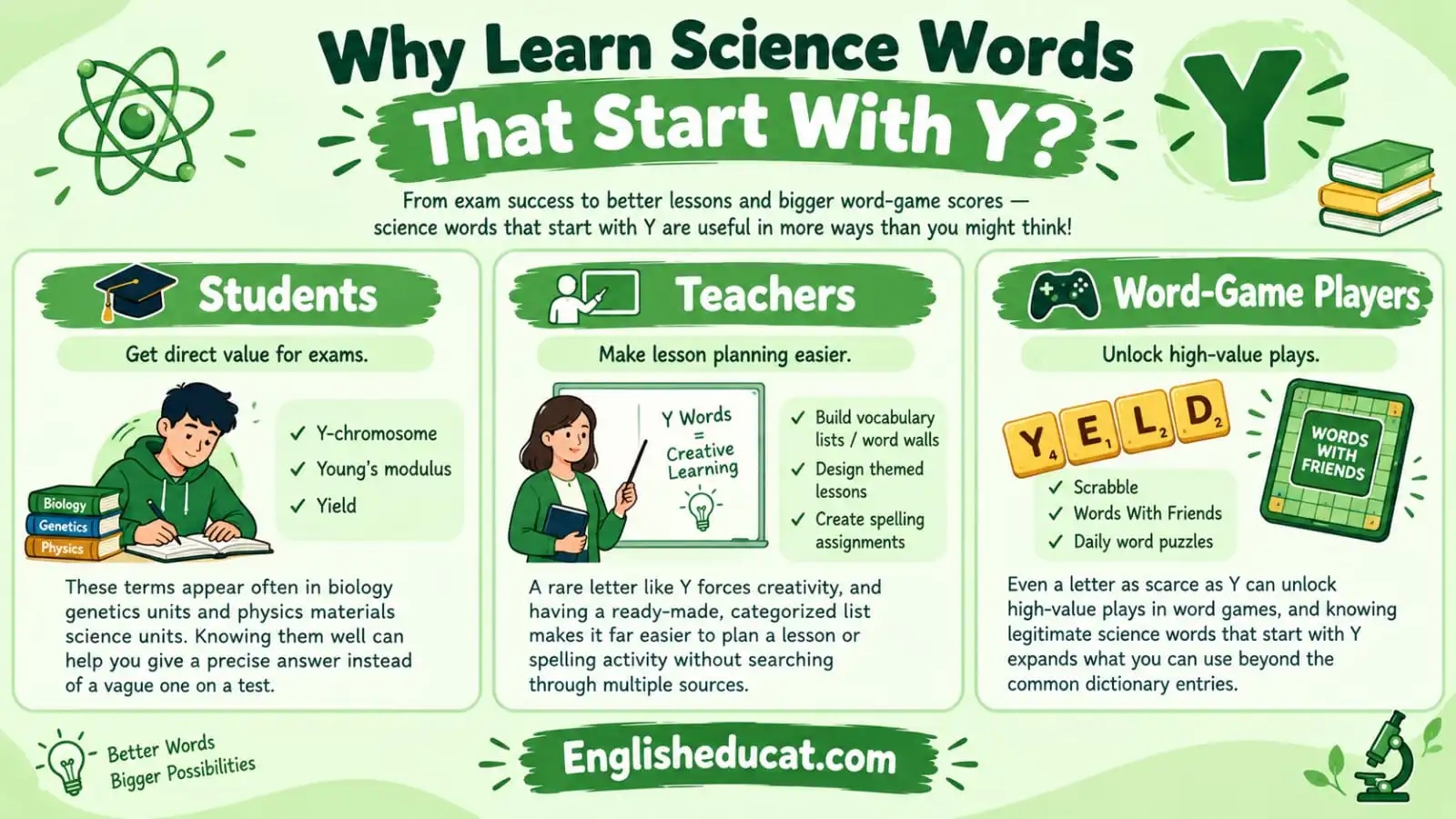
And then there is a third group that gets overlooked in most vocabulary guides: word-game players. Even a letter as scarce as Y can unlock high-value plays in Scrabble, Words With Friends, or daily word puzzles, and knowing legitimate science words that start with Y expands what is usable well beyond the common dictionary entries most players already know.
Frequently Asked Questions
What are some common science words that start with Y?
Common science words starting with Y include yeast, yolk, Y-chromosome, yttrium, Young’s modulus, yaw, and year. These terms span biology, chemistry, and physics, and most appear in general science education by middle school.
Why are there so few science words that start with Y?
Y is rare in scientific vocabulary because most scientific terms derive from Latin and Greek roots, and very few classical roots begin with a Y-sound. Most Y-science words instead come from proper nouns — element names like yttrium, or eponyms like Young’s modulus.
What is the most important science word that starts with Y?
The Y-chromosome is arguably the most significant science word starting with Y, since it determines male biological sex in humans and other mammals. Other high-impact terms include yttrium, used in lasers and MRI technology, and Young’s modulus, a foundational engineering concept.
Are science words starting with Y used in exams?
Yes, terms like Y-chromosome, yeast, Young’s modulus, yield, and yaw commonly appear in middle school through university-level science exams. They are especially frequent in biology genetics units and physics materials-science units.
What is a rare or advanced science word that starts with Y?
Yukawa potential, Y-dwarf, and the Yarkovsky effect are advanced Y-science terms typically encountered in university-level physics and astronomy courses. Yunnanozoan, an extinct Cambrian-period fossil organism, is a similarly specialized term used in paleontology.
How many science words start with the letter Y?
This list covers 130 core science words starting with Y across five branches (biology, chemistry, physics, astronomy, and earth science), plus 8 additional advanced or rare terms. The true number grows further once highly specialized sub-disciplines are included, but 130+ gives comprehensive coverage for general educational use.
Conclusion
Something is fitting about Y sitting so close to the end of the alphabet. It is easy to overlook, easy to assume it has nothing left to offer after twenty-four other letters have already claimed the obvious words. And yet here it is, quietly holding the chromosome that decides half of human biology, the element that traces back to a single Swedish quarry, the modulus that keeps bridges from bending the wrong way, and a star category we did not even know existed until 2011.
That is really the takeaway. Rarity is not the same as insignificance. A letter that produces only 130 odd scientific terms, instead of the thousands that letters like S or C generate, ends up making every one of those terms count for more. You will not find filler here: every word on this page earned its place by describing something real, a disease, a rock formation, a unit of force, a piece of the night sky.
So the next time you find a Y-word in a textbook, a lab report, or a crossword clue, you will know it is not just filling space. It carries more scientific weight per letter than almost anything else in the alphabet. And now, so do you.

ESL Content Writer
Emily is a TESOL-certified writer who has taught English to international students for over 8 years. She loves breaking down idioms and everyday expressions into simple, relatable explanations that make sense to learners at any level.