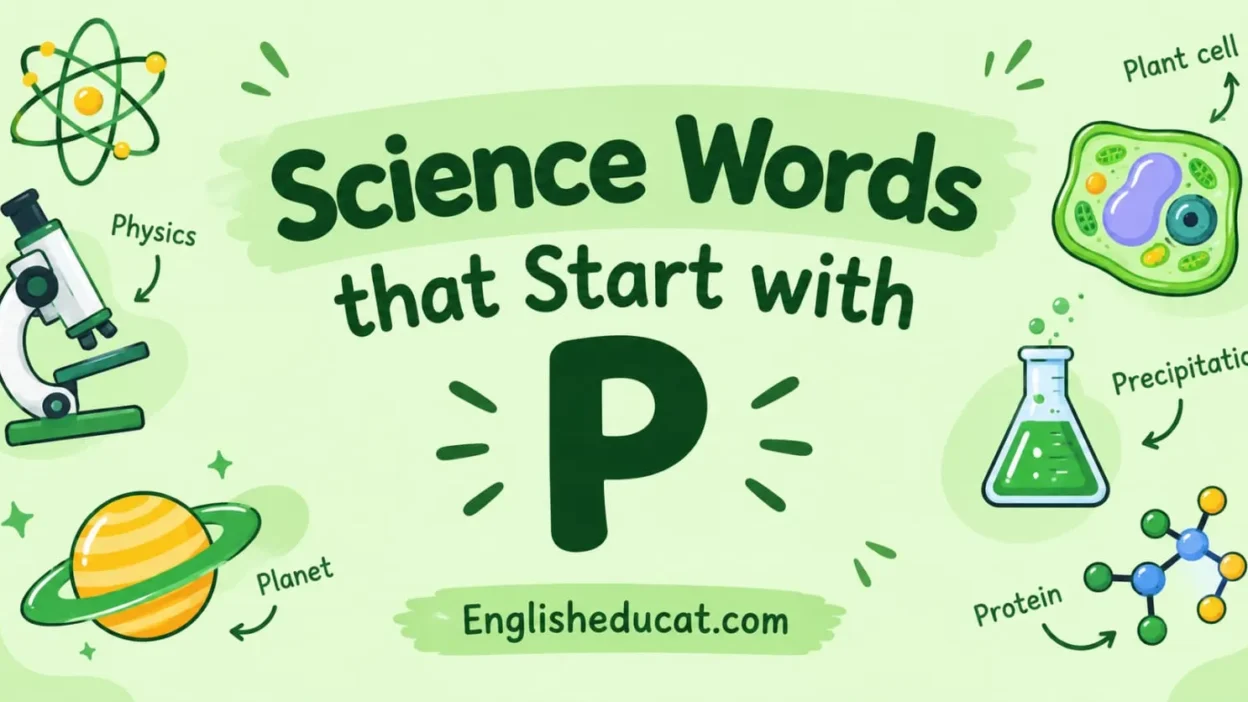
The letter P appears everywhere in scientific language, and that is no coincidence. Science words that start with P span biology, chemistry, physics, astronomy, and earth science, covering everything from the particles that make up matter to the planets orbiting our sun. Students memorizing vocabulary for an exam, teachers planning a unit, and curious readers who just like collecting interesting words will all find something useful here.
Unlike generic word lists pulled from a thesaurus, this collection sticks to real terminology pulled from actual textbooks, peer-reviewed research, and standard science curricula. Each entry pairs a plain-language definition with a natural example sentence, so the meaning sticks rather than just sitting on the page. An “Advanced P-Words” section near the end offers a tougher challenge for anyone who is already comfortable with the basics, and a FAQ block at the bottom answers the questions people search for most often. You should also learn other science words that start with Q and R.
Why Does “P” Dominate Physics and Space Vocabulary?
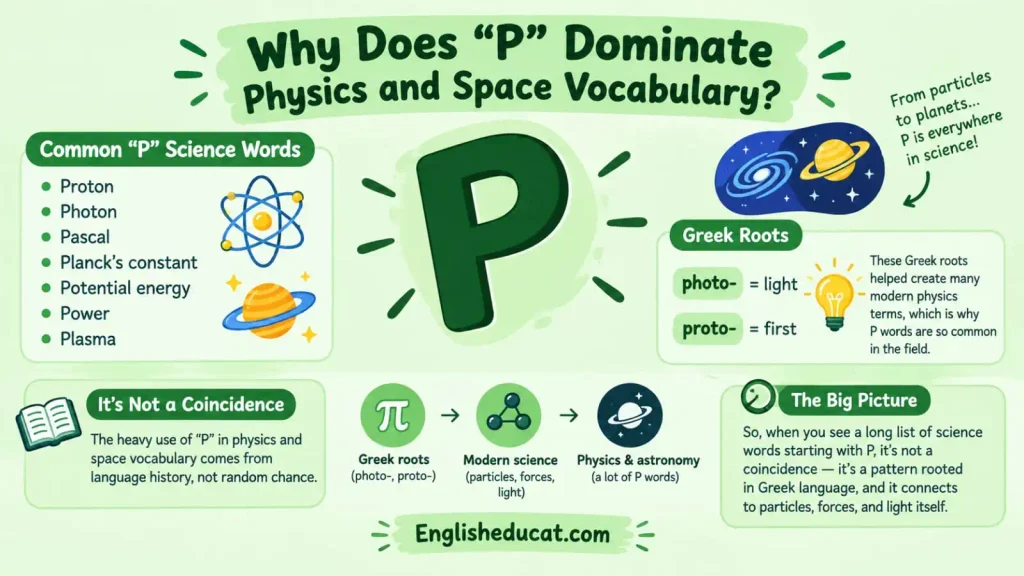
Here is a pattern worth noticing before diving into the lists below: physics and astronomy lean on P far more than most other letters. Proton, photon, pascal, Planck’s constant, potential energy, power, plasma that is an unusually long run of foundational terms sharing one initial letter, and it traces back to language history rather than chance. Greek roots like photo- (light) and proto- (first) seeded a huge portion of modern physics vocabulary, which is why science words that start with P cluster so heavily around particles, forces, and light itself. Keep an eye out for that thread as you move through the sections ahead, especially in physics and astronomy.
Biology Words That Start With P
Biology is the field that most frequently uses science words that start with P, spanning cell structures, genetics, and the relationships organisms form with one another. Plenty of these terms appear in high school and college biology courses, along with published research on ecology and physiology.
| Term | Definition | Example Sentence |
| Photosynthesis | The chemical process plants use to turn sunlight into usable energy. | Photosynthesis lets plants manufacture their own food from sunlight. |
| Protein | A biological molecule built from amino acids that carries out cellular work. | The body rebuilds muscle tissue using protein pulled from food. |
| Pathogen | Any microscopic organism capable of triggering illness in a host. | Lab technicians traced the outbreak back to a single pathogen. |
| Predator | An animal that survives by hunting and killing other animals. | Wolves act as apex predators throughout many forest ecosystems. |
| Prey | An animal that becomes food for a hunting predator. | Rabbits frequently end up as prey for foxes and hawks. |
| Pollination | The transfer of pollen grains from a flower’s male part to its female part. | Bees handle much of the pollination as they travel between blossoms. |
| Pollen | The powdery grains a plant releases to carry its male genetic material. | Airborne pollen from ragweed triggers seasonal allergies for many people. |
| Prokaryote | A single-celled organism whose DNA floats freely without a nucleus. | Bacteria fall under the prokaryote category in biology classification. |
| Phenotype | The physical traits that result from an organism’s genetic code. | Eye color is one phenotype shaped directly by inherited genes. |
| Peptide | A brief chain formed when amino acids link together. | Insulin functions as a peptide hormone that controls blood sugar. |
| Phylogeny | A mapped-out record of how species evolved and relate to each other. | DNA comparisons let scientists reconstruct a species’ phylogeny with precision. |
| Phylum | One of the broad categories used to classify related organisms. | Arthropoda covers the phylum containing insects, spiders, and crustaceans. |
| Plankton | Drifting organisms that float near the surface of oceans and lakes. | Plankton sits at the base of nearly every marine food chain. |
| Placenta | The organ that links a developing fetus to the uterine wall. | Oxygen and nutrients pass to the fetus through the placenta. |
| Pupa | The dormant stage an insect passes through before becoming an adult. | A caterpillar spends time as a pupa before emerging as a butterfly. |
| Population | The full group of one species living together in a defined area. | The deer population climbed sharply once predator numbers fell. |
Chemistry Words That Start With P
Chemistry supplies a batch of highly technical science words that start with P, many of which appear directly on standardized exams like AP Chemistry. These terms range from acidity measurements to descriptions of how matter behaves at the molecular level.
| Term | Definition | Example Sentence |
| pH | A numeric scale that tells you how acidic or alkaline a liquid is. | Lemon juice registers a low pH because of its natural acidity. |
| Polymer | A giant molecule assembled from many repeating chemical units. | Manufacturers produce plastic bottles from a polymer called polyethylene. |
| Precipitate | Solid material that drops out of a liquid during a chemical reaction. | The mixture formed a cloudy white precipitate almost instantly. |
| Proton | A positively charged particle sitting inside an atom’s nucleus. | An element’s atomic number depends entirely on its proton count. |
| Periodic table | The standard chart that sorts every known element by atomic number and traits. | Chemistry classes rely on the periodic table to spot recurring element patterns. |
| Phosphate | A chemical group built from phosphorus and oxygen atoms bonded together. | Most agricultural fertilizers contain phosphate as a key nutrient. |
| Peroxide | A compound defined by a direct bond between two oxygen atoms. | Households often use hydrogen peroxide to disinfect small cuts. |
| Polarity | An imbalance in electrical charge across different parts of a molecule. | Water’s polarity is the reason it dissolves so many other substances. |
| Pyrolysis | The decomposition of a material under intense, oxygen-free heat. | Pyrolysis breaks down organic waste into gas, oil, and solid residue. |
| Permeability | How readily a substance lets liquids or gases move through it. | Cell membranes allow selective permeability depending on molecule size. |
| Phenol | An organic compound featuring a hydroxyl group attached to a benzene ring. | Early surgeons used phenol as one of the first practical antiseptics. |
| Propane | A gas hydrocarbon burned widely as a portable fuel source. | Outdoor grills commonly run on propane stored in small tanks. |
| Petrochemical | Any chemical compound refined originally from crude oil or natural gas. | Synthetic fabrics often start out as petrochemicals before processing. |
| Pentose | A sugar molecule built around a five-carbon backbone. | Ribose qualifies as a pentose sugar and appears in RNA strands. |
| Potassium | A soft, highly reactive metal the body needs for nerve signaling. | Bananas get frequent credit as a solid dietary source of potassium. |
| Pure substance | Matter made of only one type of atom or molecule, with no mixture. | Distilled water counts as a pure substance, unlike ordinary tap water. |
Physics Words That Start With P
Physics might be the single strongest branch for science words that start with P, and the reason is almost historical: many of the core units of fields and particles happen to begin with this letter. These terms appear consistently, from introductory mechanics courses all the way through graduate-level quantum theory.
| Term | Definition | Example Sentence |
| Photon | A single unit of light energy traveling as electromagnetic radiation. | A photon’s energy rises as its wavelength gets shorter. |
| Pressure | Force distributed across a specific surface area. | Climbing to higher altitude causes air pressure to drop steadily. |
| Power | How quickly energy gets transferred or work gets completed. | A stronger engine converts fuel into motion at a faster rate. |
| Potential energy | Energy an object holds simply because of its position or condition. | A boulder perched on a cliff carries potential energy until it falls. |
| Plasma | A superheated gas made of loose, electrically charged particles. | The sun’s outer layer consists mostly of plasma, not solid rock. |
| Pendulum | A weighted object that swings freely from a fixed pivot point. | A pendulum’s swing speed depends on both its length and gravity’s pull. |
| Parallax | A shift in an object’s apparent position depending on the viewer’s angle. | Astronomers measure star distances by tracking subtle parallax shifts. |
| Polarization | Restricting a wave’s vibration to move along just one plane. | Polarized lenses cut glare by filtering out certain light angles. |
| Projectile | Any object sent airborne and then shaped purely by gravity’s pull. | Once released, a thrown baseball behaves exactly like a projectile. |
| Planck’s constant | A fixed number connecting a photon’s energy directly to its frequency. | Nearly every quantum mechanics formula depends on Planck’s constant somewhere. |
| Positron | The positively charged twin of the electron in antimatter physics. | Contact between a positron and an electron ends in mutual annihilation. |
| Pascal | The standard metric unit used to express pressure. | Meteorologists occasionally report barometric pressure using pascals instead of millibars. |
| Photoelectric effect | Electrons being knocked loose from a surface after light strikes it. | Confirmation of the photoelectric effect helped prove light acts like particles. |
| Propulsion | The driving force that sends an object, like a rocket, forward. | Expelling exhaust gas at extreme speed generates a rocket’s propulsion. |
| Precession | A gradual wobble in the direction an object’s spin axis points. | Earth’s axial precession completes one full wobble roughly every 26,000 years. |
| Piston | A moving cylindrical piece that slides back and forth within a chamber. | Inside a car engine, the piston compresses a mix of fuel and air. |
Astronomy and Space Words That Start With P
Space science contributes another strong set of science words that start with P, many tied to orbital mechanics, star life cycles, and the distance measurements astrophysicists rely on daily.
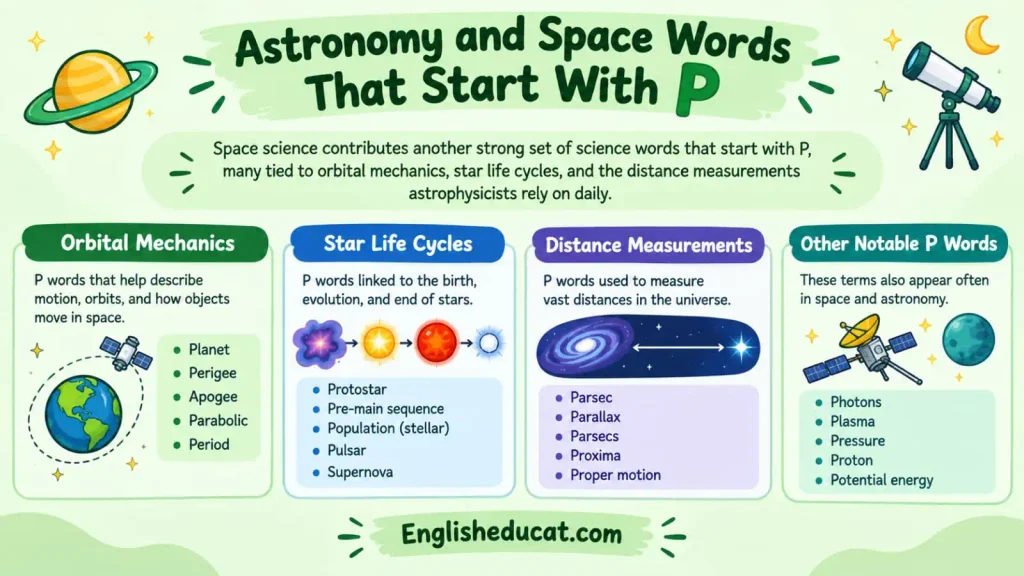
| Term | Definition | Example Sentence |
| Planet | A large body circling a star without generating its own light. | Earth holds the third position from the sun among the planets. |
| Photosphere | The bright, visible skin covering the outside of a star. | Dark sunspots stand out clearly against the sun’s photosphere. |
| Perihelion | The exact moment an orbiting body sits nearest to the sun. | Earth passes through perihelion during the first days of January. |
| Perigee | The point where the moon swings closest to Earth in its orbit. | A supermoon happens when a full moon lines up with perigee. |
| Parsec | A distance unit astronomers use, roughly equal to 3.26 light-years. | The closest neighboring star system sits just past one parsec away. |
| Pulsar | A dense, rapidly rotating neutron star flashing radiation at regular intervals. | Scientists tracked a pulsar spinning several hundred times each second. |
| Protostar | A thick, collapsing gas cloud on its way to becoming a full star. | Mass keeps building inside a protostar until fusion finally ignites. |
| Planetary nebula | An expanding cloud of gas cast off by a star nearing the end of its life. | A planetary nebula spreads outward as an aging star sheds its outer layers. |
| Protoplanet | A sizable chunk of early solar system matter en route to becoming a planet. | Repeated collisions between protoplanets gradually built the planets we know today. |
| Penumbra | The dimmer, partially shadowed zone bordering a full shadow. | Anyone standing in the penumbra witnessed only a partial eclipse. |
| Planetesimal | A small rocky or icy body left over from the solar system’s early formation. | Countless planetesimals collided and fused to create the first planets. |
| Prominence | A towering loop of glowing gas arcing off the sun’s surface. | A single solar prominence can extend hundreds of thousands of kilometers into space. |
| Planetary ring | A flattened band of ice, dust, or rock circling a planet. | Saturn’s planetary ring system remains the most striking example in our solar system. |
| Polar orbit | A satellite flight path passing close to both of a planet’s poles. | Weather-tracking satellites often follow a polar orbit to cover the whole globe. |
Earth and Environmental Science Words That Start With P
Earth science closes out this list of science words that start with P with vocabulary rooted in geology, climate patterns, and environmental processes terms that appear frequently in environmental coursework and government climate research.
| Term | Definition | Example Sentence |
| Precipitation | Any form of water — rain, snow, sleet, or hail — falling from clouds. | Nonstop precipitation overnight left the riverbanks completely flooded. |
| Plate tectonics | The scientific model explaining how Earth’s crustal plates shift over time. | Plate tectonics accounts for why earthquakes concentrate along particular fault zones. |
| Permafrost | Subsurface ground that stays frozen solid for at least two consecutive years. | Thawing permafrost risks releasing large amounts of trapped methane gas. |
| Pollution | Contamination caused by introducing harmful materials into a natural environment. | Nearby factories contributed heavily to the river’s ongoing pollution problem. |
| Peninsula | A stretch of land nearly encircled by water on three sides. | Florida qualifies as a peninsula flanked by the Atlantic and the Gulf. |
| Plateau | An elevated, mostly flat region standing well above the land around it. | The Tibetan Plateau earns its nickname as the roof of the world. |
| Paleoclimate | The climate patterns that existed during earlier chapters of Earth’s history. | Ice core samples let researchers piece together ancient paleoclimate data. |
| Pangaea | The single massive landmass that existed before today’s continents split apart. | Every current continent was once fused together into Pangaea. |
| Pyroclastic flow | A scorching, high-speed surge of gas and volcanic material rushing downhill. | A pyroclastic flow can race down a volcano’s slope faster than most vehicles. |
| Porosity | The proportion of empty space tucked inside a rock or soil sample. | Sandstone’s high porosity makes it effective at storing underground water. |
| Petrology | The branch of geology focused on how rocks form and what they’re made of. | Petrology gives geologists a framework for sorting rocks into major categories. |
| Paleontology | The scientific field devoted to studying fossils and ancient life forms. | Fossil evidence gives paleontology its main window into prehistoric ecosystems. |
| Pesticide | A manufactured chemical designed to kill or repel unwanted pests. | Farmers spray pesticide across fields to shield crops from insect damage. |
| Polar ice cap | A thick sheet of ice permanently covering one of a planet’s poles. | The North Pole’s polar ice cap has thinned noticeably over recent decades. |
Advanced and Rare Science Words That Start With P
Once the basics feel comfortable, this bonus set of science words that start with P steps into rarer territory, terminology more likely to surface in competitive exams, specialized coursework, or academic journals than in a standard textbook chapter.
| Term | Definition | Example Sentence |
| Pleiotropy | A situation where one single gene shapes several unrelated traits at once. | Pleiotropy accounts for how one gene mutation can disrupt multiple body systems simultaneously. |
| Palynology | A specialized field examining pollen and spores, often applied in criminal investigations. | Investigators used palynology to trace pollen residue back to a specific crime scene. |
| Photoautotroph | A living thing that manufactures its own nutrients using captured light energy. | Green algae rank among the most common photoautotrophs found in freshwater. |
| Praseodymium | An uncommon, silvery element from the lanthanide series used in magnets and specialty glass. | Manufacturers blend praseodymium into certain alloys to boost overall strength. |
| Perturbation theory | A mathematical technique for estimating answers to equations too complex to solve directly. | Physicists lean on perturbation theory whenever an exact solution proves out of reach. |
| Pycnocline | A sharp boundary layer in the ocean where water density changes rapidly. | Marine life often clusters near the pycnocline, drawn by concentrated nutrients. |
| Poikilotherm | An organism whose internal temperature rises and falls with its surroundings. | Reptiles count as poikilotherms, depending on sunlight to regulate their body heat. |
| Panspermia | A theory proposing that life’s raw ingredients travel between planets. | Under panspermia, microbial life could theoretically hitch a ride aboard passing meteorites. |
Why Learn Science Words That Start With P?
There is more to gain here than just padding a vocabulary list. Recognizing science words that start with P helps reveal how separate scientific disciplines quietly overlap. Plasma, for instance, means something slightly different in physics than it does in biology, yet the underlying concept of a distinct state or component carries across both. Polarity plays a similar role in chemistry and physics alike, and phase appears almost everywhere on this list in one form or another. That kind of overlap is not random; it is a byproduct of shared Greek and Latin roots woven throughout scientific language, which is exactly why spotting these patterns tends to speed up vocabulary learning over time.
Students benefit most directly, since this exact vocabulary appears constantly in biology, chemistry, physics, and earth science coursework on quizzes, in lab write-ups, and throughout standardized testing. Teachers building lessons around science words that start with P often find it easier to organize instruction branch by branch rather than dumping an unsorted list on students all at once. Even casual learners tend to retain more simply by reading a definition alongside a natural example sentence instead of memorizing isolated terms in a vacuum.
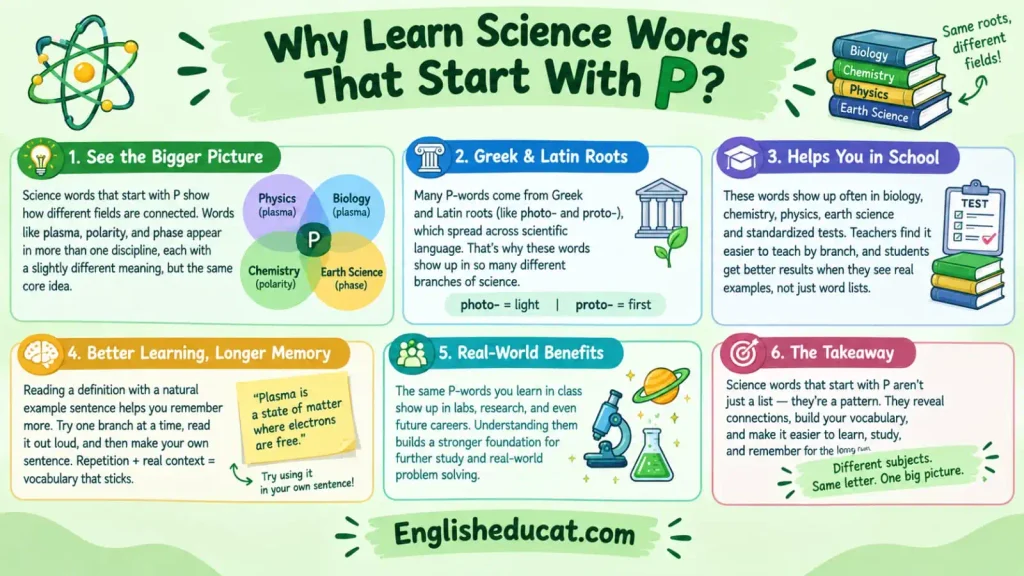
One approach that consistently works: tackle one branch at a time, read each example sentence out loud, then try building your own sentence with the same word. Pairing repetition with real context still ranks among the most reliable ways to make new vocabulary stick for the long haul.
Frequently Asked Questions
What are some science words that start with P?
Photosynthesis, proton, photon, plasma, and planet all rank among the most recognizable science words that start with P. Together they span biology, chemistry, physics, and astronomy, which makes P one of the more versatile letters in scientific vocabulary.
What is a 5-letter science word starting with P?
“Pulse,” “phase,” and “proof” all fit. Each one holds genuine scientific meaning in physics, biology, or chemistry, which makes them solid picks for word games like Wordle or crossword puzzles.
What are physics terms that start with P?
Photon, pressure, power, plasma, and potential energy sit near the top of the list. Physics carries an unusually heavy concentration of science words that start with P, largely thanks to Greek roots tied to light and particle behavior.
What is a hard or advanced science word starting with P?
Pleiotropy and palynology both qualify as advanced terms. Pleiotropy describes a single gene affecting multiple traits, while palynology covers the specialized study of pollen and spores, frequently applied in forensic work.
Which science fields use the most P words?
Physics and biology lead the pack by a clear margin. Both fields draw heavily on Greek-derived vocabulary tied to light, particles, and living processes, which pushes their P-word counts higher than most other branches.
Why do so many science words start with P?
A large share trace back to Greek prefixes such as photo- (light) and proto- (first). That linguistic root is the main reason science words that start with P show up so consistently across physics, biology, and astronomy in particular.
Conclusion
It turns out the letter P is one of the unsung workhorses of science, carrying the particles that build matter, the processes that keep living things running, and the planets that fill our night sky. What began as a simple vocabulary exercise ends up revealing something larger: science is not really a stack of separate subjects but one connected language, and science words that start with P prove just how far that overlap runs across biology, chemistry, physics, astronomy, and earth science alike.
Maybe you landed here cramming for a test, building a lesson plan for tomorrow, hunting for a winning Scrabble play, or just following curiosity down an unexpected path. Either way, you now hold a working reference of real, classroom-tested science words that start with P, each one paired with a definition and example you can actually put to use. Save this page, return to it whenever a term slips your mind, and the next time a “P” word surfaces in a textbook or news headline, you will already know exactly where it belongs.

ESL Content Writer
Emily is a TESOL-certified writer who has taught English to international students for over 8 years. She loves breaking down idioms and everyday expressions into simple, relatable explanations that make sense to learners at any level.