If you have ever seen “w/” in a message and paused for a second, then you are not alone. Understanding the w/ meaning in text is easier than it looks, and once you click it, you will find it everywhere in group chats, grocery lists, and even work Slack messages.
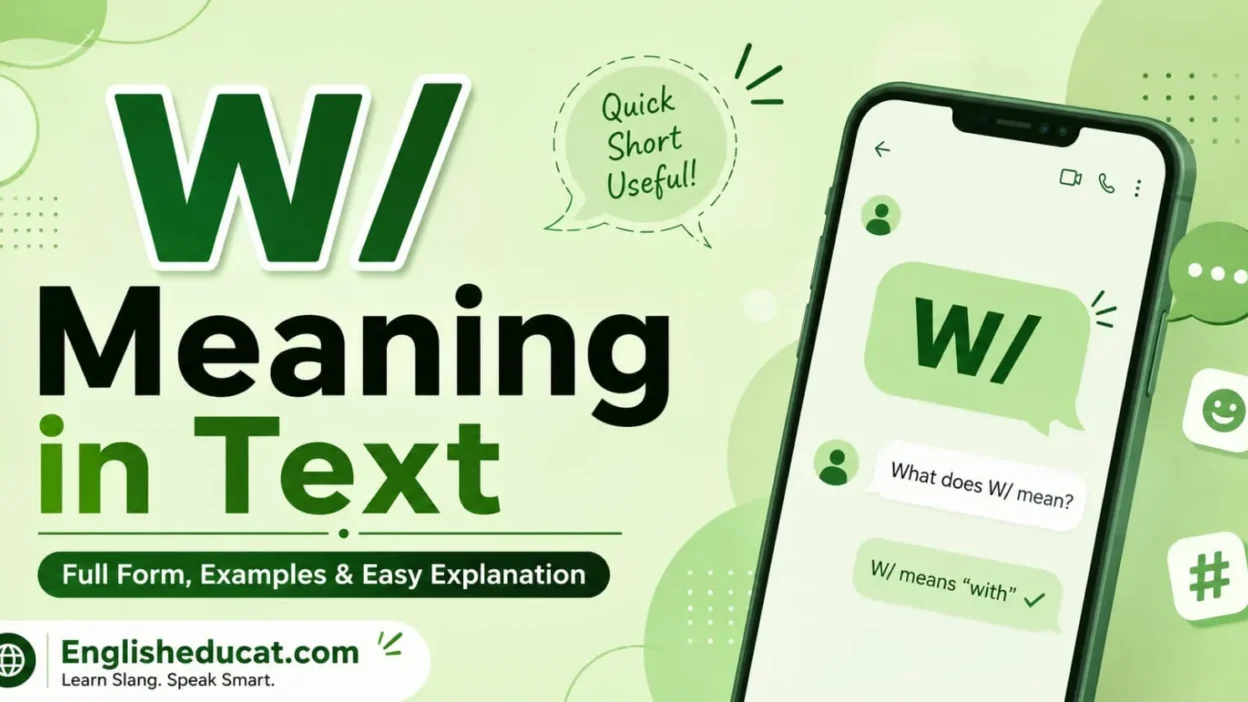
The abbreviation w/ means “with.” That is it. It is a short and informal way to write “with” in texts, notes, and casual messages. The small forward slash (/) is what makes w/ different from a plain letter “w.”
But there is a catch. A single letter W is a totally different thing. It is internet slang for “win.” This article covers the w/ meaning in text, which is the version with the slash, so let’s clear up any confusion right now.
By the end of this guide, you will know exactly what w/ means, how people use it, where it came from, and when you should avoid it. We will also cover its closest words, w/o and b/c, so you will never have to guess its meaning again.
What Does W/ Mean in Text? (Quick Answer)
W/ means “with.” People use it to save space and time when typing.
Here is a simple example: “I am going to the store w/ my sister” means “I am going to the store with my sister.” That is the whole idea behind w/: in text, it is just a shortcut for one small and common word.
You will usually see it in text messages, sticky notes, grocery lists, and quick emails to friends. It is fast and easy to type, and everyone who knows texting slang understands its meaning.
That is the core concept of it: no hidden trick and no second definition, only a faster way to write “with.” Some people learn the w/ meaning in text from friends. Others pick it up by reading old handwritten notes or restaurant menus. Both ways, when you know its meaning, you will understand what it means.
Is “W” the Same as “W/”? (Important Disambiguation)
No, they are not the same. This mix-up has troubled a lot of people because of its meaning, so let’s break it down clearly.
W/ (with slash) = “with”
When you see a lowercase or capital w with a slash, it means “with.” Example: “Pizza w/ extra cheese.”
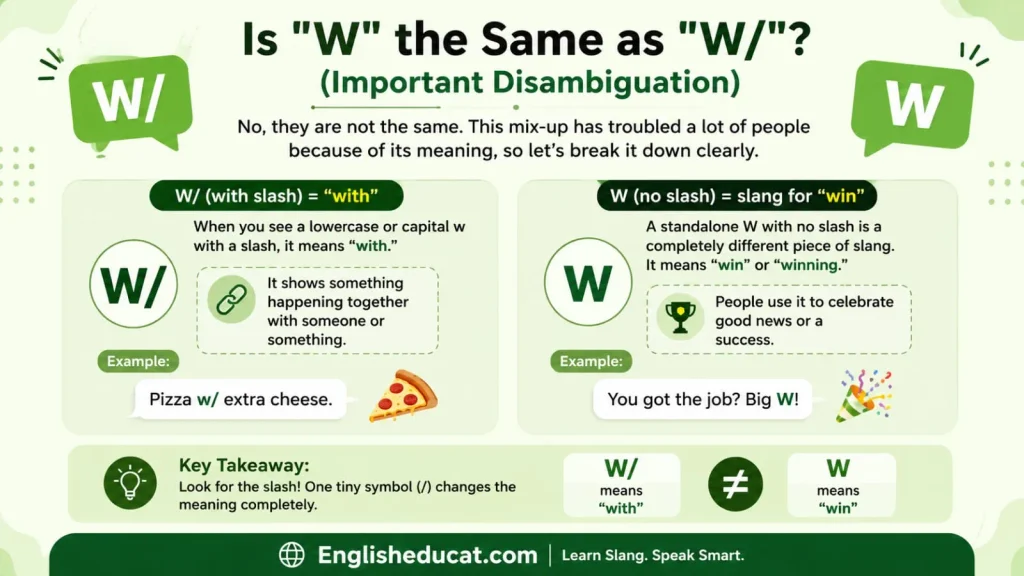
W (no slash) = slang for “win”
A standalone W with no slash is a completely different piece of slang. It means “win” or “winning.” People use it to celebrate good news. Example: “You got the job? Big W!”
Here is a simple comparison to know the difference:
| w/ | with | “Coffee w/ milk” |
| W | win | “That’s a huge W!” |
| w/o | without | “Coffee w/o sugar” |
Once you understand this difference, the rest of w/ meaning in text becomes much easier to find.
A lot of confusion online starts from here. Someone searches for “w meaning” and lands on an article about winning, when they really wanted the w/ meaning in text, the “with” version. If you typed w/ into your message, this article contains your answer. If you saw a plain W with no slash, you are probably looking at slang for “win” instead.
W/ vs. W/O vs. B/C Common Abbreviations Compared
W/ does not travel alone. It usually appears next to a few close words: w/o and b/c. These three are some of the most common informal abbreviations in American English texting and note taking.
What does w/o mean?
W/o means “without.” It is the exact opposite of w/. If w/ means “with,” then w/o simply flips that meaning.
Example: “I will take my tea w/o sugar.”
What does b/c mean?
B/c means “because.” It is used the same casual way as w/ to write fast.
Example: “I am staying home b/c it is raining.”
Comparison Table
| w/ | with | “Let’s meet w/ the whole team.” |
| w/o | without | “She left w/o saying goodbye.” |
| b/c | because | “I’m tired b/c I woke up early.” |
You may also spot similar short forms like e.g. (for example) or i.e. (that is) in casual writing. They follow the same basic idea: shrink common phrases into quick symbols so typing goes faster.
Knowing how w/ meaning in text connects with w/o, and b/c will make reading casual messages much smoother. Once you know the pattern, a letter or two, plus a slash, you can usually guess the meaning even if you have never seen that exact abbreviation before.
How to Use W/ in a Sentence
Now that you know the w/ meaning in text, let’s look at how people actually use it day to day.
In Texting and DMs
This is where w/ appears the most. Friends use it constantly because it is fast and everyone understands it.
- Running late, be there w/ the snacks.
- Can I bring a friend w/ me tonight?
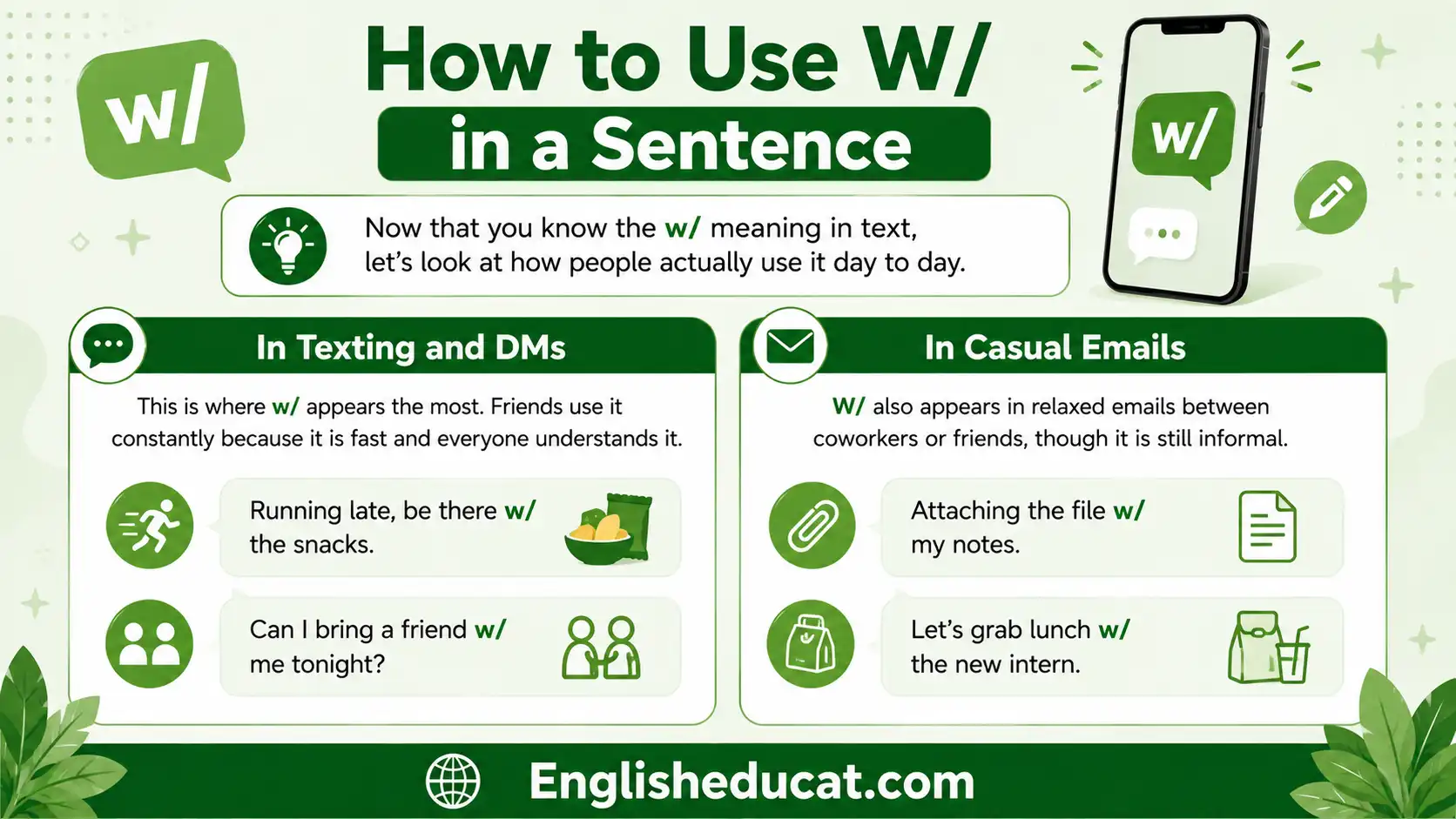
In Casual Emails
W/ also appears in relaxed emails between coworkers or friends, though it is still informal.
- Attaching the file w/ my notes.
- Let’s grab lunch w/ the new intern.
In Notes and To-Do Lists
Shopping lists, sticky notes, and quick reminders are another common home for w/.
- Buy bread w/ seeds.
- Call mom w/ update on the trip.
In all of the above examples, w/ meaning in text stays the same: it is simply standing in for “with.” No matter the setting a text to a friend, a quick email, or a scribbled note the abbreviation never changes its job. It always shortens “with” into two characters instead of four letters.
That consistency is actually what makes w/ meaning in text so easy to learn. You do not need to memorize different rules for different situations. Once you know it, you know it everywhere.
Is W/ Appropriate for Formal or Professional Writing?
The simple answer is that you should not use it in formal or professional writing. W/ is informal, and formal writing calls for full words.
Skip w/ in resumes, cover letters, academic papers, and emails to clients or your boss. Spelling out “with” looks more polished and avoids any confusion for readers who might not know texting shorthand.
Here is something I learned the hard way. Early in my career managing social media accounts, I typed up a quick internal brief for a client using “w/” throughout, the same way I would text a friend. The client’s marketing director read it and asked, only half-joking, if I had sent it from my phone by accident. It was not a huge mistake, but it taught me a clear lesson: shorthand that feels normal in a text thread can look careless in a professional document. Now I keep a simple rule: w/ is fine for quick internal chats with my team, but full words go in anything a client or manager will actually read closely.
That one small moment changed how I write at work. It is a good reminder that knowing the w/ meaning in text is only half the job. Knowing when to use it matters just as much.
Where Does the W/ Meaning in Text Come From? (Origin & Etymology)
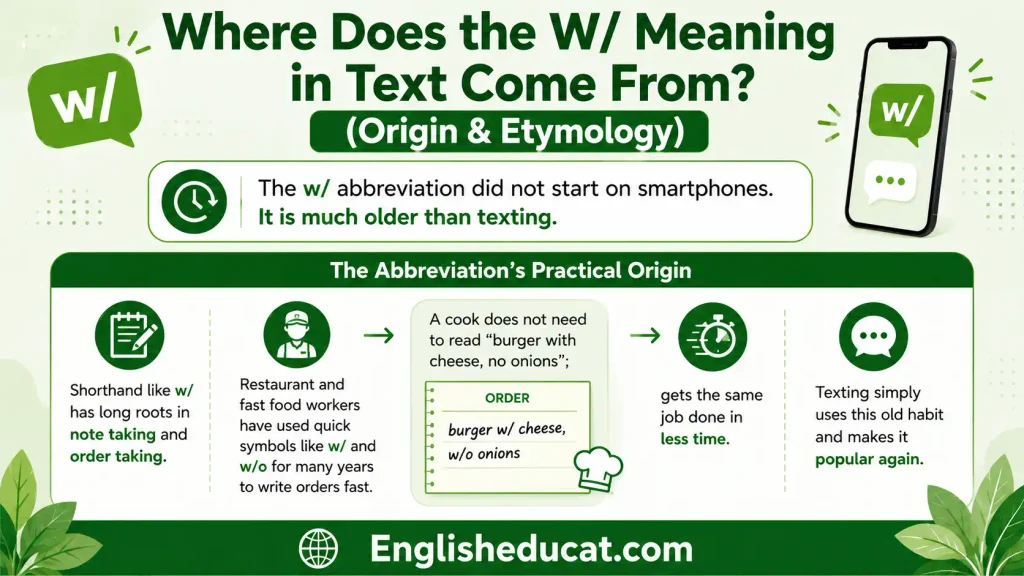
The w/ abbreviation did not start on smartphones. It is much older than texting.
The Abbreviation’s Practical Origin
Shorthand like w/ has long roots in note taking and order taking. Restaurant and fast food workers have used quick symbols like w/ and w/o for many years to write orders fast. A cook does not need to read “burger with cheese, no onions”; “burger w/ cheese, w/o onions” gets the same job done in less time.
Texting simply uses this old habit and makes it popular again.
Etymology of “With” Itself
The word “with” traces back to Old English. According to Etymonline, it comes from the Old English word wið. That word first meant “against” or “toward.” After some time, its meaning changed to describe togetherness. That is the sense we use today.
So w/ feels like modern internet shorthand, but the word behind it is over a thousand years old. The abbreviation is new. The word it shortens is ancient.
That mix is part of what makes the w/ meaning in text so interesting. It sits right at the crossroads of old language habits and new digital speed.
Synonyms and Antonyms for “With”
If you want to use other words in your writing, here are some alternatives to the word “with.”
Synonyms (words that mean the same as “with”)
- alongside
- plus
- accompanying
- together with
- along with
Antonyms (words that mean the opposite of “with”)
- without
- minus
- sans
These can be useful anytime you want to avoid repeating “with,” or “w/,” too many times in one piece of writing.
Is W/ an Abbreviation or an Acronym?
W/ is an abbreviation, not an acronym. This small distinction matters if you are curious about how language works. An acronym uses the first letters of several words. You read it like its own word, like “NASA.” An abbreviation is just a shortened version of one word or phrase. That is exactly what w/ is: a shortcut for “with,” nothing more.
Understanding this difference helps explain why w/ meaning in text is so simple: it is not a code to crack, just a faster way to write one everyday word. Dictionaries like Merriam-Webster list many similar shorthand forms, and w/ fits neatly into that same family: small, practical, and built for speed rather than style.
Frequently Asked Questions
What does w/ mean in text?
W/ is an informal written abbreviation for the word “with.” People use it in texts, notes, sticky lists, and casual writing to save time and space. It shows up most in messages between friends and family. You’ll rarely see it in formal or professional writing, since it’s considered too casual for those settings.
What’s the difference between w/ and w/o?
W/ means “with,” while w/o means “without.” They work the same way, just with opposite meanings. For example, “coffee w/ milk” means coffee that has milk in it, while “coffee w/o milk” means coffee with no milk at all. Both are common informal shorthand forms.
Are w/, w/o, and b/c common abbreviations?
Yes. W/ (“with”), w/o (“without”), and b/c (“because”) are all common informal abbreviations used in texting, notes, and casual writing, especially in the US. They date back to old note-taking habits, long before smartphones, and remain popular today because they save time when typing quickly.
Is w/ the same as W (without a slash)?
No, they are different. W/ with a slash means “with.” A standalone “W” without a slash is separate internet slang that means “win,” often seen in gaming chats and social media comments. If you saw a plain W with no slash, that’s the “win” meaning, not “with.”
Can I use w/ in a professional email?
It’s best to avoid w/ in formal or professional writing, such as client emails, resumes, cover letters, or academic work. Spell out “with” in full in those contexts instead. Using w/ in a formal document can come across as careless, even though it’s perfectly fine in a casual text to a friend.
Where does the w/ abbreviation come from?
The shorthand w/ has long been used in note-taking and order-taking, including in restaurant and fast-food settings. Workers wrote “with” and “without” quickly to keep orders moving fast. Texting later picked up this same shortcut, which is why w/ feels modern even though the habit itself is decades old.
Is w/ an abbreviation or an acronym?
W/ is an abbreviation, not an acronym. Acronyms are formed from initials and are pronounced as their own word, like “NASA.” W/ is simply a shortened written form of “with,” not a new word made from initials. That small difference is why language experts classify it as an abbreviation.
Conclusion
W/ meaning in text is simple: it stands for “with.” Do not confuse it with a plain “W,” which means “win” in slang. W/o means “without,” and b/c means “because,” both are common partners of w/. Save w/ for texts, notes, and casual chats. Skip it in formal writing. The habit of using w/ started long before texting, in old school note taking and order slips.
Next time someone texts you “meet w/ me at 6,” you do not have to guess. You will know exactly what it means, and now you know the story behind it, too. The w/ meaning in text is not complicated once you break it down. It is “with,” dressed in a faster outfit for busy typing fingers. Keep it in your back pocket for texts and notes, leave it out of anything formal, and you will always use it the right way.

Senior English Content Editor
Sarah has over 10 years of experience teaching English as a Second Language in Chicago public schools. She specializes in vocabulary building and simplifying complex word meanings for everyday learners. Sarah holds a Master’s degree in English Education from the University of Illinois.