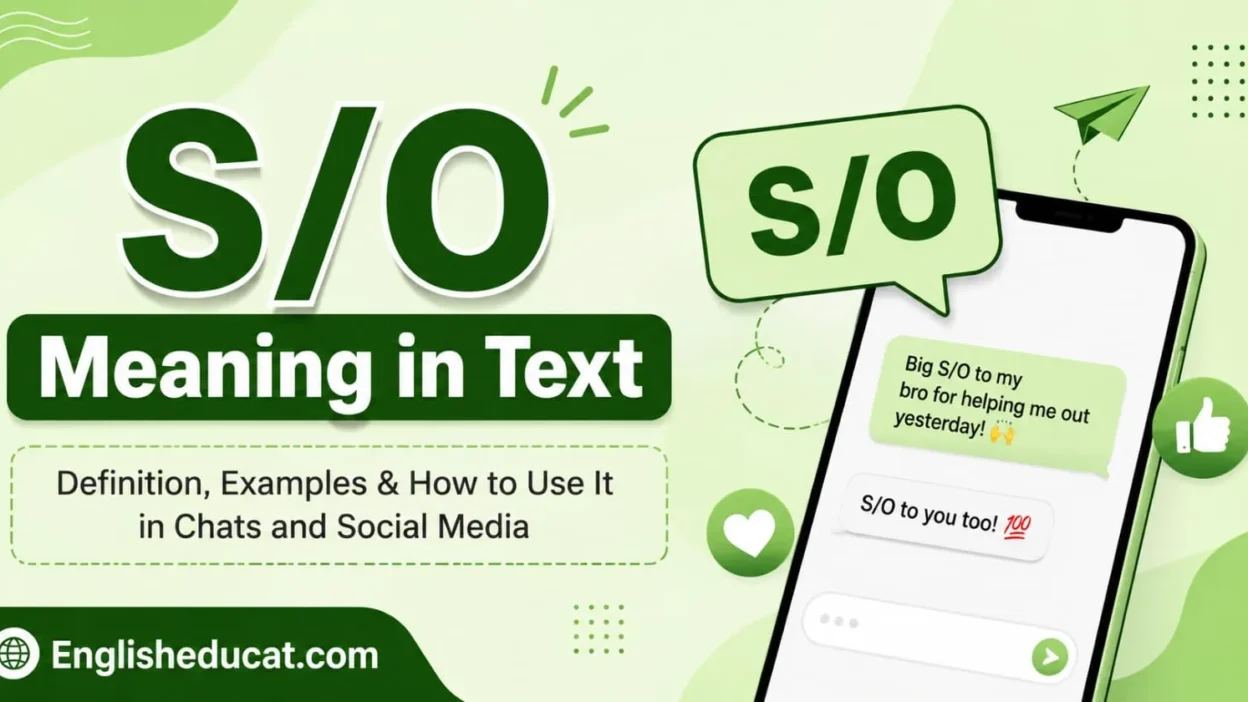
S/O meaning in text usually refers to one of two things: “significant other” or “shoutout.” Sometimes it can also mean “sold out.” The right meaning depends on what the message is about and where you saw it. This guide breaks down S/O meaning in text so you will never have to guess again.
If you have ever seen “S/O” in a message and thought about what it means, then you are not alone. It looks small, but it carries a few different meanings. We will also explain other meanings in detail below. Once you know the S/O meaning in text for every situation, it becomes easy to spot.
S/O Meaning in Text (Quick Answer)
S/O is a short piece of internet slang with multiple meanings. It can stand for “significant other,” “shoutout,” or, less often, “sold out.” Understanding the S/O meaning in text starts with knowing all three of these words.
S/O = Significant Other
The most common S/O meaning in text is “significant other.” This term refers to the romantic partner of someone. It could be a boyfriend, girlfriend, husband, wife, or any long term partner.
People like this term because it does not reveal extra details. It does not say if the couple is married or just dating. It also does not point to a specific gender. Merriam Webster defines a significant other simply as a spouse of a person or partner in an established relationship.
Example: “Can not talk right now, I am out with my S/O.”
S/O = Shoutout
The second common S/O meaning in text is “shoutout.” A shoutout is a public message that thanks, credits, or praises someone. You will see this word used a lot on social media.
Example: “S/O to my best friend for helping me move today.”
This use is different from the relationship meaning. This meaning is not used in dating. Instead, a shoutout is about giving someone credit in public.
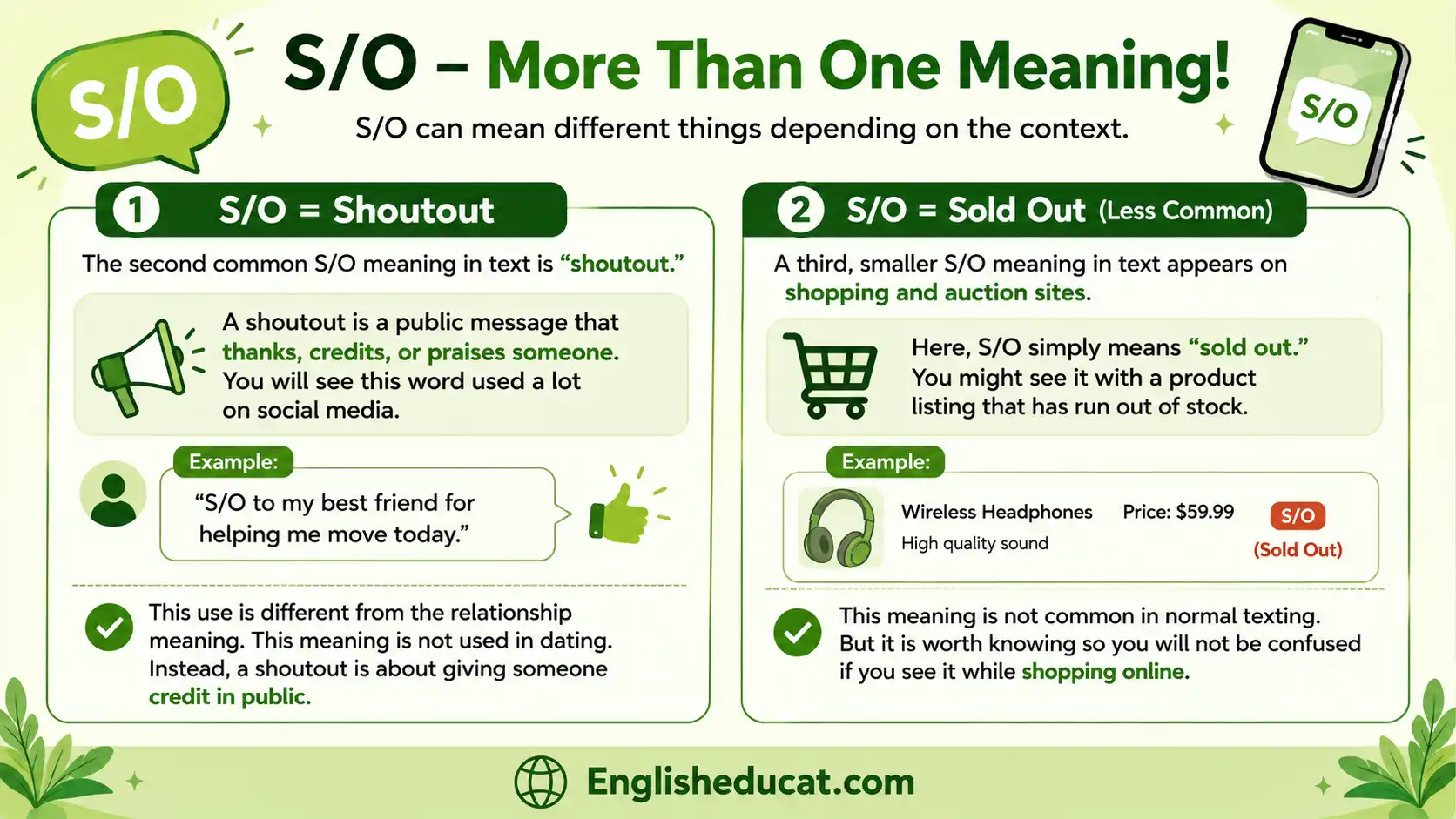
S/O = Sold Out (Less Common)
A third, smaller S/O meaning in text appears on shopping and auction sites. Here, S/O simply means “sold out.” You might see it with a product listing that has run out of stock.
This meaning is not common in normal texting. But it is worth knowing so you will not be confused if you see it while shopping online.
How to Tell the Correct S/O Meaning in Text
Context is the main key to knowing its meaning because it has many meanings. Here is a simple way to find the right S/O meaning in text every time.
Look at the Topic of the Conversation
If the message is about dating, love, or a relationship, S/O mostly means significant other. If the message is about thanking or crediting someone, it likely means shoutout.
Look at the Platform
Private texts and personal chats mostly use S/O for “significant other.” Public posts on Instagram, TikTok, Snapchat, or X (formerly Twitter) mostly use S/O for “shoutout.”
Look at the Tone
A warm and romantic tone points to significant other. A grateful and appreciative tone points to shoutout. Reading the full sentence, not just the letters, mostly makes the S/O meaning in text obvious.
| Talks about a partner or dating | Significant Other |
| Says “thank you” or gives credit | Shoutout |
| Appears in a private text | Significant Other |
| Appears in a public caption | Shoutout |
| Appears on a shopping site | Sold-out |
Where Does “S/O” Come From?
Knowing the history behind S/O meaning in text will help to explain why it is so popular today. The two main senses come from very different places.
The Origin of “Significant Other”
The psychiatrist Harry Stack Sullivan first used the phrase “significant other” in the 1950s, according to the APA Dictionary of Psychology. Sullivan studied how people are shaped by their close relationships. He used “significant other” for anyone with a strong influence on the life of a person. That first meaning was not just about romance. It could include a parent, a close friend, or a partner.
The everyday use later narrowed. By the 1970s, “significant other” mostly meant a romantic partner. This shift matched bigger cultural changes at the time, including new attitudes about relationships and gender roles.
How “Shoutout” Became Internet Slang
The “shoutout” sense of S/O has many different roots. It grew out of hip hop and rap culture. Artists would publicly thank friends, producers, or their hometowns during songs. This habit of giving public credit later moved onto social media as those platforms grew.
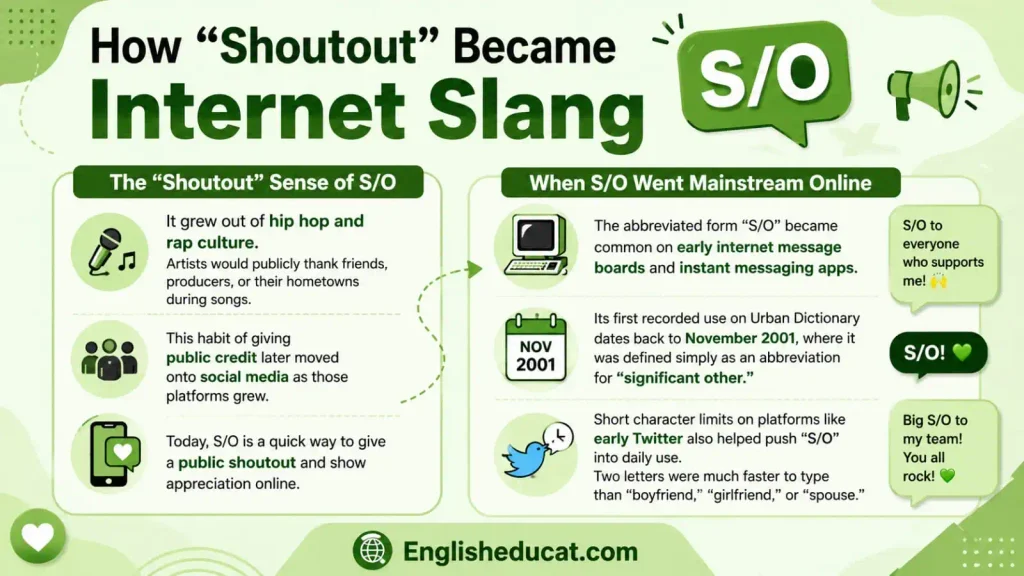
When S/O Went Mainstream Online
The abbreviated form “S/O” became common on early internet message boards and instant messaging apps. Its first recorded use on Urban Dictionary dates back to November 2001, where it was defined simply as an abbreviation for “significant other.”
Short character limits on platforms like early Twitter also helped push “S/O” into daily use. Two letters were much faster to type than “boyfriend,” “girlfriend,” or “spouse.”
S/O vs. SO vs. S.O. Does Punctuation Matter?
You may see this term written in some different ways: S/O, SO, or S.O. The good news is that the S/O meaning in text stays the same no matter which style is used.
- S/O with a slash is the most common style today.
- SO without punctuation is often written in all capital letters. So readers do not confuse it with the word “so.”
- S.O. with periods is an older and slightly more formal style.
All three point to the same two meanings: significant other or shoutout. The punctuation is only a style choice, not a change in meaning.
How to Use S/O in a Sentence
Now that you know the S/O meaning in text. Here we will explain what it looks like in real messages.
S/O for Significant Other (Real Examples)
- My S/O surprised me with flowers today.
- I am bringing my S/O to the party this weekend.
- What should I get my S/O for their birthday?
S/O for Shoutout (Real Examples)
- S/O to everyone who came to support the fundraiser.
- Big S/O to my teacher for helping me pass the exam.
- S/O to this whole community for being so kind.
S/O in Texting vs. Instagram/TikTok/X vs. Professional Emails
The S/O meaning in text can change slightly based on where you see it. This table will show you the pattern.
| Private text message | Significant Other | “Missing my S/O today” |
| Instagram caption | Shoutout | “S/O to my best friend for this photo” |
| TikTok comment | Shoutout | “S/O to whoever found this song” |
| Professional email | Significant Other (rare, informal) | “I’ll be out with my S/O next week” |
“S/O” sometimes appears on emergency contact forms as a neutral way to list a partner in workplace settings. Even so, people still see S/O as casual. It works better in personal notes than in formal reports.
A Closer Look: How S/O Shows Up in Real Conversations
Part of researching this guide meant reading real conversations on Instagram, TikTok, and text threads. The goal was to see how people actually use S/O meaning in text, not just how dictionaries define it. One clear pattern appears.
In private chats between two people, S/O mostly meant a romantic partner. In public captions, the same two letters mostly meant a shoutout instead. The letters never changed. Only settings change.
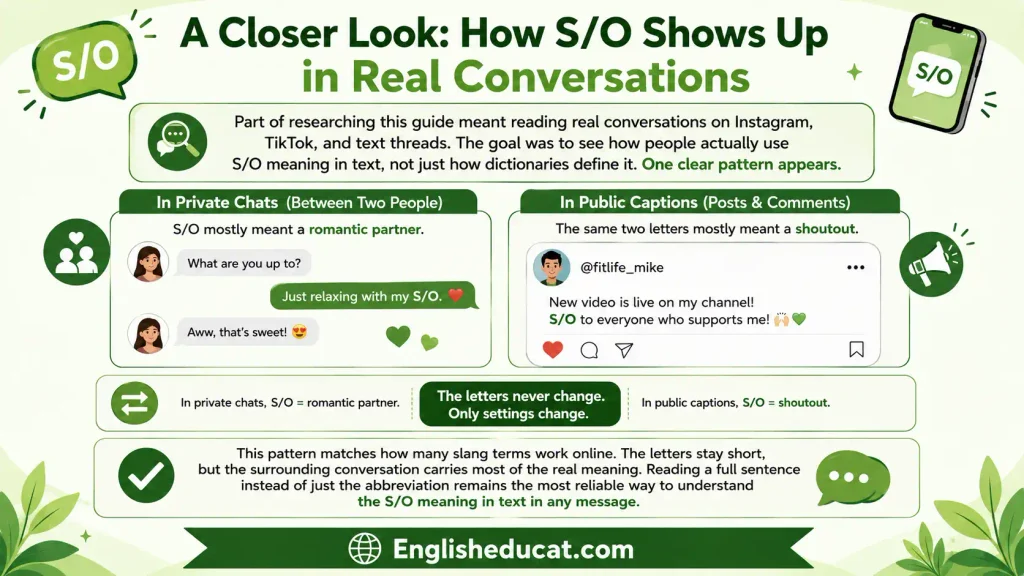
This pattern matches how many slang terms work online. The letters stay short, but the surrounding conversation carries most of the real meaning. Reading a full sentence instead of just the abbreviation remains the most reliable way to understand the S/O meaning in text in any message.
S/O vs. Similar Terms
Several other short terms overlap with S/O. Here is how they compare.
| SO (no slash) | Same as S/O, Significant Other | Casual, slightly formal |
| S.O. | Same meanings as S/O, older style | Casual |
| BF/GF | Boyfriend/Girlfriend | Direct, specific |
| BAE | “Before Anyone Else,” a partner or crush | Very casual |
| Boo | Partner or close romantic interest | Playful |
| Partner | Significant other, neutral term | Works in formal settings too |
| DH | “Dear Husband” | Casual, often used online |
| FH / FW | “Future Husband” / “Future Wife” | Casual, engagement-related |
| FI | Short for “fiancé” or “fiancée” | Casual, engagement-related |
| H/T | “Hat Tip,” similar to shoutout | Casual, credit-giving |
Why People Use S/O Instead of Boyfriend, Girlfriend, or Partner
Many people choose S/O over a specific label like “boyfriend” or “girlfriend” for just a simple reason, which is privacy. S/O does not reveal gender, marital status, or how long the relationship has lasted.
This makes S/O a flexible and gender neutral choice. The term works whether someone is newly dating or has been married for years. It also fits naturally into conversations about non traditional relationships and LGBTQ+ relationships, where one fixed label might not feel right for everyone.
Common Mistakes to Avoid With S/O
Even with a clear sense of S/O meaning in text, some small mistakes can also be made:
Using S/O in Formal or Professional Writing
S/O is casual slang. It is best not to use this word for resumes, official reports, or formal business letters, where a full word like “partner” fits better.
Confusing S/O With “So”
Lowercase “so” is a common word used every day. Uppercase S/O is a totally different term. Capitalizing S/O helps readers tell the two apart right away.
Assuming the Wrong Meaning Without Context
Guessing the S/O meaning in text without reading the full message can lead to confusion. A quick check of the topic and platform almost always clears things up.
Frequently Asked Questions
What does s/o mean in a text message?
In a text message, S/O most commonly stands for “significant other,” referring to a person’s romantic partner such as a boyfriend, girlfriend, or spouse. It can also mean “shoutout,” a public thank-you or mention, depending on the context of the full conversation and where the message appears.
What does s/o mean on Instagram?
On Instagram, S/O usually means “shoutout,” a caption or comment giving public credit, thanks, or recognition to another person, creator, or account. This differs from private texting between two people, where S/O more often refers to a romantic partner, or “significant other,” instead.
Is s/o always significant other, or does it mean something else?
No, S/O has more than one meaning, so context always matters. It most often means “significant other” in personal texts, but on social media it frequently means “shoutout” instead. Less commonly, S/O can also mean “sold-out” on shopping, auction, or online marketplace sites.
Why do people write SO instead of boyfriend or girlfriend?
People use SO because it is gender-neutral and does not reveal specific relationship details like marital status or how serious the relationship is. It works equally well for a boyfriend, girlfriend, spouse, or long-term partner, which makes it a flexible, privacy-friendly choice in casual writing.
Should SO be capitalized in a text?
Yes, SO is typically written in all capital letters, or as “S/O” or “S.O.,” to distinguish it from the everyday word “so.” Lowercase “so” written without any context can easily confuse which meaning, the abbreviation or the common word, is actually intended.
What’s the difference between s/o and s.o.?
There is no real meaning difference between them. S/O, S.O., and SO all stand for the same two terms, significant other or shoutout, depending on context. The variations are simply different punctuation styles, and S/O with a slash is the most common written form used today.
How do you know if someone means significant other or shoutout by s/o?
Check the topic and the platform first. A relationship focused message between two people usually means significant other, while a public social media caption thanking or crediting someone usually means shoutout. The overall tone of the message is also a reliable, easy to spot clue.
Conclusion
S/O meaning in text really comes down to two letters carrying two lives. It mostly points to a partner in a private message. It mostly points to a thank you in a public caption. Once you know both sides, those two letters stop feeling confusing. The next time “S/O” appears on your screen, a quick look at the setting and tone will tell you exactly what it means.

Linguistics Specialist
James is a linguist with a Ph.D. in Applied Linguistics from Boston University. His work focuses on word origins, synonyms, and how language evolves over time. He has contributed to several academic journals on English semantics.